Profiles of Social Learning Preferences and Differences in Prosocial Behaviors Among Physical Education Students
Javier García-Cazorla

Carlos Mayo-Rota
Mónica Santed
Ángel Abós

Elena Escolano-Pérez
Luis García-González
*Corresponding author: Javier García-Cazorla garciacazorlajavier@gmail.com
Cite this article
García-Cazorla, J., Mayo-Rota, C., Santed, M., Abós, Á., Escolano-Pérez, E., & García-González, L. (2026). Profiles of social learning preferences and differences in prosocial behaviors among physical education students. Apunts. Educación Física y Deportes, 164, 10-21. https://doi.org/10.5672/apunts.2014-0983.es.2026.164.02
Abstract
Physical Education (PE) lessons have long been recognized not only for promoting the development of students’ motor skills and behaviors, but also as a valuable context for fostering social and emotional learning. Despite this, limited research has explored students’ social learning preferences in PE and their associations with prosocial behaviors. This study aimed to identify distinct student profiles based on four social learning preferences in PE (i.e., competitive, cooperative, affiliative, and individualistic) and to examine how these profiles differ in prosocial behaviors, including empathy, respect, relatedness, and leadership. Validated questionnaires were administered to 299 Spanish adolescents (50% boys; Mage = 13.76). A two-step cluster analysis (Ward’s method + K-means) revealed four distinct profiles: (1) highly competitive-cooperative-affiliative preference, (2) moderately cooperative preference, (3) moderately competitive-individualistic preference, and (4) individualistic preference. A MANCOVA (with gender as a covariate) showed that profiles emphasizing cooperation and affiliation exhibited the highest levels of empathy, relatedness, and leadership, even when competitiveness was also present. In contrast, the individualistic profile scored the lowest across all prosocial dimensions. These findings highlight the potential of cooperative and affiliative activities in PE to promote adolescents’ prosocial development. PE teachers are encouraged to design tasks that enhance peer collaboration and belonging, while minimizing excessively individualistic approaches.
Introduction
Physical Education (PE) lessons are essential not only for the development of students’ motor skills and behaviors, but also for promoting social, emotional, and cognitive learning (Casey & Goodyear, 2015). Within this context, social interaction plays a pivotal role in fostering social competence and reinforcing prosocial dispositions in young people (González et al., 2019). According to González et al. (2014), social interaction in the PE classroom encompasses the communicative dynamics that emerge between teachers and students, as well as among peers. Several studies have highlighted that the nature of social interactions in PE can lead to both adaptive and maladaptive outcomes, such as the development of communication skills, teamwork, or academic performance (Dyson, 2002; González et al., 2014; Inglés et al., 2009; Ruiz et al., 2010). Nonetheless, research exploring how combinations of these interactions relate to prosocial behaviors in PE remains limited. Therefore, this study addresses this gap by identifying students’ social learning preferences profiles in PE and examining how these combinations foster or hinder prosocial behaviors, namely empathy, respect, relatedness, and leadership. Ultimately, this work seeks to contribute to the creation of more inclusive and supportive learning environments in PE.
Social Learning Preferences
Social learning preferences refer to students’ tendencies to engage in particular types of social interaction during learning activities (Ruiz et al., 2010). These preferences directly influence both academic performance and the development of social skills (Navarro-Patón et al., 2019; Ruiz et al., 2010). Four primary types of social interaction have been identified in PE contexts (Johnson et al., 1994; Ruiz et al., 2010): (1) competitive, where students individually strive to outperform others; (2) cooperative, where students collaborate to achieve shared goals; (3) affiliative, which emphasizes belonging and social acceptance within a group (Weiss & Chaumeton, 1992); and (4) individualistic, where students work toward goals independently of others’ performance.
Research indicates that cooperative and affiliative environments tend to enhance communication skills and academic outcomes, whereas competitive and individualistic settings may generate less favorable effects, depending on their pedagogical implementation (Navarro-Patón et al., 2019; Oortwijn et al., 2008; Velázquez, 2015). In PE, competitive dynamics are often inherent to the content itself (e.g., sport-based activities), but the effects of competition largely depend on how teachers shape the motivational climate of the class. According to achievement goal theory (Di Battista et al., 2019; García-González et al., 2019), when the focus is placed on personal improvement and effort (task-involving climate), competition can enhance enjoyment, engagement, and prosocial outcomes. In contrast, when the emphasis is on outperforming others (ego-involving climate), students may experience increased anxiety, disaffection, or social comparison (García-González et al., 2019; Lochbaum et al., 2019). Competitive preferences can therefore elicit both positive and negative outcomes, contingent on how teachers structure and frame activities (Prat & Soler, 2003). Conversely, individualistic preferences, often conceptualized as the opposite of cooperative ones, tend to be associated with less prosocial engagement (Ruiz et al., 2010).
While these preferences are often studied separately, they are not mutually exclusive. Students may exhibit combinations of preferences, for instance, aligning high cooperative with affiliative tendencies, or competitive with individualistic orientations. Competitiveness, in particular, is considered an ambivalent dimension (Prat & Soler, 2003), as it may coexist with either socially constructive preferences (e.g., cooperation or affiliation) or with more individualistic ones, depending on how teachers design and manage the learning environment (task or ego climate) (García-González et al., 2019). Despite this potential for coexistence, there is a scarcity of research examining the multiple social learning preferences —especially in relation to prosocial outcomes in PE. To our knowledge, only a few studies have explored students’ social interaction in the PE context (Ruiz et al., 2010; Luengo et al., 2013), and none have directly linked them to prosocial behaviors. For example, Ruiz et al. (2010) charted adolescents’ cooperative, competitive, affiliative, and individualistic dispositions in PE classes, finding that cooperative learning was generally the most preferred style, while individualistic approaches were the least favored. However, that variable-centered study did not examine how these preferences cluster within participant or how a mix of preferences might influence social outcomes. Similarly, Luengo et al. (2013) acknowledged that competitive orientations can co-occur with either cooperative or individualistic tendencies, yet empirical evidence connecting specific preference profiles to prosocial behavior is lacking. This gap underscores the need to better understand the interplay of these preferences and their implications for youths’ social development in PE settings.
Prosocial Behaviors
Prosocial behaviors are voluntary actions intended to benefit others and are essential for effective group functioning and social well-being (Abdullahi & Kumar, 2016; Eisenberg et al., 2006). According to Martorell et al. (2011), key dimensions of prosocial behavior include empathy, respect, relatedness, and leadership. Empathy refers to an affective response triggered by understanding another’s emotional state (Eisenberg et al., 2006). In PE, this may be demonstrated when a student helps a peer who is struggling to achieve a goal. Respect is a value associated with personal and social integrity (Anderson, 2019); for example, a student may show respect by listening to others’ opinions or showing patience when a teammate makes a mistake. Relatedness involves warm, trusting interpersonal connections (Mayseless et al., 1998; Ryan & Deci, 2017) and in PE is reflected in inclusive participation and group cohesion. This behavior is particularly relevant in adolescence, as peer relationships often become more salient than family connections (Mayseless et al., 1998; Ryan & Deci, 2017). Lastly, leadership refers to the ability to influence and guide others (Lacunza et al., 2013), such as when a student organizes a group activity or facilitates collective goal achievement.
While prosocial behaviors emerge throughout development (Martorell et al., 2011), adolescence is a critical period for their consolidation, as youths refine their identities and expand their social competencies (Inglés et al., 2009; Luengo et al., 2013)). Although most research on prosociality in PE has focused on younger children (Contreras & Reyes, 2009), it is during adolescence that fostering these behaviors becomes particularly relevant for long-term social development (Luengo et al., 2013). Given that social learning preferences influence how students interact with peers in PE contexts, exploring how different combinations of these preferences relate to prosocial behaviors during this life stage may offer valuable insights for educational practice.
The Present Study
To address the above-mentioned gaps, the present study pursued two main objectives: (1) To identify student profiles based on combinations of four social learning preferences in PE (i.e., cooperative, affiliative, competitive, and individualistic). Given the exploratory nature of this analysis, no specific hypotheses were formulated regarding the coexistence of these preferences. (2) To examine how these different combinations of social interaction preferences are more or less adaptive in terms of prosocial behaviors by comparing students’ scores on empathy, respect, relatedness, and leadership. It was expected that profiles characterized by higher cooperative and affiliative preferences would exhibit more adaptive prosocial patterns, whereas those with higher individualistic tendencies would score lower on prosocial dimensions (Dyson & Strachan, 2002; Navarro-Patón et al., 2019; Oortwijn et al., 2008; Velázquez, 2015). Expectations regarding competitive preferences were more tentative, given the mixed findings in the literature about its effects in achievement settings (Prat & Soler, 2003).
Design, Participants, and Procedure
A cross-sectional design with purposive sampling was employed. A total of 311 Spanish students from a semi-private school in northeastern Spain agreed to participate. Two students were excluded due to incomplete responses, and an additional nine were removed because of extreme univariate and/or multivariate outliers (see the Statistical Analysis section for details). The final sample comprised 299 students (47.83% girls), aged between 12 and 17 years (Mage= 13.76, SD = 1.28), divided into 12 classes (M = 24.92). In terms of school year distribution: 79 students were in Year 8 (1st year of Spanish Secondary Education; 26.5%), 75 students in Year 9 (2nd year; 25%), 72 students in Year 10 (3rd year; 24%), and 73 students in Year 11 (4th year; 24.5%).
The main researcher contacted the school administration and PE teachers to request collaboration. Both students and their parents were informed of the study’s objectives, and written informed consent was obtained from both parties. Before completing the online questionnaire, students were assured that participation was voluntary and anonymous. Data were collected in a quiet classroom without the PE teacher present. The main researcher remained available to answer any questions. Completing the questionnaires required approximately 25–30 minutes.
This study adhered to the ethical principles of the Declaration of Helsinki and was approved by the Research Ethics Committee of the University of Zaragoza (CEIN_2025_3).
Instruments
Social Preferences for Learning in PE
The Graupera/Ruiz Social Participation in Physical Education Scale (GR-SIPPEL; Ruiz et al., 2010) was used to assess students’ preferences for social interaction. The scale begins with the stem “In PE class activities…” and includes 28 items across four subscales (i.e., seven items per subscale): competitive (e.g., “I like to do things better than others”), cooperative (e.g., “I like to say and do things that help others”), affiliative (e.g., “I work in groups so they want to be with me”), and individualistic (e.g., “I like to do things my way, without worrying about what others are doing”). Students responded on a 5-point Likert scale ranging from 1 (strongly agree) to 5 (strongly disagree). Confirmatory factor analysis (CFA) supported the four-factor structure: χ2 (df = 344) = 595.375, p < .001; χ2/df = 1.73; CFI = .93, TLI = .92, RMSEA = .05, SRMR = .05). McDonald’s omega (ω) coefficients indicated good internal consistency, being .84 for competitive, .74 for cooperative, .63 for affiliative, and .79 for individualistic preferences.
Prosocial Behaviors in PE
The Prosocial Behavior Questionnaire (Martorell et al., 2011) was used to assess prosocial behaviors. The instrument includes 54 items across four subscales: empathy (19 items; e.g., “When someone has problems, I worry”), respect (16 items; e.g., “When I offend or bother someone, I apologize”), relatedness (11 items; e.g., “I like to talk to my friends and colleagues”), and leadership (8 items; e.g., “I like to lead work groups”). Students responded using a 4-point Likert scale ranging from 1 (never) to 4 (always). CFA confirmed the four-factor structure: χ2 (df = 1371) = 1891.56, p < .001; χ2/df = 1.38; CFI = .97, TLI = .97, RMSEA = .04, SRMR = .04). McDonald’s omega (ω) coefficients indicated good internal consistency, being .91 for empathy, .82 for respect, .72 for relatedness, and .78 for leadership.
Data Analyses
Descriptive statistics, Pearson’s correlations, and McDonald’s omega (ω) reliability coefficients were computed for all study variables. While a reliability threshold of .70 is widely accepted, some researchers advocate for interpreting reliability along a continuum: .90–.95 (excellent), ≥ .80 (good), ≥ .70 (acceptable), ≥ .60 (reasonable), ≥ .50 (fair), and < .50 (unacceptable) (George & Mallery, 2003; Hernaez, 2015). A two-step cluster analysis was used to identify student profiles based on social learning preferences, combining hierarchical (Ward’s method) and non-hierarchical (K-means) approaches (Garson, 2014). Prior to clustering, Z-scores were computed for the four preferences. Students with univariate scores ±3 SD or extreme Mahalanobis distances were excluded to minimize the influence of outliers (Steinley & Brusco, 2011). In Step 1, hierarchical clustering using Ward’s method with squared Euclidean distances was conducted. Three- to five-cluster solutions were evaluated based on explained variance and theoretical coherence (Aguinis et al., 2013). In Step 2, a K-means cluster analysis was performed using the centroids from Step 1. The final cluster solution was validated using double-split cross-validation with Cohen’s Kappa, where values above .50 were considered acceptable. Because gender may influence social participation styles in PE (Navarro-Patón et al., 2019; Ortega et al., 2019), its inclusion as a covariate was tested via chi-square analysis. Finally, a Multivariate Analysis of Covariance (MANCOVA) with Bonferroni-adjusted post hoc comparisons was used to examine differences between clusters on students’ prosocial behaviors. Partial eta squared (ηp²) was used to interpret effect sizes: small (> .01), medium (> .06), and large (> .14) (Cohen, 1988). All statistical analyses were conducted using IBM SPSS 29.0.
Results
Descriptive Statistics, Reliability Coefficients, and Correlations Among Variables
Table 1 presents the descriptive statistics (i.e., M and SD), reliability coefficients (McDonald’s omega, ω), and Pearson’s correlations for all study variables. Among the social learning preferences, competitive preference was significantly and positively correlated with both affiliative and individualistic preferences. Cooperative preference showed a significant positive correlation with affiliative preference and a significant negative correlation with individualistic preference. All four prosocial behaviors, empathy, respect, relatedness, and leadership, were significantly and positively correlated with each other. Regarding the links between social learning preferences and prosocial behaviors, competitive preference was significantly and positively related to relatedness and leadership. Both cooperative and affiliative preferences showed significant positive correlations with all prosocial behaviors, except for respect, which was not significantly related to affiliative preference. Finally, individualistic preference was significantly and negatively correlated with relatedness.

Table 1
Descriptive statistics, reliability coefficients, and Pearson’s correlations among study variables
Identification and Interpretation of Students’ Profiles Based on Social Learning Preferences in PE
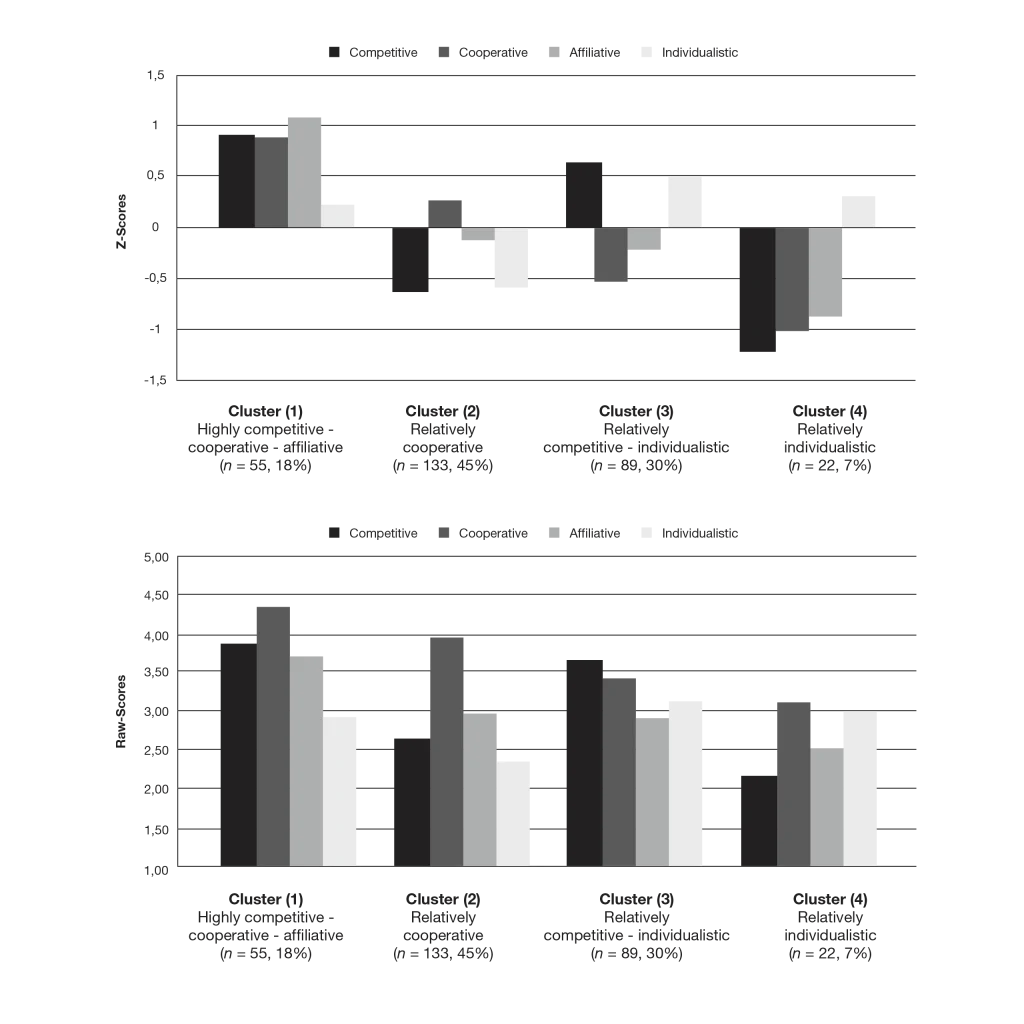
Four distinct student groups were identified, explaining an average variance of 62% across the four social learning preferences in PE (i.e., competitive, cooperative, affiliative, and individualistic). The three-cluster solution was discarded due to its low explained variance (40%), while the five-cluster solution was rejected due to challenges in interpretability (Ellison et al., 2005; Ruiz et al., 2010). For the four-cluster solution, the double-split cross-validation procedure yielded a mean Kappa value of .85, indicating excellent cluster stability.
Figure 1 displays the Z-score profiles of the four identified clusters based on students’ social learning preferences in PE. The first cluster, labeled “highly competitive-cooperative-affiliative” (n = 55; 18%), included students who reported high levels of competitive, cooperative, and affiliative preferences, alongside relatively low levels of individualistic preference. The second cluster, “relatively cooperative” (n = 133; 45%), was characterized by moderate cooperative tendencies and low scores across the other dimensions. The third cluster, “relatively competitive-individualistic” (n = 89; 30%), reflected a pattern of highly competitive and individualistic preferences, combined with lower levels of cooperation and affiliation. Finally, the fourth cluster, “relatively individualistic” (n = 22; 7%), showed moderate endorsement of individualistic preference and the lowest scores across all other social learning dimensions.
Gender distribution across the four identified profiles was then examined. A chi-square test revealed a significant association between gender and cluster membership (χ2 [3, N = 299] = 32.837, p < .001), justifying the inclusion of gender as a covariate in subsequent analyses. In the “highly competitive-cooperative-affiliative” group (cluster 1), boys represented 66% (n = 36) and girls 34% (n = 19). The “relatively cooperative” group (cluster 2) showed the opposite pattern, with 66% girls (n = 88) and 34% boys (n = 45). The “relatively competitive-individualistic” group (cluster 3) comprised 62% boys (n = 60) and 38% girls (n = 29), while the “relatively individualistic” group (cluster 4) had the highest proportion of boys (68%, n = 15) compared to girls (32%, n = 7)
Analysis of Differences According to Groups of Social Preference for Learning
Using the four-cluster solution of social learning preferences as the independent variable and gender as a covariate, MANCOVA revealed a significant multivariate effect with a large effect size (F(24, 832.98) = 28.16, p < .001, ηp2 = .43). Bonferroni-adjusted pairwise comparisons, as well as F-values and univariate effect sizes (ηp²) for prosocial behaviors (empathy, respect, relatedness, and leadership), are reported in Table 2.
Table 2
Clusters’ mean scores, F-values, and effect sizes for social learning preferences and prosocial behaviors
The “highly competitive-cooperative-affiliative” group (cluster 1) exhibited the highest levels of empathy, relatedness, and leadership. However, despite showing the highest means, it did not differ significantly from the “relatively cooperative” group (cluster 2) in empathy, respect, and relatedness, nor from the “relatively competitive-individualistic” group (cluster 3) in respect and leadership. Moreover, no significant differences were found between the “relatively cooperative” (cluster 2) and the “relatively competitive-individualistic” (cluster 3) groups on any of the prosocial behavior dimensions, suggesting comparable prosocial patterns. In contrast, the “relatively individualistic” group (cluster 4) displayed the least favorable prosocial profile, with significantly lower scores across all variables, except for empathy, where it did not differ from the “relatively competitive-individualistic” group (cluster 3).
Discussion
The present study aimed to examine how students combine different social learning preferences in PE lessons and how these combinations (i.e., clusters) differ in terms of their empathy, respect, relatedness, and leadership. The main findings revealed that: 1) PE students exhibit diverse combination of competitive, cooperative, affiliative, and individualistic preferences; 2) Students in the “highly competitive-cooperative-affiliative” group reported the highest levels of prosocial behaviors, whereas those in the “relatively individualistic” group reported the lowest levels on these variables; and 3) no significant differences in prosocial behaviors were found between students in the “relatively cooperative” group and the “relatively competitive-individualistic” group.
Identification and Interpretation of Students’ Profiles Based on Social Learning Preferences in PE
Regarding the first aim, students reported moderate-to-high levels of cooperative preference (M = 3.78/5), moderate levels of competitive (M = 3.11/5) and affiliative (M = 3.03/5) preferences, and moderate-to-low individualistic preference (M = 2.72/5). Interestingly, even among students in the “relatively individualistic” group, cooperative preference remained moderate (M = 3.09/5), suggesting that cooperation is generally valued across the sample. These findings are in line with previous research (Navarro-Patón et al., 2019; Ortega et al., 2019; Ruiz et al., 2004; Ruiz et al., 2010), which indicates that adolescents in PE tend to prioritize cooperation, followed by competition, affiliation, and lastly individualism. This order of preference, also supported by Ruiz-Maestre et al. (2024), challenges the widespread assumption that competition and individualism prevail in educational settings, and reinforces the importance of promoting cooperative attitudes in PE contexts.
In terms of combinations, the results revealed four significantly distinct clusters, two of which (clusters 2 and 4) reflected contrasting tendencies in participation, cooperation vs. individualism (Ruiz et al., 2010). The “relatively cooperative” group (cluster 2) included nearly half the sample (45%), while the “relatively individualistic” group (cluster 4) comprised just 7%. These results reinforce the idea that most adolescents are predisposed to participate in PE through cooperation (Velázquez, 2015) and are less inclined to engage in individualistic modes of interaction (Ruiz et al., 2010). Similarly, given that cooperative and individualistic dimensions appear to be conceptually opposed (Ortega et al., 2019; Ruiz et al., 2010), the emergence of these two distinct groups suggests that students who strongly favor cooperation are less inclined to engage in individualistic forms of interaction in PE, and vice versa.
In line with the conceptual framework of social participation dimensions (Johnson et al., 1994; Ruiz et al., 2010), two additional groups (clusters 1 and 3) were identified, in which certain preferences clearly predominated over others, revealing more complex interaction profiles. Consistent with studies linking cooperation and affiliation (Ruiz et al., 2004), the “highly competitive-cooperative-affiliative” group (cluster 1) emerged, comprising 18% of the students. This group stood out for its high levels of both cooperative and affiliative preferences, suggesting that students may simultaneously prioritize collaborative and group-oriented goals in PE. Notably, this group also showed the highest competitive scores, indicating that some adolescents pursue personal achievement without disregarding social connection. This pattern may reflect a task-involving orientation, in which competition is framed positively and aligned with effort, improvement, and shared success (Di Battista et al., 2019; García-González et al., 2019). In contrast, the “relatively competitive-individualistic” group (cluster 3), which comprised nearly one-third of the sample, was characterized by moderate-to-high levels of both competitiveness and individualism. This profile suggests a preference for self-oriented success and outperforming others, with less emphasis on group collaboration. Such a profile is conceptually aligned with an ego-involving climate, which prioritizes social comparison (Lochbaum et al., 2019).
Additionally, gender distribution across profiles aligns with previous findings, where girls were more frequently found in the purely cooperative group (cluster 2), and boys were more represented in profiles with stronger competitive or individualistic components (clusters 1, 3, and 4) (Navarro-Patón et al., 2019; Royo et al., 2025; Ruiz et al., 2010). This supports earlier claims that boys tend to seek social comparison and victory, whereas girls are more motivated by the social and participatory aspects of PE. These patterns may also reflect the persistence of hegemonic masculinity in PE settings, where competitive success and dominance are often emphasized and socially reinforced among boys (Beltrán-Carrillo et al., 2012; Beltrán-Carrillo & Devís-Devís, 2019).
Analysis of Differences According to Groups of Social Preference for Learning
While identifying distinct groups of adolescents based on their combinations of social learning preferences in PE represents an important theoretical contribution, its practical relevance lies in understanding how these combinations influence prosocial behavior. In this regard, previous research has shown that cooperative and affiliative learning preferences support adolescents’ holistic development, while individualistic preferences tend to be associated with less adaptive outcomes (Navarro-Patón et al., 2019; Ortega et al., 2019). The role of competitive preferences, however, appears more nuanced, with both positive and negative effects depending on the context and outcomes assessed (Prat & Soler, 2003). Similarly, previous studies have shown that competitive preference can be either positive or negative depending on the consequences explored (Prat & Soler, 2003). Consistent with these findings and with expectations, the “highly competitive-cooperative-affiliative” group (cluster 1) showed the highest levels in empathy, relatedness, and leadership, whereas the “relatively individualistic” group (cluster 4) was characterized by the lowest scores across all four prosocial dimensions.
On the other hand, literature suggests that purely cooperative preferences should be the most adaptive for achieving prosocial behavior (Dyson, 2002; Navarro-Patón et al., 2019; Oortwijn et al., 2008). In this sense, an especially relevant comparison for educational practice is that between the “relatively cooperative” group (cluster 2) and the combined group (cluster 1), which showed high levels of cooperation, affiliation, and competitiveness. According to the results, both groups demonstrated similar levels of prosocial behavior, except for leadership, which was significantly higher in cluster 1. However, these results should be interpreted with caution. Although cluster 1 displayed higher levels of competitiveness, it also reported higher levels of cooperation and affiliation than cluster 2, which may offset or equalize the prosocial impact of a group based solely on cooperation but with lower absolute levels of this preference. This could explain the minimal differences observed between both clusters. Moreover, the higher leadership scores observed in cluster 1, the group with stronger competitive preference, may be attributed to another complementary explanation. A recent study found a strong relationship between competitive preference and perceived motor competence in PE (Royo et al., 2025). This may indicate that students with a greater preference for competition also possess higher levels of motor competence, which in turn may position them as natural leaders in group activities and tasks.
Although the “highly competitive–cooperative-affiliative” group (cluster 1) was largely similar to the “relatively cooperative” group (cluster 2), the differences became more pronounced when compared to the “relatively competitive–individualistic” group (cluster 3), especially in empathy and relatedness. These findings suggest that competitive preference may be beneficial for prosocial behavior when paired with high levels of adaptive social preferences (i.e., cooperation and affiliation), but less so when aligned with individualistic tendencies. This interpretation is consistent with previous research indicating that even minimal levels of individualism can have negative developmental consequences in adolescence (Navarro-Patón et al., 2019).
Finally, the results confirm that a purely individualistic profile (cluster 4) constitutes the least adaptive pattern in terms of prosocial behaviors. This was evident even when compared to cluster 3, whose members also exhibited high levels of individualistic preference but combined it with greater endorsement of competitive, cooperative, and affiliative preferences. Students in cluster 3 scored higher in respect, relatedness, and leadership, suggesting that the positive influence of these additional social learning preferences (Navarro-Patón et al., 2019) may help buffer the negative effects of elevated individualism, at least within the scope of prosocial outcomes.
Practical Implications
The findings of this study offer meaningful guidance for PE teachers aiming to foster students’ social and emotional development through everyday instructional practices. First, the positive association between cooperative and affiliative learning preferences and prosocial behaviors suggests that teachers should design activities that promote collaboration, mutual support, and group belonging. Structuring tasks that value group participation and shared achievements can reinforce empathy, respect, and relatedness among students. Second, the ambivalent role of competitiveness identified in this study highlights the importance of how competitive elements are framed. Rather than eliminating competition, teachers are encouraged to implement it within a framework that values effort, improvement, and shared experience, avoiding formats that reward only individual superiority. By doing so, students can still experience the motivational benefits of competition without fostering isolation or social comparison. Lastly, the consistently negative outcomes associated with individualistic learning preferences point to the importance of avoiding tasks that promote excessive independence or detachment from peers. PE lessons should aim to cultivate inclusive environments where students feel connected and engaged with others. By balancing cooperative and competitive elements thoughtfully, PE teachers can contribute to more adaptive social climates that support both student participation and social development.
Limitations and Future Directions
This study presents several limitations that should be acknowledged. First, the findings are based on a cross-sectional design, which limits the ability to determine whether the identified profiles of social learning preferences remain stable over time or how their evolution may influence the development of prosocial behaviors in PE. Future research should adopt longitudinal or experimental designs to explore how changes in social learning preferences affect various student outcomes. Second, all variables were measured through self-report questionnaires, which, despite the anonymity provided, may be subject to response biases such as belief distortion, subjective self-perception, or social desirability. To address this limitation, future studies could complement self-report data with observational methods to enhance validity. Third, the sample was purposive and composed exclusively of Spanish adolescents from a single secondary school, which limits the generalizability of the results. Therefore, findings should be interpreted with caution. Further studies should include larger and more diverse samples, incorporating participants from multiple schools, cultural contexts, and educational stages. Fourth, it is important to emphasize that student learning outcomes are not solely determined by their social preferences for learning. The teaching style and interactions of PE teachers also play a crucial role (Abós et al., 2018). As such, future studies should include measures of teachers’ (de)motivating teaching styles to better contextualize the influence of students’ preferences. Finally, the present study focused exclusively on positive outcomes, specifically prosocial behaviors. Future research should extend this line of inquiry by exploring how social learning preferences relate to negative outcomes, such as conflict, disengagement, or disruptive behavior.
Conclusions
This study identified four distinct profiles of social learning preferences among adolescents in PE, reflecting different combinations of cooperative, competitive, affiliative, and individualistic tendencies. The results showed that students who combine high levels of cooperation and affiliation, sometimes alongside moderate competitiveness, tend to display more favorable prosocial behaviors, such as empathy, respect, relatedness, and leadership. In contrast, students with predominantly individualistic preferences, especially when paired with competitiveness, exhibited less adaptive prosocial patterns. These findings suggest that social interaction styles in PE are not fixed or mutually exclusive but can coexist in ways that influence students’ social functioning. From an educational perspective, promoting cooperative and affiliative dynamics in PE lessons appears essential for fostering a socially enriching environment. While competitive elements can be beneficial, their integration should be carefully managed to ensure they support, rather than hinder, group cohesion and prosocial development. Overall, this study underscores the importance of designing PE activities that cultivate meaningful peer interactions and encourage students to participate in ways that contribute positively to the group climate.
Funding
This study has been funded by the Government of Aragon for the development of I+D+i projects in priority and multidisciplinary lines for the period 2024-2026. Project code: PROY S01_24. Carlos Mayo-Rota is supported by a grant from the Government of Aragon. .
References
[1] Abdullahi, I. A., & Kumar, P. (2016). Gender differences in prosocial behaviour. The International Journal of Indian Psychology, 3(4), 171–175. doi.org/10.25215/0304.017
[2] Abós-Catalán, Á., Sevil-Serrano, J., Martín Albo-Lucas, J., Julián-Clemente, J.A., & García-González, L. (2018). An integrative framework to validate the Need-Supportive Teaching Style Scale (NSTSS) in secondary teachers through exploratory structural equation modeling. Contemporary Educational Psychology, 52, 48–60. doi.org/10.1016/j.cedpsych.2018.01.001
[3] Aguinis, H., Gottfredson, R. K., & Joo, H. (2013). Best-practice recommendations for defining, identifying, and handling outliers. Organizational Research Methods, 16(2) 270–301. doi.org/10.1177/1094428112470848
[4] Anderson, E. (2019). A referee perspective on the educational practice of competitive youth games: exploring the pedagogical function of parents, coaches and referees in grassroots soccer. Physical Education and Sport Pedagogy, 24(6), 615–628. doi.org/10.1080/17408989.2019.1652806
[5] Beltrán-Carrillo, V. J., Devís-Devís, J., Peiró-Velert, C. y Brown, D. H. K. (2012). When physical activity participation promotes inactivity: Negative experiences of Spanish adolescents in physical education and sport. Youth and Society, 44(1), 3–27. doi.org/10.1177/0044118X10388262
[6] Beltrán-Carrillo, V. J., y Devís-Devís, J. (2019). Inactive student thinking on their negativeexperiences in Physical Education: discourses of performance, healthism, and hegemonicmasculinity. RICYDE. Revista Internacional de Ciencias del Deporte, 15(55), 20–34. doi.org/10.5232/ricyde2019.05502
[7] Casey, A., & Goodyear, V. A. (2015). Can cooperative learning achieve the four learning outcomes of physical education? A review of literature. Quest, 67(1), 56–72. doi.org/10.1080/00336297.2014.984733
[8] Cohen, J. (1988). Statistical power analysis for the behavioral sciences. Lawrence Erlbaum Associates.
[9] Contreras, C., & Reyes, I. (2009). Methodological approaches to the measurement of prosocial behavior in children of school age. Revista Iberoamericana de Diagnóstico y Evaluación-e Avaliação Psicológica, 1(27), 29–44.
[10] Di Battista, R., Robazza, C., Ruiz, M. C., Bertollo, M., Vitali, F., y Bortoli, L. (2019). Student intention to engage in leisure-time physical activity: the interplay of task-involving climate, competence need satisfaction and psychobiosocial states in physical education. European Physical Education Review, 25(3), 761–777. doi.org/10.1177/1356336X18770665
[11] Dyson, B. (2002). The implementation of cooperative learning in an elementary physical education program. Journal of Teaching in Physical Education, 22(1), 69–85. doi.org/10.1123/jtpe.22.1.69
[12] Eisenberg, N., Fabes, R. A., & Spinrad, T. L. (2006). Prosocial development. In N. Eisenberg, W. Damon, y R. M. Lerner (Eds.), Handbook of child psychology: Social, emotional, and personality development (pp. 646–718). Wiley. doi.org/10.1002/9780470147658.chpsy0311
[13] Ellison, C. M., Boykin, A. W., Tyler, K. M., & Dillihunt, M. L. (2005). Examining classroom learning preferences among elementary school students. Social Behavior and Personality, 33(7), 699–708. doi.org/10.2224/sbp.2005.33.7.699
[14] García-González, L., Sevil, J., Abós, A., Aelterman, N., & Haerens, L. (2019). The role of task and ego-oriented climate in explaining students’ bright and dark motivational experiences in Physical Education. Physical Education and Sport Pedagogy, 24(4), 344–358. doi.org/10.1080/17408989.2019.1592145
[15] Garson, G. (2014). Cluster analysis: 2014 edition. Statistical Associates Publishing
[16] George, D., & Mallery, P. (2003). SPSS for Windows step by step: A simple guide and reference. 11.0 update (4th ed.). Boston: Allyn & Bacon, 21.
[17] González, J., Cayuela, D., & López-Mora, C. (2019). Prosociality, physical education and emotional intelligence in school. Journal of Sport and Health Research. 11(1), 17–32.
[18] González, L., Rivera, E., & Trigueros, C. (2014). The social interaction within the physical education classroom. Revista de Currículum y Formación del Profesorado, 18(2), 305–320. revistaseug.ugr.es/index.php/profesorado/article/view/19248
[19] Hernaez, R. (2015). Reliability and agreement studies: A guide for clinical investigators. Gut, 64(7), 1018–1027. doi.org/10.1136/gutjnl-2014-308619
[20] Inglés, C., Benavides, G., Redondo, J., García-Fernández, J. M., Ruiz-Esteban, C., Estévez, C., & Huescar, E. (2009). Conducta prosocial y rendimiento académico en estudiantes españoles de Educación Secundaria Obligatoria. Anales de Psicología, 25(1), 93-101.
[21] Johnson, D. W., Johnson, R. T., & Holubec, E. J. (1994). The new circles of learning: Cooperation in the classroom and school. ASCD.
[22] Lacunza, A. B., Caballero, S. V., & Contini, E. N. (2013). Adaptation and Evaluation of the Psychometric Properties of the BAS-3 Socialization Battery to Adolescents Sample from Tucumán (Argentina). Diversitas: Perspectivas en Psicología, 9(1), 29–44. doi.org/10.15332/s1794-9998.2013.0001.02
[23] Lochbaum, M., Zanatta, T., y Kazak, Z. (2019). The 2 × 2 Achievement Goals in Sport and Physical Activity Contexts: A Meta-Analytic Test of Context, Gender, Culture, and Socioeconomic Status Differences and Analysis of Motivations, Regulations, Affect,156Effort, and Physical Activity Correlates. European Journal of Investigation in Health, Psychology, and Education, 10(1), 173–205. doi.org/10.3390/EJIHPE10010015
[24] Luengo, B. P., Pastorelli, C., Eisenberg, N., Zuffianò, A., & Caprara, G. V. (2013). The development of prosociality from adolescence to early adulthood: The role of effortful control. Journal of Personality, 81(3), 302–312. doi.org/10.1111/jopy.12001
[25] Martorell, C., González, R., Ordóñez, A. N. A., & Gómez, O. (2011). Confirmatory study of antisocial behavior questionnaire (CCA) and its relationship with personality and antisocial behavior. Revista Iberoamericana de Diagnóstico y Evaluación-e Avaliação Psicológica, 1(31), 97–114.
[26] Mayseless, O., Wiseman, H., & Hai, I. (1998). Adolescents’ relationships with father, mother, and same-gender friend. Journal of Adolescent Research, 13(1), 101–123. doi.org/10.1177/0743554898131006
[27] Navarro-Patón, R., Ferreiro, M. C., Liz, C. D., & Roig, C. M. G. (2019). Análisis de las preferencias de interacción social en educación física del alumnado gallego en función de la edad, género y etapa educativa. Revista Iberoamericana de Psicología del Deporte y Ejercicio, 14(2), 160-165.
[28] Oortwijn, M. B., Boekaerts, M., Vedder, P., & Fortuin, J. (2008). The impact of a cooperative learning experience on pupils’ popularity, non‐cooperativeness, and interethnic bias in multiethnic elementary schools. Educational Psychology, 28(2), 211–221. doi.org/10.1080/01443410701491916
[29] Ortega, G., Robles, J., Abad, M. T., Duran, L. J., Franco, J., Jiménez, A. C., & Fuentes-Guerra, F. J. G. (2019). Las preferencias de interacción social en las Escuelas Sociodeportivas de Baloncesto de la Fundación Real Madrid (The preferences of social interaction in the Basketball Socio-sport Schools of the Real Madrid Foundation). Retos: Nuevas Tendencias en Educación Física, Deporte y Recreación, 35, 101–106. doi.org/10.47197/retos.v0i35.62992
[30] Prat, M., & Soler, S. (2003). Actitudes, valores y normas en la educación física y el deporte. Ed. Inde.
[31] Royo, E., Aznar, M., Blasco, S., & Peñarrubia, C. (2025). Relación entre los factores de motivación de logro y las preferencias de interacción social en Educación Física con adolescentes. Journal of Sport and Health Research, 17(2), 288–301. doi.org/10.58727/jshr.105969
[32] Ruiz, L. M., Graupera, J. L., Moreno, J. A., & Rico, I. (2010). Social preferences for learning among adolescents in secondary physical education. Journal of Teaching in Physical Education, 29(1), 3–20. doi.org/10.1123/jtpe.29.1.3
[33] Ruiz, L. M., Graupera, J. L., Rico, I., & Mata, E. (2004). Preferencias participativas en educación física de los chicos y chicas de la educación secundaria mediante la escala GR de participación social en el aprendizaje. Motricidad, 12, 151–168.
[34] Ruiz-Maestre, A., Boned-Gomez, S., Ferriz-Valero, A., Molina García, N., & Baena-Morales, S. (2024). Análisis de la dimensión social del desarrollo sostenible. Análisis de las preferencias de interacción en Educación Física en Secundaria (Analysing the social dimension of sustainable development. Analysis of interaction preferences in Physical Education in Secondary School). Retos, 54, 294–302. doi.org/10.47197/retos.v54.102879
[35] Ryan, R. M., & Deci, E. L. (Ed.) (2017). Self-Determination Theory: Basic Psychological Needs in Motivation, Development, and Wellness. Guilford Press. doi.org/10.1521/978.14625/28806
[36] Steinley, D., & Brusco, M. J. (2011). Choosing the number of clusters in Κ-means clustering. Psychological Methods, 16(3), 285–297. doi.org/10.1037/a0023346
[37] Velázquez, C. (2015). Aprendizaje cooperativo en Educación Física: estado de la cuestión y propuesta de intervención (Cooperative learning in Physical Education: the state of the question and intervention proposal). Retos: Nuevas Tendencias en Educación Física, Deporte y Recreación, 28, 234–239. doi.org/10.47197/retos.v0i28.35533
[38] Weiss, M. R., & Chaumeton, N. (1992). Motivational orientations and sport behavior. In T. Horn (Ed.), Advances in Sport Psychology (pp. 101-184). Human Kinetics.
ISSN: 2014-0983
Received: July 2, 2025
Accepted: September 23, 2025
Published: April 1, 2026
Editor: © Generalitat de Catalunya Departament de la Presidència Institut Nacional d’Educació Física de Catalunya (INEFC)
© Copyright Generalitat de Catalunya (INEFC). This article is available from url https://www.revista-apunts.com/. This work is licensed under a Creative Commons Attribution-NonCommercial-NoDerivatives 4.0 International License. The images or other third party material in this article are included in the article’s Creative Commons license, unless indicated otherwise in the credit line; if the material is not included under the Creative Commons license, users will need to obtain permission from the license holder to reproduce the material. To view a copy of this license, visit https://creativecommons.org/licenses/by-nc-nd/4.0/deed.en


