The Power of Inclusion Dynamics in Physical Education: An Analysis of Social Interaction Patterns
Vanessa Sastre
Oleguer Camerino


Marta Castañer
*Corresponding author: Vanessa Sastre vanessa.sastre@udl.cat
Cite this article
Sastre, V., Camerino, O., & Castañer, M. (2026). The power of inclusion dynamics in physical education: An analysis of social interaction patterns. Apunts. Educación Física y Deportes, 166, 43-55. https://doi.org/10.5672/apunts.2014-0983.es.2026.166.05
Abstract
The aim of this study was to identify the types of motor skills interactions that occur during physical education classes, exploring how they occur between students of different cultural backgrounds according to activity type and gender. To that end, we used a mixed methods design combining different analyses of the results based on the data extracted from the systematic observational methodology. The sample was made up of 87 students (39 females and 48 males) aged between 10 and 11 years (M = 10.49; SD = 0.50) from two schools with different socio-economic contexts. We designed an ad hoc observational instrument based on motor action theory to record cooperative and oppositional behavior between non-immigrant and immigrant students, using LINCE PLUS software. We supplemented the analyses by combining temporal pattern detection (T-patterns) using the program THEME and Welch’s ANOVA statistical analysis with a linear regression analysis and an exploratory factor analysis. The results reveal different motor interaction patterns according to the school concerned and student gender. From a quantitative approach, the results show that the type of activity proposed and the number of times it is performed directly impact how students interact during class. These findings suggest that inclusion or exclusion dynamics depend on the school environment and how the activities are designed, with the resulting recommendation that physical education be based on educational projects that promote equitable participation among students.
Keywords: detection of T-patterns, domestic student, foreign student, inclusion-exclusion, observational methodology, physical education
Introduction
In the early decades of the 21st century, international migration flows have increased substantially, particularly throughout the European continent. In 2023, more than 3.7 million people legally migrated to Europe, mainly for work- or family-related reasons, while only a small fraction entered irregularly (European Parliament [Parlamento Europeo], 2023). That same year, the United Nations’ refugee agency reported that 19.5 million people were forcibly displaced in Europe, of which close to 13 million were refugees and around 4.9 million were internally displaced, and some 1.4 million were new asylum-seekers (UNHCR, 2024). Despite these numbers, non-EU citizens represent only 6% of the European population.
In response to this growing migratory pressure, multiple EU policies have been drafted. In April 2024, the European Commission presented the Pact on Migration and Asylum with the aim of establishing a common system that guarantees both the safety and dignity of individuals requesting international protection, as well as catering to the concerns of Member States in terms of their management capacity (European Commission [Comisión Europea], 2024).
In Spain, immigration has had a particularly significant impact. In January 2025, the Spanish population reached 49,077,984 inhabitants, with this growth mainly due to the rising number of individuals from other countries. Likewise, the immigrant population surpassed 9.3 million, and many of those new residents have already obtained Spanish citizenship (INE [Instituto Nacional de Estadística], 2025). Thus, in a short period of time, Spain has transformed from a country of emigration to a country that receives immigrants from multiple locations.
This socio-economic and demographic transformation has produced social, economic, and educational changes. With this new sociological context, pedagogical responses must adapt to promote integration, social harmony, and respect for diversity (Economic and Social Council [Consejo Económico y Social], 2019).
In this setting of social transformation and reception, physical education and sports (PES) at school can be an excellent tool for social inclusion, creating and encouraging spaces for direct interaction and building social bonds between the key players: teachers and students. The experiential and motor dimensions of PES offer unique opportunities to promote values such as equality, cooperation, mutual respect, and empathy, all of which are essential in culturally diverse contexts (Espinola González et al., 2024; Jiménez-Parra et al., 2022; Shao et al., 2025; UNESCO, 2015). Beyond its value in terms of physical development, sports and PE are agents for socialization that can actively contribute to social cohesion and strengthen feelings of belonging, both in a school environment and within the community at large (Ferrari et al., 2025; Monjas et al., 2015; Mundet et al., 2021; Ríos, 2017; Sandoval-Iniesta & Alonso-Roque, 2023; Sherlock, 2024).
The scientific evidence on PES as a potential channel for communication, based on pedagogical innovation that promotes student participation, supports this vision of it as an agent of socialization (Camerino et al., 2019, 2023; García-Castejón et al., 2021; Hellison, 1995; Prat et al., 2019; Valero-Valenzuela et al., 2020). Likewise, inclusive approaches such as the cooperation inherent in physical education (Boke et al., 2025; Graça et al., 2024; Burgueño et al., 2020; Sánchez-Alcaraz et al., 2019) have shown their efficacy not only in terms of motor skills acquisition, but also in developing executive functions (Belando et al., 2024a, 2024b; Martín-Rodríguez et al., 2024) and social and emotional skills (Belando et al., 2012, 2024a; García-García et al., 2023; Jiménez-Parra et al., 2022; Sánchez-Alcaraz et al., 2019). These methodological proposals promote equity, student prominence, and the transfer of learning to other areas of life.
Some studies present evidence showing that participation in shared physical activities between non-immigrant and immigrant students can foster positive intercultural relationships, reduce stereotypes, and improve the classroom climate (Evangelio et al., 2018; Carter et al., 2021). In that regard, PES offers an ideal setting for addressing the topics of social justice, global citizenship, and educational inclusion through an active and participatory approach (García López & Abellán, 2024; Gerdin, 2025; Greco et al., 2024).
This study offers empirical evidence of the inclusion-exclusion potential of PES classes and aims to explore how motor skills interactions unfold between participants from different cultural backgrounds during different class sessions. As such, the aim of this study was to analyze motor skills interactions among students from different cultural backgrounds during physical education classes, taking into consideration the schools, motor skills mastery, and the gender of the participants.
Method
Study Design and Approach
For this study, we used a systematic observational methodology (Anguera et al., 2020), framed within a mixed-method approach (Camerino et al., 2012; Anguera et al., 2018), which enabled us to answer complex social research questions (Greene, 2015) and understand social and human behavior during PES sessions (Hernández-Mendo et al., 2010). We used direct, nonparticipant observation, using continuous weekly intrasession recordings, allowing us to conduct intersession monitoring of the participants. The observational design was nomothetic, as it included a diverse variety of students, and multidimensional, as it considered various criteria that make up the observation tool used.
This methodology allowed us to capture spontaneous and meaningful behavior in authentic physical activity contexts, providing an in-depth view of the actual role that sport plays in the integration of immigrant students. It also allowed us to identify relational patterns that often go unnoticed in traditional approaches, thus contributing scientific evidence to the debate around the transformative potential of PES in diverse school environments.
Participants
The sample was made up of 87 students (39 females and 48 males) aged between 10 and 11 years (M = 10.49; DE = 0.50). Students from the equivalent of 6th grade of Spanish elementary school were selected from two schools in the city of Lleida. Both schools had two classes per grade (A and B). These schools represent different socioeconomic contexts and were specifically chosen for their contrasts: one state-subsidized private school located in the neighborhood with the highest income level in the city, and one public school located in an area with a high level of economic vulnerability.
Four students were observed in each session (two male and two female), ensuring at all times the representation of one non-immigrant student and one immigrant student. A total of eight sessions were recorded, with the participation of 32 students.

Instruments
An ad hoc observation instrument was designed based on the theory of motor action or motor action science (Parlebas, 1986, 2001). This theory identifies socio-motricity as the combination of leisure experiences in which participants interact with their classmates or peers (cooperation), with their opponents (opposition), or both (cooperation-opposition) (Lagardera & Lavega, 2003).
The theory of motor action, developed in the 1970s, laid the foundations of motor praxeology as a new scientific discipline (Parlebas, 1981, 2001). Since then, this discipline has produced evidence for a field of knowledge that was previously unexplored: motor action (Lagardera & Lavega, 2003).
From this theoretical perspective, the instrument considers three domains of motor action that have been transformed into dimensions and criteria:
- Cooperation: activities based on positive interactions between classmates, such as dancing or building human towers.
- Opposition: situations in which an individual uses motor skills to interact with an opponent, such as in judo or singles tennis.
- Cooperation-opposition: scenarios that combine cooperation with classmates and opposition against opponents, such as soccer, basketball, volleyball, or doubles tennis.
To ensure the content validity of the instrument, we created a panel of experts made up of researchers specializing in social relationships in sports, observational methodology professionals, and PES professionals. The validation process focused on a review of the observation categories and criteria: initially, we presented the experts with a preliminary instrument, and they evaluated the suitability, clarity, and relevance of each category and criterion in relation to the study objectives and the sports-related context. Based on their comments, we removed categories deemed redundant or that offered little information, changed ambiguous criteria, and added new categories or subcategories that better reflected the observable behaviors of cooperation, opposition, and cooperation-opposition. The modified instrument then underwent a second review by the panel, ensuring that the changes had improved the precision, coherence, and completeness of the observation system. This process allowed the final instrument to have clear, relevant categories and criteria that were appropriate to the context and the study objectives.
Observation Instrument
Based on the validated categories and criteria, we created an instrument designed to record interactive behavior and reveal behavior patterns among the participants according to gender, immigrant background, and school. The instrument was made up of an observation system with five criteria (see Table 2), combining a field format with a category system, allowing us to collect precise, systematic data to analyze the motor skills interactions.
Recording Instrument
We used the LINCE PLUS software to record the behavior documented in the observation system (Soto et al., 2019, 2022). The software offers multiple functions, such as collaborative work, since it can be used with simultaneous videos and multiple observers; the behaviors are presented within the application in real time and can be selected there, allowing users to directly view the frames where they occur. Figure 1 shows the interactive screen with the session video, the observational instrument categories, and the codes for the behaviors that occur as the researcher selects them in the tool.

Procedure
The sessions analyzed were held in October 2024. The classes were recorded after receiving prior authorization from the management teams of both schools and the teachers involved, and after obtaining signed informed consent forms from the parents. The study also received approval from the University of Lleida Ethics Committee (reference number: CERT172).
Before starting fieldwork, we held informational meetings with the management teams from both schools and the teachers responsible for teaching the physical education classes. Our aim was to explain the study goals and obtain consent to record the classes.
We then held various meetings with experts in the field of physical education and social relationships in order to define and reach an agreement regarding the observation tool to be used during the study.
The recordings were taken over the course of one week during regular physical education classes and included classes held on the playground as well as those that coincided with recess periods. We used an elevated, fixed camera placed in a corner, allowing us to record a panoramic shot of everything that occurred during the motor action activities.
Being able to record in the students’ regular school environment helps minimize possible reactivity bias or changes in behavior due to the presence of a camera (Behar & Riba, 1993).
Data Analysis
Detection of T-patterns using THEME software
The temporal pattern analysis (T-patterns) was carried out using THEME 6.0 software (Magnusson, 2000), a specialized tool for identifying hidden temporal structures in observational data through the detection of T-patterns. These patterns correspond to recurring sequences of behavior that repeat with a significant temporal structure (Anguera et al., 2011; Magnusson, 2000).
To ensure the validity and relevance of the obtained results, the following parameters were defined:
- Minimum Occurrence: 3, to detect relevant patterns without excluding less frequent patterns with interpretive value (Anguera et al., 2011).
- Maximum d1: 5000, allowing us to identify consistent relationships between events far apart in time.
- Burst Detection: activated with a significance level of .05 and a minimum of 5 occurrences per burst, filtering relevant events and avoiding noise (Magnusson, 2000).
- Packet Detection: deactivated, as it was not relevant to this study.
The analysis was carried out using the data previously coded in the LINCE PLUS program and exported in a format compatible with THEME, following the methodological recommendations inherent to the systematic observational approach (Anguera et al., 2011; Portell et al., 2015).
Generalizability
We conducted multiple additional analyses to assess the internal validity of the instrument and the possibility of generalizing the results to samples with similar characteristics.
We evaluated the internal reliability using Cronbach’s alpha coefficient and detected the need to recode one of the variables (times), resulting in the variable times_recode. Likewise, due to the lack of homogeneity of variances in multiple variables (according to Levene’s test), we decided to use Welch’s ANOVA instead of the traditional ANOVA.
Additionally, we applied a multiple linear regression model and exploratory factor analysis with oblique rotation (Oblimin) to explore the predictive power of the included variables and the dimensional structure of the instrument.
The results from these analyses are presented in the Results section.
ANOVA
We used the SPSS program (version 30.0) for the statistical data analysis. We worked with a database comprising 387 valid cases, with no missing data, allowing for robust information management.
We initially calculated descriptive statistics for the study variables (activity, interaction, recipient and times) and applied a traditional ANOVA to identify significant differences between groups. This analysis revealed statistically significant effects on the activity and times variables, while interaction and recipient showed no significant differences.
During the analysis, we detected violations of homogeneity of variance in the variables activity, recipient and times_recode, according to Levene’s test. For that reason, we decided to use Welch’s ANOVA, which is more appropriate under conditions of heteroscedasticity. This analysis was conducted individually for each variable, allowing us to identify significant differences between groups with greater methodological precision.
It must also be pointed out that, after detecting inverse coding in the variable times, we created a new variable, times_recode, which showed more consistent behavior in the subsequent analyses.
Data Quality Control
The two study authors recorded the data: one researcher with observational methodology experience and one physical education teacher with experience in education. The researcher recorded 100% of the sessions, while the teacher acted as a second observer to calculate interobserver reliability.
Both observers received specific training based on the methodological principles proposed by Anguera (2003), focused on the criteria of the observation system used.
To ensure data quality and reliability, we calculated interobserver agreement via Cohen’s kappa coefficient (Cohen, 1960, 1968), using the LINCE PLUS software (Soto et al., 2022). This procedure was developed according to the methodological recommendations of Bakeman and Quera (1996, 2001).
The second observer analyzed two sessions from two different schools, coding the behavior of eight randomly chosen students (two male and two female non-immigrant students and two male and two female immigrant students from each school).
These values reflect a high level of agreement in the coding of the observed behaviors, which supports the reliability of the recording instrument used.
Results
Generalizability
The internal reliability analysis initially presented a negative Cronbach’s alpha value (α = –.288), revealing consistency problems in the scale. After recoding the variable times (times_recode), the value improved, although it did not reach optimal levels. Therefore, we analyzed the variables individually as different dimensions.
Welch’s ANOVA, which we used due to the heterogeneity of variances, revealed significant differences between the groups in the activity and times_recode variables, yet no differences were observed in interaction or recipient.
The multiple linear regression model was significant (F(4, 382) = 39.875, p < .001), with an adjusted R² of .287. Of the predictors, the variables activity, times_recode, and recipient showed significant effects, while interaction did not reach statistical significance. No problems of collinearity were detected (VIF < 1.1).
Lastly, the exploratory factor analysis identified a two-dimensional structure that explained the 55.13% of the total variance. The commonalities were adequate in all the variables, which supports the internal validity of the instrument, although not as a unified scale.
Detection of T-patterns Using THEME Software
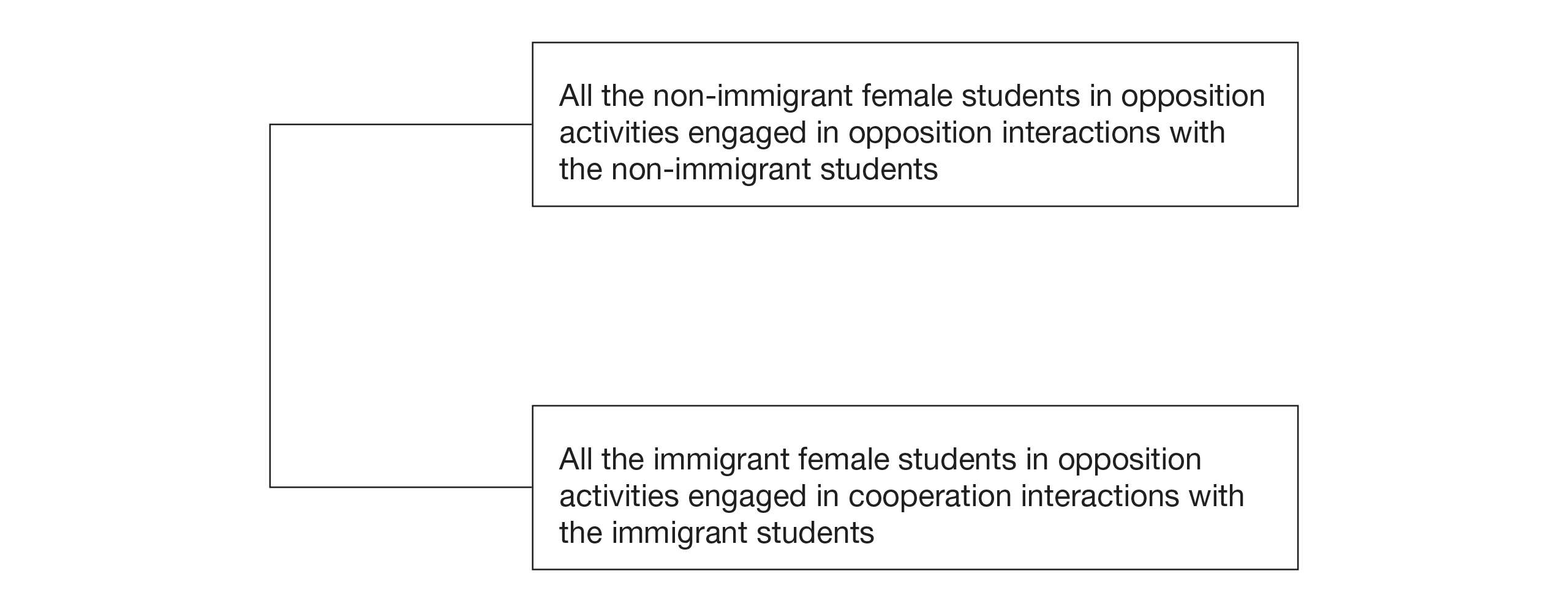
The results obtained with the THEME software revealed different motor interaction patterns based on school, student gender, and type of behavior (cooperation or opposition). At school 1 and for opposition activities, non-immigrant female students showed a greater tendency to interact with non-immigrant male students; however, they engaged in opposition interactions, choosing to eliminate them to break the continuity of the game, while immigrant female students tended to interact by cooperating with immigrant male students in opposition activities, engaging in behavior such as holding or supporting them to maintain balance or prevent their elimination from the game (see Figure 2).
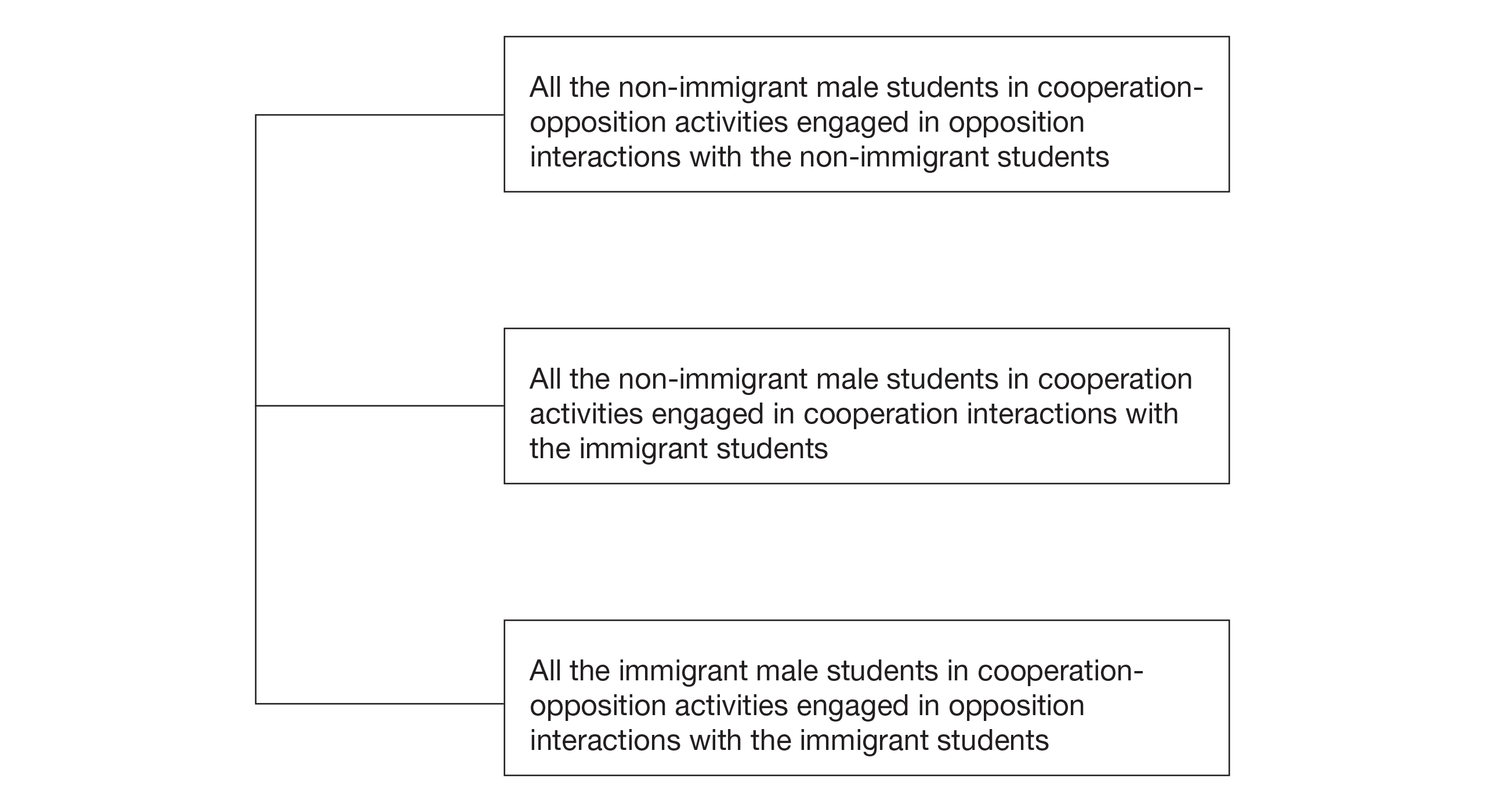
In the case of non-immigrant male students at school 1, they demonstrated opposition behaviors toward other non-immigrant students in cooperation-opposition activities, with elimination being the most frequent behavior; however, they showed cooperation with immigrant students, with holding onto others to steady them or facilitate completion of the exercise being the most frequent behavior (see Figure 3). Nevertheless, the immigrant male students displayed a pattern of cooperation with immigrant students in cooperation-opposition activities (see Figure 3), with the most significant behaviors being embrace/lean and holding to steady or reinforce cohesion during the task.
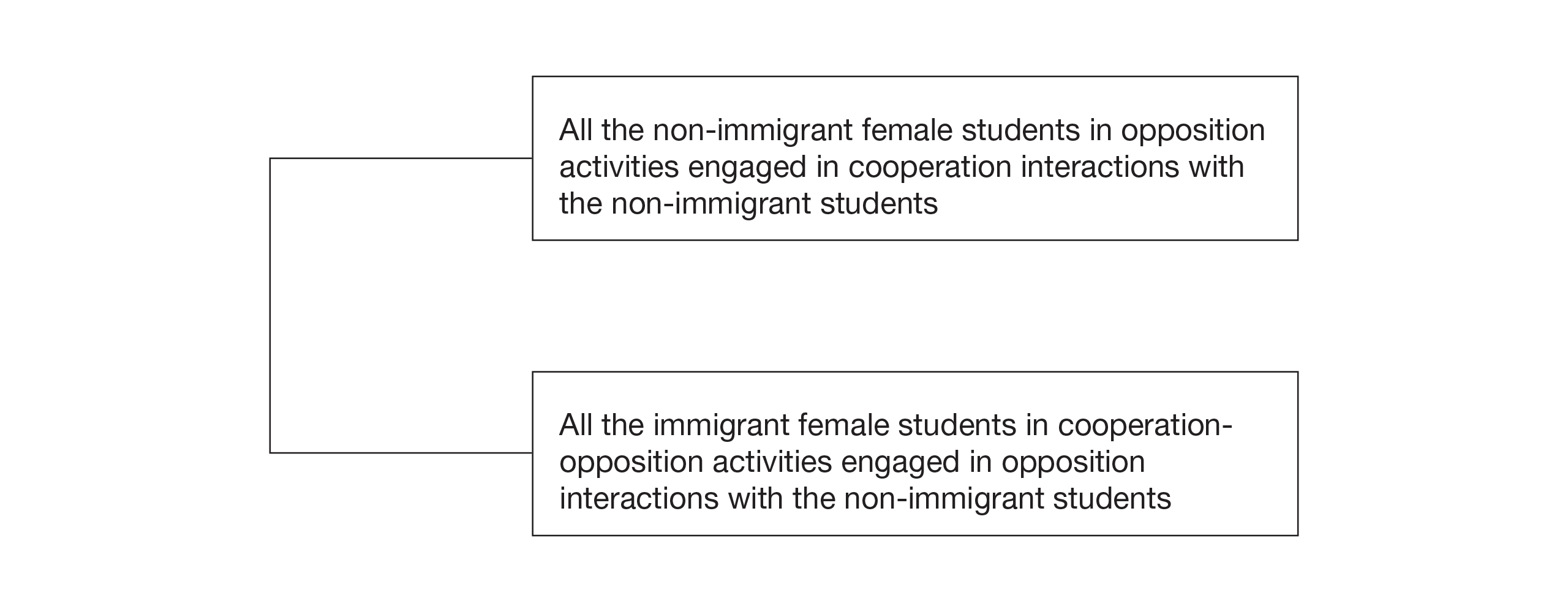
Nevertheless, in opposition activities, the non-immigrant female students at school 2, mostly engaged in cooperation interactions with the non-immigrant students, with the behavior of holding onto classmates to maintain their stability and, therefore, continuity in the game being particularly relevant. The immigrant female students presented an inverse pattern in this type of activity, as they interacted in opposition to the non-immigrant students, with behaviors such as chasing them in order to catch them or limiting their movements within the game (see Figure 4).
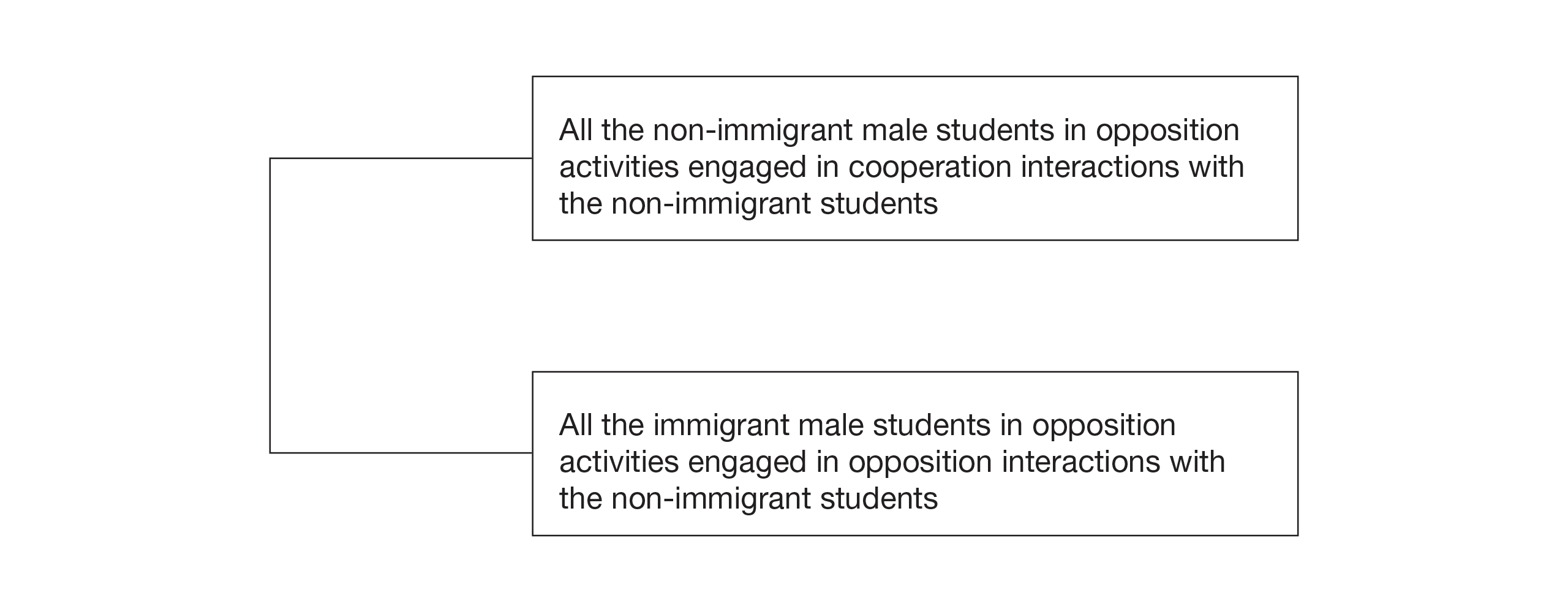
As for the non-immigrant male students from school 2, we identified patterns of cooperation, such as holding onto one another to maintain balance during the game and ensure continuity during opposition activities with non-immigrant students (see Figure 5). On the other hand, in the same type of activity, the immigrant students showed a greater tendency toward opposition to the non-immigrant students, engaging in more capturing behavior to prevent these students from continuing to play (see Figure 5).
ANOVA
To determine whether there were significant differences between the groups in the observed dimensions, we used Welch’s ANOVA for the activity, interaction, recipient, and times_recode variables. We considered this test more appropriate than the traditional ANOVA because Levene’s test indicated violations of the assumption of homogeneity of variances for multiple variables (activity, recipient, and times).
The times variable was previously recoded (times_recode), as its original coding was inverse to that of the other variables, which negatively affected the internal reliability of the instrument.
The results showed statistically significant differences in the activity and times_recode variables. Specifically, for activity, the traditional ANOVA resulted in a value of F = 10.634, p < .001, although Welch’s ANOVA could not be calculated due to the existence of zero variances in some groups. For times_recode, Welch’s ANOVA was significant: F(31, 100.053) = 3.585, p < .001.
On the other hand, no significant differences were observed in interaction (Welch’s F = 1.031, df = 31, 100.253, p = .438) or recipient, for which, once again, we could not calculate Welch’s ANOVA due to the presence of zero variances.
In summary, these results suggest that the group significantly affects the type of activity and the frequency with which it occurs but does not influence the nature of the interaction or the person to whom it is directed.
Discussion
The study results allowed us to better understand how social-motor dynamics in physical education not only reflect current social relations but also help shape them. Based on the T-pattern analysis, we observed that interactions between non-immigrant and immigrant students do not follow a uniform pattern but are structured differently according to school context, gender, and type of motor action situation.
At school 1, the results show a clear tendency among students to group together based on their background, particularly in opposition situations. In the case of female students, a clearly distinct pattern can be observed based on origin. While the non-immigrant female students engaged in oppositional behaviors directed toward their own group, the immigrant female students showed a tendency to cooperate with other immigrant female students even during opposition situations, engaging in behaviors such as holding onto others or steadying one another. This result reinforces the existence of grouping based on background, in which intragroup cooperation acts as a cohesion and support mechanism that promotes continuity of the activity.
As for the male students from the same school, we observed more complex dynamics. The non-immigrant male students combined oppositional behavior toward their own group with cooperative behavior toward the immigrant students, while the immigrant male students tended to cooperate primarily with classmates from their same background. These results highlight that cooperation-opposition situations generate more flexible spaces for interaction in which relationships are not exclusively structured around cultural background. In line with motor action praxeology (Parlebas, 2001), these types of motor action domains promote changeable interactions, requiring students to alternate between collaboration and confrontation, which can expand opportunities for interaction and relationships.
However, these spaces do not, in and of themselves, guarantee inclusive dynamics. While we observed cross-cultural interactions between students of different backgrounds, these were not distributed equitably, signaling the presence of partial or selective inclusion dynamics. This supports the idea that the inclusive potential of physical education depends not only on the type of activity but also on how tasks are structured and pedagogically designed.
On the other hand, at school 2, we identified clearly distinct patterns, with greater polarization according to cultural background. In this case, non-immigrant female students displayed cooperative behaviors within their own group, while immigrant female students displayed oppositional behaviors toward non-immigrant students. The same pattern occurred among male students, with non-immigrant students cooperating within their own group and immigrant male students showing a tendency toward opposition to the non-immigrant students.
These results can be interpreted from a social identity perspective, which posits that individuals tend to strengthen their bonds with their own group and distinguish themselves from others, particularly when they are in the minority. In this sense, the immigrant students’ opposition toward the majority group could be understood as a form of identity affirmation within the social-motor context and beyond the rationale of the actual game. Likewise, this cooperation among mainly non-immigrant students suggests the possible existence of internal cohesion dynamics that do not always extend to the class group as a whole.
The differences observed between the two schools highlight the decisive role of the social-educational context. At school 1, where immigrant students constituted the majority, interactions were more diverse and there was less polarization. By contrast, at school 2, where immigrant students were the minority, more pronounced patterns of differentiation emerged between groups. This finding aligns with previous studies showing that the proportion of students from different backgrounds conditions opportunities for interaction and the development of social relationships in the classroom.
From a quantitative point of view, Welch’s ANOVA results indicate that variables such as type of activity and activity frequency significantly influence interaction dynamics. However, the lack of differences in the interaction and recipient variables may suggest an apparent homogeneity that is nuanced by the T-pattern analysis. This analysis reveals that interactions are not random but are organized into complex temporal structures, with distinct patterns emerging based on the context and student profile.
Taken as a whole, these results support the idea that, in physical education, inclusion does not automatically occur due to the mere existence of a diverse student body but rather depends greatly on the creation of motor action situations and teachers’ pedagogical intentions. Cooperation, when directed in a balanced manner, can encourage social cohesion; however, in the absence of deliberate planning, other dynamics can arise, such as grouping together, exclusion, or confrontation between groups.
This highlights the need to promote pedagogical approaches that foster equitable interaction between students from different backgrounds, integrating models based on cooperation and social and personal responsibility. Only through deliberate educational design will it be possible to transform physical education into a true space for social cohesion and inclusion.
Study Limitations
This study presents certain limitations that must be considered when interpreting the results. First, the sample included a small number of directly observed students, which could limit the generalizability of the findings to other educational settings. Likewise, the study focused on two schools in the same city, with differing socioeconomic situations, but did not consider other geographic or cultural settings. Another limitation is the brief time frame for data collection, which did not allow us to analyze the evolution of interactions over the course of the school year. Lastly, no individual variables were included, such as level of motor competence, prior inclusion experience, or attitudes toward diversity, all of which could enrich our interpretation of the detected relational patterns.
Practical Implications and Future Lines of Research
The obtained results underscore the importance of physical education teachers’ development of activities that foster equitable interaction between students from distinct cultural backgrounds. Methodological strategies based on cooperation and hybrid pedagogical models for inclusion can help minimize exclusion dynamics and encourage group cohesion. For teachers, this entails planning activities that strike a balance between cooperation and opposition, ensuring the active participation of all students and creating a classroom climate that promotes empathy and mutual respect.
In terms of future research, it could be interesting to expand the sample to other social-educational contexts, including different school ages, and conduct a longitudinal analysis of the evolution of motor interactions over time. Similarly, it would be interesting to include individual variables (motor competence, prior level of integration, motivation) that can provide a deeper understanding of the factors that influence the development of inclusive relationships in physical education.
Conclusions
Intercultural inclusion in physical education is not a natural consequence of classroom diversity but rather the result of deliberate teaching choices. For this space to truly contribute to fostering harmony and mutual respect, teachers must design activities that promote equitable interaction among all students, regardless of their cultural background. Only through well-planned, context-sensitive, and cooperation-oriented teaching approaches is it possible to transform physical education into a true driving force for inclusion and social cohesion in the school environment.
This study has shown that inclusion does not occur automatically but rather depends on factors such as activity type, school context, and student gender. While we identified opportunities for cooperation to promote integration, we also observed exclusion dynamics in certain scenarios. Therefore, it is essential that physical education activities extend beyond technical goals to encourage the creation of inclusive and equitable social bonds. Physical education, understood as a space for social-motor interaction, can be a driver of social cohesion provided that learning and activities are designed in a deliberate and diversity-conscious manner.
Conflict of interest
No conflict of interest was reported by the authors.
References
[1] Anguera, M. T. (2003). Observational methods (general). In R. Fernández-Ballesteros (Ed.), Encyclopedia of psychological assessment (Vol. 2, pp. 632–637). Sage.
[2] Anguera, M. T., Blanco-Villaseñor, A., Hernández-Mendo, A., & Losada, J. L. (2011). Diseños observacionales: ajuste y aplicación en psicología del deporte. Cuadernos de Psicología del Deporte, 11(2), 63–76. revistas.um.es/cpd/article/view/133241
[3] Anguera, M. T., Blanco-Villaseñor, A., Losada, J. L., & Sánchez-Algarra, P. (2020). Integración de elementos cualitativos y cuantitativos en metodología observacional. Ámbitos. Revista Internacional de Comunicación, 49, 49–70. doi.org//10.12795/Ambitos.2020.i49.04
[4] Anguera, M. T., Blanco-Villaseñor, A., Losada, J. L., Sánchez-Algarra, P., & Onwuegbuzie, A. J. (2018). Revisiting the difference between mixed methods and multimethods: Is it all in the name? Quality & Quantity, 52, 2757–2770. doi.org/10.1007/s11135-018–0700-2
[5] Bakeman, R., & Quera, V. (2001). Using GSEQ with SPSS. Metodología de las Ciencias del Comportamiento, 3(2), 195–214.
[6] Bakeman, R., & Quera, V. (1996). Análisis de la interacción. Análisis secuencial con SDIS y GSEQ. Ra-Ma.
[7] Behar, J., & Riba, C. (1993). Sesgos del observador y de la observación. En M. T. Anguera (Ed.), Metodología observacional en la investigación psicológica: Fundamentación (Vol. 2, pp. 15–128). PPU.
[8] Belando, N., Ferriz-Morell, R., & Moreno-Murcia, J. A. (2012). Proposal of a model for personal and social improvement through the promotion of responsibility for physical and sporting activity. RICYDE. Revista Internacional de Ciencias del Deporte, 8(29), 202–222. doi.org/10.5232/ricyde2012.02902
[9] Belando, N., Postigo, S. B., Arriaga, K. R., & Gostian, L. A. (2024a). Simulation-based learning in Exercise and Sports Sciences degree students: a pilot study. Retos,53, 288–295. doi.org/10.47197/retos.v53.102124
[10] Belando, N., Mendoza, D., López, C., Navarro, E., Tornero, J., Gostian, L., Beltrán, A., & Clemente, V. (2024b). Acute effects on the psychological perception of university students after participation in the "RegulACTION" workshop for the improvement of emotional health and promotion of an active lifestyle. Frontiers in Psychology, 15, 1419981. doi.org/10.3389/fpsyg.2024.1419981
[11] Boke, H., Aygun, Y., Tufekci, S., Yagin, F. H., Canpolat, B., Norman, G., Prieto-González, P., & Ardigò, L. P. (2025). Effects of cooperative learning on students' learning outcomes in physical education: A meta-analysis. Frontiers in Psychology, 16, 1508808. doi.org/10.3389/fpsyg.2025.1508808
[12] Burgueño, R., Cueto, M. B., Morales, E., & Medina, J. M. (2020). Influence of sport education on high school students' motivational response: A gender perspective. REID: Revista Electrónica de Investigación y Docencia, 37, 45–62. doi.org/10.47197/retos.v37i37.70880
[13] Camerino, O., García-Castejón, G., Valero-Valenzuela, A., & Castañer, M. (2023). Innovar en educación física y deportes: El modelo pedagógico de responsabilidad personal y social (MRPS). Universitat de Lleida.
[14] Camerino, O., Valero-Valenzuela, A., Prat, Q., Manzano-Sánchez, D., & Castañer, M. (2019). Optimizing education: A mixed methods approach oriented to teaching personal and social responsibility (TPSR). Frontiers in Psychology, 10, 1439. doi.org/10.3389/fpsyg.2019.01439
[15] Camerino, O., Castañer, M., & Anguera, M. T. (2012). Mixed methods research in the movement sciences: Case studies in sport, physical education and dance. Routledge.
[16] Carter, B., López-Pastor, V., Gallardo, F., & Carter, J. (2021). Physical Education, Sport and Immigration: critically analyzing some possibilities for Chile. Ágora para la Educación Física y el Deporte, 23, 52–72. doi.org/10.24197/aefd.0.2021.52–72
[17] Cohen, J. (1968). Weighted kappa: Nominal scale agreement with provision for scaled disagreement or partial credit. Psychological Bulletin, 70(4), 213–220. doi.org/10.1037/h0026256
[18] Cohen, J. (1960). A coefficient of agreement for nominal scales. Educational and Psychological Measurement, 20(1), 37–46. doi.org/10.1177/001316446002000104
[19] Comisión Europea. (2024). Pacto sobre migración y asilo. commission.europa.eu/strategy-and-policy/priorities-2019–2024/promoting-our-european-way-life/migration-and-asylum/pact-migration-and-asylum_es
[20] Consejo Económico y Social. (2019). Informe 02/2019: La inmigración en España: Efectos y oportunidades (Colección Informes, N.º 02/2019). www.ces.es
[21] Espinola González, D., Nieva Boza, C., & Porta Martínez, F. X. (2024). La importancia del área de educación física para una educación basada en valores y actitudes inclusivos. Entre Líneas. Revista especializada en Psicomotricidad, 54, 41–49. ddd.uab.cat/record/308125
[22] Evangelio, C., Guijarro, E., Rocamora, I., & González-Víllora, S. (2018). Sport Education Model in Spain: a systematic review. Retos, 38, 886–894. doi.org/10.47197/retos.v38i38.77249
[23] Ferrari, I., Bretz, K., Kress, J., Niederberger, L., & Schuler Braunschweig, P. (2025). Sports activities in extended education—their leading role for educational development. Frontiers in Education, 10, 1536664. doi.org/10.3389/feduc.2025.1536664
[24] García‑Castejón, G., Camerino, O., Castañer, M., Manzano‑Sánchez, D., Jiménez‑Parra, J. F., & Valero‑Valenzuela, A. (2021). Implementation of a hybrid educational program between the model of personal and social responsibility (TPSR) and the teaching games for understanding (TGfU) in physical education and its effects on health: An approach based on mixed methods. Children, 8(7), 573. doi.org/10.3390/children8070573
[25] García-García, J., Belando-Pedreño, N., Fernández-Río, F. J., & Valero-Valenzuela, A. (2023). Prosocial behaviours, physical activity and personal and social responsibility profile in children and adolescents. Apunts. Educación Física y Deportes, 153, 79–89. doi.org/10.5672/apunts.2014–0983.es.(2023/3).153.07
[26] García López, L. M., & Abellán, J. (2024). Construyendo la justicia social a través de la educación física y el deporte. En J. M. Medina Bravo (Ed.), Justicia social, igualdad y equidad educativa en la práctica docente: Una mirada desde la práctica reflexiva docente (pp. 97–109). Ediciones de la Universidad de Castilla-La Mancha. ruidera.uclm.es/server/api/core/bitstreams/a9089360-983e-4683-a7db-6e6261a6c6da/content
[27] Gerdin, G. (2025). Level the playing field: Pupils' experiences of inclusion and social justice in physical education and health. Sport, Education and Society, 30(4), 397–412. doi.org/10.1080/13573322.2024.2323495
[28] Graça, A., Estriga, L., & Batista, P. (2024). The problem of nurturing sustainable inclusion within team sports in physical education. Sustainability, 16(15), 6379. doi.org/10.3390/su16156379
[29] Greco, G., Poli, L., Petrelli, A., Fischetti, F., & Cataldi, S. (2024). Physical education and sport: A path to inclusiveness, equality and sustainable development. Formazione & Insegnamento, 22(2), 214–220. doi.org/10.7346/-fei-XXII-02-24_23
[30] Greene, J. D. (2015). The rise of moral cognition. Cognition, 135, 39–42. doi.org/10.1016/j.cognition.2014.11.018
[31] Hellison, D. (1995). Teaching responsibility through physical activity. Human Kinetics.
[32] Hernández-Mendo, A., Díaz Martínez, F., & Morales Sánchez, V. (2010). Construcción de una herramienta observacional para evaluar las conductas prosociales en las clases de educación física. Revista de Psicología del Deporte, 19(2), 305–318.
[33] Instituto Nacional de Estadística. (2025). El crecimiento de la población en España. www.ine.es/dyngs/Prensa/ECP4T24.htm
[34] Jiménez-Parra, J. F., Belando-Pedreño, N., Lopez-Fernandez, J., García-Vélez, A. J., & Valero-Valenzuela, A. (2022). "ACTIVE VALUES": An Interdisciplinary Educational Programme to Promote Healthy Lifestyles and Encourage Education in Values—A Rationale and Protocol Study. Applied Sciences, 12(16), 8073. doi.org/10.3390/app12168073
[35] Lagardera, F., & Lavega, P. (2003). Introducción a la praxiología motriz. Paidotribo.
[36] Landis, J. R., & Koch, G. G. (1977). The measurement of observer agreement for categorical data. Biometrics, 33(1), 159–174. doi.org/10.2307/2529310
[37] Magnusson, M. S. (2000). Discovering hidden time patterns in behavior: T-patterns and their detection. Behavior Research Methods, Instruments, & Computers, 32(1), 93–110. doi.org/10.3758/BF03200792
[38] Martín-Rodríguez, A., Gostian-Ropotin, L. A., Beltrán-Velasco, A. I., Belando-Pedreño, N., Simón, J. A., López-Mora, C., Navarro-Jiménez, E., & Tornero-Aguilera, J. F. (2024). Sporting mind: The interplay of physical activity and psychological health. Sports, 12(1), 37. doi.org/10.3390/sports12010037
[39] Monjas, R., Ponce, A., & Gea, J. M. (2015). La transmisión de valores a través del deporte: Deporte escolar y deporte federado, relaciones, puentes y posibles transferencias. Retos, 28, 276–284.
[40] Mundet, A., Simó, M., Lleixà, T., Batalla, A., & Crespo, R. (2021). De la práctica deportiva a la inclusión social: Un diagnóstico para la acción en 6 países de Europa. Revista Española de Educación Física y Deportes, 434, 73–80. doi.org/10.55166/reefd.vi434.1000
[41] Parlamento Europeo. (2023, 21 de diciembre). Asilo y migración en la UE: Cifras y hechos. www.europarl.europa.eu/topics/es/article/20170629STO78630/asilo-y-migracion-en-la-ue-cifras-y-hechos
[42] Parlebas, P. (1981). Contribution á un lexique commenté en science de l'action motrice. París: INSEP
[43] Parlebas, P. (1986). Elementos de sociología del deporte. Unisport.
[44] Parlebas, P. (2001). Juegos, deporte y sociedad: Léxico de praxiología motriz. Paidotribo.
[45] Portell, M., Anguera, M. T., Hernández-Mendo, A., & Jonsson, G. K. (2015). Quantifying biopsychosocial aspects in everyday contexts: An integrative methodological approach from the behavioral sciences. Psychology Research and Behavior Management, 8, 153–160. doi.org/10.2147/PRBM.S82417
[46] Prat, Q., Camerino, O., Castañer, M., Andueza, J., & Puigarnau, S. (2019). The Personal and Social Responsibility Model to Enhance Innovation in Physical Education. Apunts. Educación Física y Deportes, 136(2), 83–99. doi.org/10.5672/apunts.2014–0983.es.(2019/2).136.06
[47] Ríos, M. (2017). El deporte como recurso educativo en la inclusión social. Educació Social. Revista d'Intervenció Socioeducativa, 65, 44–56. doi.org/10.34810/EducacioSocialn65id320429
[48] Sandoval-Iniesta, A., & Alonso-Roque, J. I. (2023). Towards social inclusion through sport: the case of an educational program for children in conflict with the law. Revista Electrónica Interuniversitaria de Formación del Profesorado, 26(3), 1–14. doi.org/10.6018/reifop.569411
[49] Sánchez-Alcaraz Martínez, B. J., Gómez-Mármol, A., Valero-Valenzuela, A., De la Cruz-Sánchez, E., Belando, N., & Moreno Murcia, J. A. (2019). Achieving greater sportsmanship and decreasing school violence through responsibility and sport practice. Revista de Psicología del Deporte, 28(2), 151–160.
[50] Shao, J., Cui, Z., & Bao, Y. (2025). Adaptive sports programs as catalysts for social inclusion and cognitive flexibility in inclusive physical education: The mediating roles of emotional resilience and empathy. BMC Psychology, 13, 770. doi.org/10.1186/s40359-025–03092-2
[51] Sherlock, T. (2024). The role of community sports programs in promoting social cohesion. International Journal of Arts, Recreation and Sports, 3(5), 15–27. doi.org/10.47941/ijars.2073
[52] Soto, A., Camerino, O., Anguera, M. T., Iglesias, X., & Castañer, M. (2022). Lince plus software for systematic observation studies of sports and health. Behavior Research Methods, 54, 1263–1271. doi.org/10.3758/s13428-021–01642-1
[53] Soto, A., Camerino, O., Iglesias, X., Anguera, M. T., & Castañer, M. (2019). Lince plus: Research software for behavior video analysis. Apunts. Educación Física y Deportes, 137, 149–153. doi.org/10.5672/apunts.2014–0983.es.(2019/3).137.11
[54] UNESCO. (2015). International Charter of Physical Education, Physical Activity and Sport. unesdoc.unesco.org/ark:/48223/pf0000235409
[55] UNHCR. (2024). Europe: Figures at a glance – 2023. www.unhcr.org/europe/europe-figures-glance-2023
[56] Valero-Valenzuela, A., García, D. G., Camerino, O., & Manzano, D. (2020). Hybridisation of the Teaching Personal and Social Responsibility Model and Gamification in Physical Education. Apunts. Educación Física y Deportes, 141(3), 63–74. doi.org/10.5672/apunts.2014–0983.es.(2020/3).141.08
ISSN: 2014-0983
Received: March 6, 2026
Accepted: June 10, 2026
Published: October 1, 2026
Editor: © Generalitat de Catalunya Departament de la Presidència Institut Nacional d’Educació Física de Catalunya (INEFC)
© Copyright Generalitat de Catalunya (INEFC). This article is available from url https://www.revista-apunts.com/. This work is licensed under a Creative Commons Attribution-NonCommercial-NoDerivatives 4.0 International License. The images or other third party material in this article are included in the article’s Creative Commons license, unless indicated otherwise in the credit line; if the material is not included under the Creative Commons license, users will need to obtain permission from the license holder to reproduce the material. To view a copy of this license, visit https://creativecommons.org/licenses/by-nc-nd/4.0/deed.en


