Satisfaction and Frustration of Basic Psychological Needs and Intention to Engage in Physical Activity in Primary Education
Enrique Cano-Cañada

Sergio Diloy-Peña

Diego Esteban-Torres
José Antonio Sayavera-Cidoncha
Ana Acedo-Castela
Miguel Ángel Tapia-Serrano
*Corresponding author: Miguel Ángel Tapia-Serrano matapiase@unex.es
Cite this article
Cano-Cañada, E., Diloy-Peña, S., Esteban-Torres, D., Sayavera-Cidoncha, J. A., Acedo-Castela, A., & Tapia-Serrano, M. Á. (2026). Satisfaction and frustration of basic psychological needs and intention to engage in physical activity in primary education. Apunts. Educación Física y Deportes, 166, 20-31. https://doi.org/10.5672/apunts.2014-0983.es.2026.166.03
Abstract
Satisfaction and frustration of the basic psychological needs (BPNs) for autonomy, competence, and relatedness have been linked to various adaptive and maladaptive outcomes in physical education (PE) in high school, yet their role in elementary school remains underexplored due to a lack of studies. Based on self-determination theory (SDT), this study aimed to examine the relationship between BPNs satisfaction and frustration and the intention to engage in physical activity (PA), with motivation (autonomous motivation, controlled motivation, and amotivation) as the mediating variable. A cross-sectional study was conducted with 171 elementary school students from grades 3 to 6 (Mage= 9.95, SD= 1.23; 55% female) from five schools. Validated questionnaires were administered to assess BPNs satisfaction and frustration, motivation in PE, and intention to engage in PA. Structural equation modeling results showed that the satisfaction of competence and relatedness positively predicted autonomous motivation, which in turn was positively associated with the intention to engage in PA. In contrast, autonomy and competence frustration were positively associated with higher amotivation, which negatively predicted the intention to engage in PA. Overall, the findings highlight the important role of satisfying BPNs, as well as preventing their frustration in PE contexts to foster more self-determined forms of motivation and promote active lifestyles from childhood.
Keywords: healthy lifestyles, motivation, physical education, self-determination theory, students
Introduction
Regularly engaging in physical activity (PA) in childhood is an essential part of students’ physical, psychological, and social development, and it also protects them against numerous short- and long-term health problems (García-Hermoso et al., 2021). Despite this well-known fact, international reports warn that most students do not meet the 60 minutes or more of daily moderate-to-vigorous PA recommended by international organisms (Guthold et al., 2020), resulting in negative physical, cognitive, and psycho-social consequences (Rollo et al., 2020). With that in mind, physical education (PE) offers an exceptional opportunity to promote students’ participation in meaningful bodily movement and to equip them with skills, values, and tools that encourage engaging in PA outside the school setting (SHAPE America, 2014; Hollis et al., 2017). Physical education thus helps prevent health, self-esteem, and motor skills development problems associated with sedentary lifestyles (Carson et al., 2016).
In that regard, we must further explore the motivational mechanisms behind the adoption of active habits at young ages, and specifically in elementary education as this stage is rarely analyzed through the lens of self-determination theory (SDT; Ryan & Deci, 2017). With the aim of delving into this topic, this study examines these relationships within the context of PE.
Self-Determination Theory
Self-determination theory (SDT) provides an excellent framework for understanding the motivational processes involved in engaging in physical activity. With this approach, how students experience the satisfaction or frustration of their basic psychological needs (BPNs; autonomy, competence, and relatedness) is critical to explaining the quality of their motivation. Autonomous motivation lies at one end of the continuum, and emerges when an activity is perceived as pleasing, voluntary, and meaningful. This type of motivation includes different regulatory styles: intrinsic motivation (due to the enjoyment it produces), integrated regulation (due to alignment with own values or identity), and identified regulation (due to personal value). For example, a student may actively engage in PE classes because they enjoy the activities or because they value how the class benefits their life. This type of motivation is associated with higher levels of well-being, persistence, and commitment to the activity. As self-determination diminishes, controlled motivation rises, in which participation is influenced by external or internal pressure. This type of motivation includes two main regulatory styles: introjected regulation, in which students are motivated by feelings of guilt, anxiety, or desire for approval, and external regulation, which involves completing an activity to obtain rewards or avoid punishment. For example, a student may participate in class to avoid getting marked as absent, to get a grade, or out of fear of feeling guilty if they do not. While this can produce some level of participation or engagement, this type of motivation tends to be less stable and beneficial in the long-term. At the other end of the continuum is amotivation, which is characterized by a lack of intention, meaning, or value attributed to the activity. In PE, this is seen in students who do not participate or who do so passively, believing that their effort is futile or doubting their ability to successfully complete the activity (Ryan & Deci, 2017).
According to SDT, the type of motivation that a student develops is significantly conditioned by the degree to which the educational setting satisfies or frustrates the three BPNs. In education, satisfying the need for autonomy refers to students feeling like they are acting of their own volition and are the source of their own behavior, acting in line with their interests, values, or personal goals. On the contrary, frustration of autonomy occurs when students feel that their actions are externally controlled and they feel pressured to act a certain way. Competence satisfaction involves feeling effective and capable of successfully meeting the challenges of an activity. This occurs when a student feels they are progressing, mastering skills, and achieving set goals. On the other hand, this need is frustrated when students feel ineffective, inept, or constantly overwhelmed by the difficulty of tasks. Lastly, relatedness satisfaction refers to feeling connected to, accepted, and valued by other important individuals such as classmates and teachers. On the contrary, this need is frustrated when students feel isolated, rejected, or lacking affectional bonds or when they do not feel that they belong to the group.
Empirical evidence has shown that satisfaction of BPNs in PE is positively associated with autonomous motivation and greater intention to engage in PA during free time (Di Battista et al., 2019; Gråstén et al., 2021). On the other hand, when these needs are frustrated, forms of controlled motivation or amotivation tend to arise, which are associated with lower enjoyment, diminished commitment, and a higher risk of not engaging in PA (Vansteenkiste et al., 2020; Vasconcellos et al., 2020). Therefore, since the satisfaction and frustration of BPNs are not simple opposites but rather conceptually different constructs, their joint analysis allows us to better understand the psychological mechanisms that promote or hinder the adoption of active habits during childhood (Vansteenkiste et al., 2020).
Nevertheless, and despite the growing interest around motivation in the field of PE given its importance in developing active and healthy lifestyles at a young age, most studies (Fernández-Espínola et al., 2021; González-Peño et al., 2025) have focused on later educational years, such as high school. As such, very few studies have analyzed simultaneously the effects of the satisfaction and frustration of these needs on motivation and the intention to engage in PA in elementary education (Vasconcellos et al., 2020). Likewise, there is a lack of research that uses structural equation modeling to jointly examine the satisfaction and frustration of BPNs, the different types of motivation (autonomous, controlled, and amotivation), and their mediating role in the intention to engage in PA during free time. This gap highlights the need to delve into how BPNs influence motivation and the intention to engage in PA in PE.
This Study
Considering the lack of studies that use SDT to analyze these relations in elementary education, this study aimed to analyze the relationship between BPNs satisfaction and frustration and the intention to engage in PA during free time among elementary school students, exploring the role of motivation as the mediating variable.
Based on the study objective and in light of the findings from the meta-analysis by Vasconcellos et al. (2020), we defined the following hypotheses: (H1) a positive association between satisfaction of autonomy, competence, and social relatedness and autonomous motivation, predicting, due to its mediating role, greater intention to engage in PA; (H2) a positive association between frustration of autonomy, competence, and relatedness and controlled motivation and amotivation, resulting in a lower intention to engage in PA.

Methodology
Participants
We conducted a cross-sectional study with a descriptive and correlational approach. A total of 171 elementary school students from five different schools participated in the study. They were recruited via convenience sampling. The exclusion criteria were as follows: students absent on the day the questionnaire was administered, lack of regular attendance in PE classes (less than 75% overall), incomplete questionnaires or with invalid response patterns, and missing informed consent from the legal guardians.
After eliminating the non-valid data, the final sample comprised 171 students (Mage = 9.95, SD = 1.23; 55% female), with ages ranging from 8 to 12 years old. In total, 94 were female (Mage = 10.12, SD = 1.2) and 77 were male (Mage = 9.73, SD = 1.27), divided into different elementary school grades (3rd grade = 32; 4th grade = 49; 5th grade = 41; 6th grade = 49).
Materials and Instruments
Satisfaction and frustration of basic psychological needs
The satisfaction and frustration of BPNs were measured using a 5-point Likert scale (1 = “Strongly disagree,” 5 = “Strongly agree”) in its Spanish version adapted to elementary school education and the PE environment (Sayavera-Cidoncha et al., 2026). This adaptation to an elementary school setting is based on previously validated instruments, such as the Basic Psychological Need Satisfaction and Frustration Scale (BPNSFS; Haerens et al., 2015), which was validated in the Spanish setting by Zamarripa et al. (2020). In the original validation study, the version adapted to the elementary school setting showed adequate fit values: χ²(237, n = 336) = 574.53, p < .001; Comparative Fit Index (CFI) = .98; Tucker Lewis Index (TLI) = .98; Root Mean Square Error of Approximation (RMSEA) = .04, (90% CI = .04 – .05). The instrument comprises 24 items distributed among six sub-scales (four for every dimension), which evaluate satisfaction of autonomy (e.g., “…I feel that I can make my own choices [games, materials, groups, etc.]”), competence (e.g., “…I feel capable of doing the activities well”), and relatedness (e.g., “…I feel like I get along well with my classmates”), as well as frustration of autonomy (e.g., “…I feel like I am told what to do without asking me”), competence (e.g., “…I feel like I am bad at the activities”), and relatedness (e.g., “…I feel excluded from the group I want to belong to”). The scale also presented acceptable psychometric properties for this study sample. For satisfaction: χ²(51, n = 171) = 64.00, p < .11; CFI = .94; TLI = .92; RMSEA = .04 (90% CI = .02 – .07), while for frustration: χ²(51, n = 171) = 76.44, p < .001; CFI = .93; TLI = .91; RMSEA = .05 (90% CI = .03 – .08). In addition, the reliability coefficients estimated via McDonald’s omega (ω) presented adequate values. For satisfaction, we obtained the following values: autonomy (ω = .70), competence (ω = .60), and relatedness (ω = .73). For frustration, the values were as follows: autonomy (ω = .72), competence (ω = .70), and relatedness (ω = .71).
Motivation in PE classes
Student motivation in PE class was measured via the Physical Education Motivation Questionnaire adapted for elementary education (CMEF; Leo et al., 2016). Completing the sentence “I participate in PE classes…,” the scale includes 20 items, four for each type of motivational regulation, with the exception of introjected, evaluating intrinsic regulation (e.g., “…because Physical Education is fun”), identified regulation (e.g., “…because I can learn skills that I might use in other areas of my life”), introjected regulation, (e.g., “…because I feel bad about myself if I skip class”), external regulation (e.g., “…because it is expected of me by my teacher and classmates”), and amotivation (e.g., “…but I actually feel like I am wasting my time in this class”). Based on the approaches in SDT and previous research on PE (Haerens et al., 2015), we calculated composite scores for autonomous motivation (averaging intrinsic motivation and identified regulation) and controlled motivation (averaging introjected and external regulation) to simplify the analysis. Responses were logged using a 5-point Likert scale (1 = “Strongly disagree,” 5 = “Strongly agree”). In this study, the confirmatory factor analysis (CFA) showed an acceptable fit for the three factor model: χ2(132, n = 171) = 198.75, p < .001, CFI = .95; TLI = .94; RMSEA = .05, 90% CI= .04 – .07). The reliability coefficients obtained via McDonald’s omega were adequate for autonomous motivation (ω = .82), controlled motivation (ω = .81), and amotivation (ω = .60).
Intention to engage in PA
Student intention to engage in PA was measured using three items (e.g., “In the coming weeks I intend to do sports or play in the afternoons”) from the Theory of Planned Behavior Questionnaire (Hagger et al., 2009). Responses were logged using a 7-point Likert scale (1 = “Strongly disagree,” 7 = “Strongly agree”). The CFA conducted in this study indicated an adequate fit for a single factor model: χ2(2, n = 171) = 9.63, p < .001, CFI = .98; TLI = .98; RMSEA = .04, 90% CI = .01 – .05). McDonald’s omega coefficient indicated adequate reliability (ω = .68).
Procedure
Before starting the study, the principal investigator contacted the school leadership teams to inform them about the aim of the research and to request collaboration. The family members or legal guardians were then asked to sign an informed consent form authorizing their children’s participation. The students themselves also filled out a written informed consent form. The questionnaires were administered collectively during classroom hours, taking approximately 25 minutes of class time. The PE teachers were not present in the classroom when the questionnaires were completed to minimize potential bias or influence in the students’ responses. This study was conducted in accordance with the ethical principles of the Declaration of Helsinki and received approval from the University of Extremadura ethics committee (Ref.: 240/2024).
Data Analysis
In the preliminary analyses, we calculated the descriptive statistics (mean and standard deviation), composite reliability (McDonald’s omega coefficient, ω), and latent correlations, among other variables. The available sample size (n = 171) was deemed adequate to estimate structural equation models with a moderate number of latent variables, guaranteeing the stability and reliability of the estimated parameters (Wang & Wang, 2012). For the primary analyses, we estimated a structural equation model using the weighted least squares mean and variance (WLSMV) adjusted estimator, which is adequate for ordinal Likert-like data and robust to non-normality (Muthén & Muthén, 2017). To estimate the indirect effects, we used a bootstrap procedure with 5,000 resamples, from which we obtained 95% confidence intervals based on the percentile method, due to its greater robustness against potential deviations in normality in the distribution of the indirect effects. In addition, we evaluated reliability using McDonald’s omega coefficient (ω), interpreted according to psychometric recommendations that consider values between .60 and .70 as acceptable in short and multidimensional scales, particularly in children (Loewenthal & Lewis, 2020; Cicchetti, 1994; Hernaez, 2015). The predictive relationship of satisfaction and frustration of autonomy, competence, and relatedness with motivation (autonomous, controlled, and amotivation) and intention to engage in PA was analyzed using a two-step model proposed by Kline (2011). The first step examined the measurement model, including the relationships between all the latent variables. The second step evaluated the hypothesized structural relationships. The model fit was evaluated via the following indices: CFI and TLI values over .90 indicate a good fit, while values over .95 reflect an excellent fit. For the RMSEA, values ≤ .08 were interpreted as adequate and ≤ .06 as excellent (Marsh et al., 2004). The analysis was conducted using IBM SPSS (version 25.0) and Mplus (version 8.0) statistics software.
Results
Preliminary Results
The results presented in Table 1 show the descriptive statistics, the composite reliability, and the latent correlations between the analyzed variables. Likewise, the differences according to sex and school grade, respectively, can be seen in Tables 1 and 2. In terms of BPNs, the mean scores for satisfaction of autonomy, competence, and relatedness were above the midpoint of the scale, while the mean scores for frustration of said needs were situated below said value. In terms of the types of motivation, autonomous motivation presented a very high mean value, while both controlled motivation and amotivation presented means below the midpoint of the scale. Likewise, the mean for intention to engage in PA was considerably higher than the midpoint. The correlations between satisfaction of autonomy (r = .28, p < .05), competence (r = .71, p < .01), and relatedness (r = .55, p < .01) with autonomous motivation were positive and significant. Similarly, each of the BPNs showed positive and significant correlations with the intention to engage in PA (r = .31, .44 and .46; p < .05, respectively). On the other hand, competence frustration was significantly and negatively correlated with controlled motivation (r = –.24; p < .05), while relatedness frustration (r = .19; p < .05) was positively associated. As for amotivation, a significant and positive correlation was observed with frustration of autonomy (r = .43; p < .01), competence (r = .36; p < .01), and relatedness (r = .38; p < .01). Lastly, frustration of autonomy (r = –.26; p < .01), competence (r = –.37; p < .01), and relatedness (r = –.23; p < .01) were significantly and negatively associated with the intention to engage in PA.

Table 1
Descriptive analysis, composite reliability, and latent correlations between the study variables
Primary Results
While some of the direct effects were not significant, the hypothesized models presented good fit indices in terms of the observed data: χ²/df = 1.31, p < .001; CFI = .90; TLI = .90; RMSEA = .04 (90% CI = .03 – .05). All the direct effects are presented in Table 2.
Table 2
Direct effects of the satisfaction and frustration of BPNs on student motivation and intention to engage in PA
Figure 2 shows the direct effects of the satisfaction and frustration of the BPNs autonomy, competence, and relatedness, as well as the types of motivation for the intention to engage in PA. Competence and relatedness satisfaction were significantly and positively related to autonomous motivation. Autonomy frustration was positively associated with controlled motivation and amotivation. Competence frustration was negatively related to controlled motivation and positively related to amotivation. Lastly, the intention to engage in PA was positively predicted by autonomous motivation and negatively by amotivation.
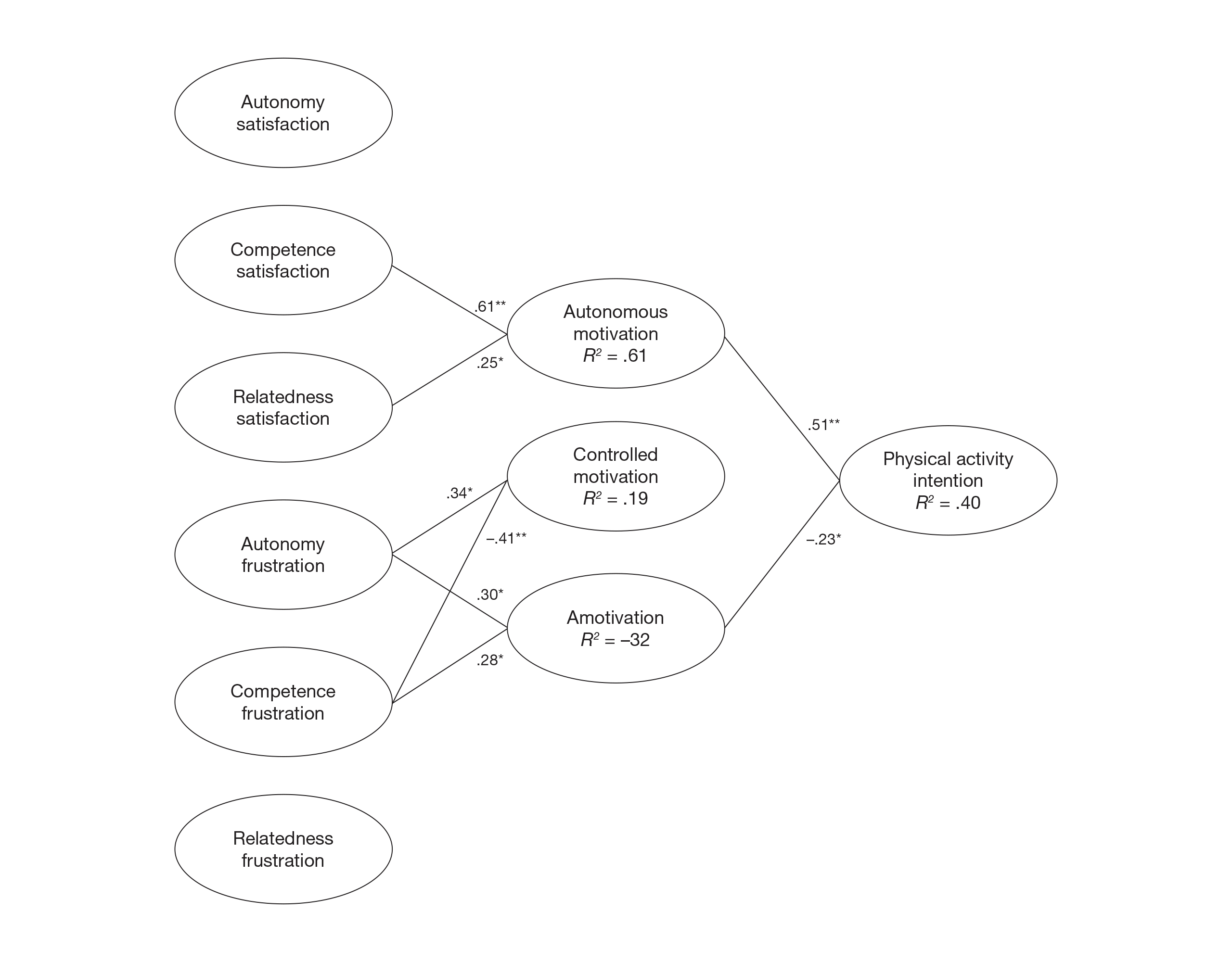
Note: All the relations shown in the figure were significant where p < .05* and p < .01**.
Table 3 presents the indirect effects of the satisfaction and frustration of the needs for autonomy, competence, and relatedness on the intention to engage in PA, mediated by autonomous motivation, controlled motivation, and amotivation. In particular, competence and relatedness satisfaction presented a positive indirect effect on intention to engage in PA through autonomous motivation. In contrast, autonomy frustration presented a negative indirect effect on intention to engage in PA, mediated by amotivation.
Table 3
Indirect effects of the satisfaction and frustration of BPNs on student motivation and intention to engage in PA
Discussion
The aim of this study was to analyze the effects of BPNs satisfaction and frustration on the intention to engage in PA in elementary school students, exploring the mediating role of motivation according to SDT (Ryan & Deci, 2017). The main findings were: 1) satisfaction of the competence and relatedness needs was positively and indirectly related to the intention to engage in PA through autonomous motivation; 2) autonomy frustration was negatively and indirectly related to intention to engage in PA through amotivation; and 3) competence frustration was negatively related to controlled motivation, which did not present a significant influence on student intention to engage in PA.
First, the fact that competence and relatedness satisfaction were positively and indirectly related to the intention to engage in PA through autonomous motivation partially supports the first hypothesis, highlighting the key role of these BPNs in developing motivation that is more self-determined and that has adaptive consequences in PE (Vasconcellos et al., 2020). By creating feelings of efficacy and mastery of skills, the perception of competence encourages personal interests, regulates behavior in a more internal manner, and reinforces self-confidence and personal commitment (Ryan & Deci, 2017). This pattern has been confirmed in studies that identified competence as one of the needs that is most directly associated with students’ intention to engage in PA (Fernández-Espínola et al., 2020). Specifically, in our study, competence emerged as the primary predictor of motivational quality in PE, a similar pattern to that reported by Vasconcellos et al. (2020) in their meta-analysis conducted in high school students.
In that case, feeling connected to others, particularly to a group of equals or to the teacher, contributes to creating positive affectional bonds with PA and developing an active identity (Leo et al., 2020). In elementary school, where social and emotional development is particularly important, these dimensions are especially relevant. The literature has shown that a positive relationship environment can promote enjoyment and the feeling of belonging, which in turn positively influences the intention to continue engaging in PA (Trigueros et al., 2019a). This pattern is also in line with that set forth in the trans-contextual model (Hagger et al., 2003), which highlights the role of autonomous motivation in transferring behavior intention to leisure time contexts.
Second, autonomy frustration is negatively and indirectly associated with the intention to engage in PA through increased amotivation, which supports our second hypothesis. This result is consistent with previous studies (Haerens et al., 2015; Vansteenkiste & Ryan, 2013), which indicate that educational settings that are overly controlling or that offer little participation may stir up feelings of pressure, obligation, or lack of freedom in students, thereby limiting their feeling of personal choice and causing less adaptive forms of regulation. In elementary school, when students are developing their self-concept and decision-making abilities, perceiving activities as imposed upon them or overly directed could cause disinterest, feelings of obligation, or rejection, thus diminishing autonomous motivation and increasing amotivation, in turn hindering the adoption of long-term behaviors and compromising future intention to engage in PA (Assor et al., 2005). This negative pattern has been associated with controlling teaching styles that limit involvement in PE (Trigueros et al., 2019b) and, according to the trans-contextual model, these frustrating experiences hinder motivational internalization and the transfer of intention to extracurricular activity (Ntovolis et al., 2015).
Third, and unexpectedly, competence frustration was negatively associated with controlled motivation. Contrary to our expectations, as we had hypothesized that this frustration would promote less self-determined forms of motivation, the findings suggest that students who perceive themselves as incompetent not only fail to develop greater autonomous motivation, but also fail to respond to external incentives. Though counterintuitive, this interpretation could be explained by the concept of “behavioral withdrawal” in SDT (Bartholomew et al., 2011), according to which extreme frustration of competence may lead students to experience emotions such as frustration, shame, or low self-esteem, possibly resulting in fully disconnecting from PA completely. Thus, feeling incapable may result in emotional overwhelm and disconnection, even when receiving rewards or praise (Franco et al., 2021), this being particularly relevant in elementary school, where self-regulatory mechanisms are only just emerging and repeated experiences of inefficacy could result in avoiding PA (Ntoumanis et al., 2021). This pattern has also been described in motivational profiles with elevated frustration, characterized by low levels of both autonomous motivation and controlled motivation (Warburton et al., 2020).
Lastly, neither autonomy satisfaction nor relatedness frustration were significantly associated with the intention to engage in PA. These results do not align with previous studies (Leyton-Román et al., 2020), where BPNs satisfaction predicted more autonomous motivation, which consequently promoted increased engagement in PA among students. Our hypothesis posits that, in elementary school, decision-making processes and social experiences may be contextual. In other words, children tend to follow norms and respond to social signals within the classroom without necessarily internalizing these experiences as motivations to engage in PA outside the educational setting (Chen et al., 2021; Reeve & Cheon, 2021). This hypothesis, as well as the results obtained by Manzano-Sánchez (2023), who showed that elementary school students already exhibit a more self-determined motivational profile towards PA compared to high school students, could contribute to explaining the discrepancies found in comparison to prior research. In terms of relatedness frustration, our hypothesis suggests that its lack of association with intention to engage in PA could be due to the weight of the teacher’s role in this educational stage, since teachers that provide emotional support and promote cooperative dynamics may soften negative experiences between equals and promote safe and motivating environments (Moreno-Murcia et al., 2024; Trigueros et al., 2019a). What’s more, the inherently playful and cooperative nature of PE may dilute the influence of negative social experiences by creating recurring opportunities to develop interpersonal relationships (Aracil-Alcocer & Alonso-Villodre, 2024).
Practical Applications
The results of this study, in line with those proposed in SDT, provide important implications for improving student motivation in PE classes during the elementary education years. Firstly, they highlight the need to design activities adapted to students’ perceived competence level and offer individualized feedback targeted at progression and mastery of skills while avoiding social comparisons or focusing on end results, which could produce frustration and disengagement (Reeve et al., 2014). Likewise, encouraging positive social relationships through cooperative dynamics, group activities, and an emotionally safe environment reinforces students’ feelings of belonging and connection (Fierro-Suero et al., 2024). In addition to promoting teaching behaviors that are supportive of BPNs, it is crucial to avoid practices that negatively impact motivation, such as excessively controlling styles, which can frustrate autonomy and competence and cause amotivation or rejection towards engaging in PA (Haerens et al., 2015). Therefore, training teachers in SDT-aligned motivational strategies is essential to creating inclusive, emotionally-sensitive environments aimed at developing sustainable active habits from a young age.
Study Limitations and Future Perspectives
Despite the contributions of this study, it presents some limitations and potential future lines of research that are important to highlight. First, the cross-sectional design prevents us from establishing causal relationships between the analyzed variables, so longitudinal or quasi-experimental studies could be useful to confirm the directionality of the relationships. Second, though our sample included students from 3rd to 6th grade from five different elementary schools, the small sample size limits our ability to generalize the results, so we recommend replicating the study with larger sample sizes. Third, the exclusive use of self-reporting questionnaires could be subject to social-desirability bias; supplementing this methodology with other qualitative processes, such as focus groups, could provide a more in-depth understanding of the topic at hand. Likewise, this study evaluated the intention to engage in PA, but not actual behavior. Future research should consider including direct or objective measures of PA that allows for a comparison of these results. Lastly, some dimensions of the instruments used showed relatively low omega values (such as competence satisfaction, amotivation, and the intention to engage in PA). However, these omega values can be deemed acceptable in short scales, multidimensional instruments, or studies in children, which tend to present a higher degree of response variability (Loewenthal & Lewis, 2020; Cicchetti, 1994; Hernaez, 2015). From a contemporary perspective, reliability is not considered a dichotomous criterion based on strict cut-off points but rather a continuum in which what matters is providing sufficient evidence to support the internal consistency of the instrument. Consequently, the results provide sufficient evidence of the instruments’ internal consistency for the purposes of this study. Future research could continue to optimize and validate these instruments in elementary education to improve their psychometric precision.
Conclusion
Collectively, the results allowed us to identify two different motivational trajectories in this group of elementary school students. On the one hand, competence and relatedness satisfaction are linked to more self-determined motivation, which encourages the intention to engage in PA outside the school environment. On the other hand, frustration of autonomy and competence are associated with higher amotivation, limiting students from adopting an active lifestyle.
These findings reinforce the importance of creating educational settings that promote the satisfaction of BPNs from an early age, as seen in SDT, thereby promoting more adaptive motivational processes that translate into better adherence to PA and the ongoing benefits to the students’ physical and emotional well-being. It also emphasizes the need to train teachers in teaching strategies that are aligned with the principles of more self-determined motivation to promote the all-around well-being of students and to help consolidate active and healthy lifestyles in the long-term.
Acknowledgments
This study received support from the European Community and the Extremadura Department of Economics (Ref.: IB24203) and was 85% co-funded by the European Union, the European Regional Development Fund, and the Government of Extremadura, through the Department of Finance Managing Authority (subsidies GR24082 and GR24155). José Antonio Sayavera-Cidoncha receives support from PRE2022-101338. In addition, Enrique Cano-Cañada and Ana Acedo-Castela receive support from the Government of Spain (Ministry of Science, Innovation, and Universities FPU22/01788, FPU23/01355, respectively). Diego Esteban-Torres has a predoctoral contract with the Government of Aragón.
Lastly, the authors would like to thank the schools, the students, and their families for their willingness to voluntarily participate in the study.
Conflict of interest
No conflict of interest was reported by the authors.
References
[1] Aracil-Alcocer, R., & Alonso-Villodre, N. (2024). Trabajo cooperativo en educación física: un enfoque para mejorar las relaciones sociales en adolescente. Escuela Abierta, 27, 3–13. doi.org/10.29257/EA27.2024.01
[2] Assor, A., Kaplan, H., Kanat-Maymon, Y., & Roth, G. (2005). Directly controlling teacher behaviors as predictors of poor motivation and engagement in girls and boys: The role of anger and anxiety. Learning and Instruction, 15(5),397–413. doi.org/10.1016/j.learninstruc.2005.07.008
[3] Bartholomew, K. J., Ntoumanis, N., Ryan, R. M., & Thøgersen-Ntoumani, C. (2011). Psychological Need Thwarting in the Sport Context: Assessing the Darker Side of Athletic Experience. Journal of Sport and Exercise Psychology, 33(1),75–102. doi.org/10.1123/jsep.33.1.75
[4] Carson, V., Hunter, S., Kuzik, N., Gray, C. E., Poitras, V. J., Chaput, J.-P., Saunders, T. J., Katzmarzyk, P. T., Okely, A. D., Connor Gorber, S., Kho, M. E., Sampson, M., Lee, H., & Tremblay, M. S. (2016). Systematic review of sedentary behaviour and health indicators in school-aged children and youth: an update. Applied Physiology, Nutrition, and Metabolism, 41(6, Suppl. 3). doi.org/10.1139/apnm-2015–0630
[5] Chen, S., Sun, H., Zhu, X., Chen, A., & Ennis, C. D. (2021). Learners' motivational response to the Science, PE, & Me! curriculum: A situational interest perspective. Journal of Sport and Health Science, 10(2), 243–251. doi.org/10.1016/j.jshs.2019.11.001
[6] Cicchetti, D. V. (1994). Guidelines, criteria, and rules of thumb for evaluating normed and standardized assessment instruments in psychology. Psychological Assessment, 6(4), 284–290. doi.org/10.1037/1040–3590.6.4.284
[7] Di Battista, R., Robazza, C., Ruiz, M. C., Bertollo, M., Vitali, F., & Bortoli, L. (2019). Student intention to engage in leisure-time physical activity: The interplay of task-involving climate, competence need satisfaction and psychobiosocial states in physical education. European Physical Education Review, 25(3), 761–777. doi.org/10.1177/1356336X18770665
[8] Fernández-Espínola, C., Almagro, B. J., & Tamayo Fajardo, J. A. (2020). Prediction of physical education students' intention to be physically active: A model mediated by the need for novelty. Retos, 37, 442–448. doi.org/10.47197/retos.v37i37.70946
[9] Fernández-Espínola, C., Jorquera-Jordán, J., Paramio-Pérez, G., & Almagro, B. J. (2021). Necesidades psicológicas, motivación e intención de ser físicamente activo del alumnado de educación física. Journal of Sport and Health Research, 13(3), 467–480
[10] Fierro-Suero, S., Van Doren, N., De Cocker, K., & Haerens, L. (2024). Towards a refined insight into physical education teachers' autonomy-supportive, structuring, and controlling style to the importance of student motivation: a person-centered approach. Physical Education and Sport Pedagogy, 1–17. doi.org/10.1080/17408989.2024.2432307
[11] Franco, E., Coterón, J., Gómez, V., & Spray, C. M. (2021). A person-centered approach to understanding dark-side antecedents and students´ outcomes associated with physical education teachers´ motivation. Psychology of Sport and Exercise, 57,102021. doi.org/10.1016/j.psychsport.2021.102021
[12] García-Hermoso, A., Ezzatvar, Y., Ramírez-Vélez, R., Olloquequi, J., & Izquierdo, M. (2021). Is device-measured vigorous physical activity associated with health-related outcomes in children and adolescents? A systematic review and meta-analysis. Journal of Sport and Health Science, 10(3), 296–307. doi.org/10.1016/j.jshs.2020.12.001
[13] Gråstén, A., Yli-Piipari, S., Huhtiniemi, M., Salin, K., Hakonen, H., & Jaakkola, T. (2021). A one-year follow-up of basic psychological need satisfactions in physical education and associated in-class and total physical activity. European Physical Education Review, 27(3), 436–454. doi.org/10.1177/1356336X20957356
[14] González-Peño, A., Franco, E., Ocete, C., & Coterón, J. (2025). Students' psychological needs' frustration in Physical Education and intention to be physically active from a person-centred approach. Psychology, Society and Education, 17(1), 11–20. doi.org/10.21071/pse.v17i1.17378
[15] Guthold, R., Stevens, G. A., Riley, L. M., & Bull, F. C. (2020). Global trends in insufficient physical activity among adolescents: a pooled analysis of 298 population-based surveys with 1·6 million participants. The Lancet Child & Adolescent Health, 4(1), 23–35. doi.org/10.1016/S2352-4642(19)30323–2
[16] Haerens, L., Aelterman, N., Vansteenkiste, M., Soener, B., & Van Petegem, S. (2015). Do perceived autonomy-supportive and controlling teaching relate to physical education students´ motivational experiences through unique pathways? Distinguishing between the bright and dark side of motivation. Psychology of Sport and Exercise, 16,26–36. doi.org/10.1016/j.psychsport.2014.08.013
[17] Hagger, M. S., Chatzisarantis, N. L. D., Culverhouse, T., & Biddle, S. J. H. (2003). The Processes by Which Perceived Autonomy Support in Physical Education Promotes Leisure-Time Physical Activity Intentions and Behavior: A Trans-Contextual Model. Journal of Educational Psychology, 95(4), 784–795. doi.org/10.1037/0022–0663.95.4.784
[18] Hagger, M. S., Chatzisarantis, N. L. D., Hein, V., Soós, I., Karsai, I., Lintunen, T., & Leemans, S. (2009). Teacher, peer and parent autonomy support in physical education and leisure-time physical activity: A trans-contextual model of motivation in four nations. Psychology & Health, 24(6), 689–711. doi.org/10.1080/08870440801956192
[19] Hernaez, R. (2015). Reliability and agreement studies: A guide for clinical investigators. Gut, 64(7), 1018–1027. doi.org/10.1136/gutjnl-2014–308619
[20] Hollis, J. L., Sutherland, R., Williams, A. J., Campbell, E., Nathan, N., Wolfenden, L., Morgan, P. J., Lubans, D. R., Gillham, K., & Wiggers, J. (2017). A systematic review and meta-analysis of moderate-to-vigorous physical activity levels in secondary school physical education lessons. International Journal of Behavioral Nutrition and Physical Activity, 14, 52. doi.org/10.1186/s12966-017–0504-0
[21] Kline, R. B. (2011). Principles and practice of structural equation modeling (3rd ed.). The Guilford Press.
[22] Leo, F. M., García-Fernández, J. M., Sánchez-Oliva, D., Pulido, J. J., & García-Calvo, T. (2016). Validación del Cuestionario de Motivación en Educación Física en Educación Primaria (CMEF-EP). Universitas Psychologica, 15(1). 315–326, doi.org/10.11144/Javeriana.upsy15-1.vmpe
[23] Leo, F. M., López-Gajardo, M. A., González-Ponce, I., García-Calvo, T., Benson, A. J., & Eys, M. (2020). How socialization tactics relate to role clarity, cohesion, and intentions to return in soccer team. Psychology of Sport and Exercise, 50, 101735. doi.org/10.1016/j.psychsport.2020.101735
[24] Leyton-Román, M., Núñez, J. L., & Jiménez-Castuera, R. (2020). The Importance of Supporting Student Autonomy in Physical Education Classes to Improve Intention to Be Physically Active. Sustainability, 12(10), 4251. doi.org/10.3390/su12104251
[25] Loewenthal, K. M., & Lewis, C. A. (2020). An introduction to psychological tests and scales (2nd ed.). Routledge. doi.org/10.4324/9781315782980
[26] Manzano-Sánchez, D. (2023). Profile analysis through self-determination theory and intention to be physically active: Differences according to gender and age. Frontiers in Psychology, 14. doi.org/10.3389/fpsyg.2023.1277532
[27] Marsh, H. W., Hau, K. T., & Wen, Z. (2004). In Search of Golden Rules: Comment on Hypothesis-Testing Approaches to Setting Cutoff Values for Fit Indexes and Dangers in Overgeneralizing Hu and Bentler's (1999) Findings. Structural Equation Modeling: A Multidisciplinary Journal, 11(3), 320–341. doi.org/10.1207/s15328007sem1103_2
[28] Moreno-Murcia, J. A., Saorín-Pozuelo, M., Baena-Morales, S., Ferriz-Valero, A. & Barrachina-Peris, J. (2024). Motivating teaching styles and directiveness in Physical Education. Apunts Educación Física y Deportes, 155, 38–49. doi.org/10.5672/apunts.2014–0983.es.(2024/1).155.05
[29] Muthén, L.K. & Muthén, B.O. (1998–2017). Mplus User's Guide (8th Edition). Muthén & Muthén
[30] Ntoumanis, N., Ng, J. Y. Y., Prestwich, A., Quested, E., Hancox, J. E., Thøgersen-Ntoumani, C., Deci, E. L., Ryan, R. M., Lonsdale, C., & Williams, G. C. (2021). A meta-analysis of self-determination theory-informed intervention studies in the health domain: effects on motivation, health behavior, physical, and psychological health. Health Psychology Review, 15(2), 214–244. doi.org/10.1080/17437199.2020.1718529
[31] Ntovolis, Y., Barkoukis, V., Michelinakis, E., & Tsorbatzoudis, H. (2015). An Application of the Trans-Contextual Model of Motivation in Elementary School Physical Education. The Physical Educator, 72(5). doi.org/10.18666/TPE-2015-V72-I5-5111
[32] Reeve, J., Vansteenkiste, M., Assor, A., Ahmad, I., Cheon, S. H., Jang, H., Kaplan, H., Moss, J. D., Olaussen, B. S., & Wang, C. K. J. (2014). The beliefs that underlie autonomy-supportive and controlling teaching: a multinational investigation. Motivation and Emotion, 38, 93–110. doi.org/10.1007/s11031-013–9367-0
[33] Reeve, J., & Cheon, S. H. (2021). Autonomy-supportive teaching: Its malleability, benefits, and potential to improve educational practice. Educational Psychologist, 56(1), 54–77. doi.org/10.1080/00461520.2020.1862657
[34] Rollo, S., Antsygina, O., & Tremblay, M. S. (2020). The whole day matters: Understanding 24-hour movement guideline adherence and relationships with health indicators across the lifespan. Journal of Sport and Health Science, 9(6), 493–510. doi.org/10.1016/j.jshs.2020.07.004
[35] Ryan, R. M., & Deci, E. L. (2017). Self-determination theory: Basic psychological needs in motivation, development, and wellness.The Guilford Press. doi.org/10.1521/978.14625/28806
[36] Sayavera-Cidoncha, J. A., Burgueño-Menjíbar, R., Tapia-Serrano, M. A., Fierro-Suero, S., González-Cutre, D. & Sevil-Serrano, J. (2026). Development and validation of the Need Satisfaction and Frustration Scale in Physical Education for Primary Students. Article in press.
[37] SHAPE America—Society of Health and Physical Educators (2014) National Standards & Grade-Level Outcomes for K-12 Physical Education. Reston.Human Kinetics.
[38] Trigueros, R., Aguilar-Parra, J. M., Cangas, A. J., López-Liria, R., & Álvarez, J. F. (2019a). Influence of Physical Education Teachers on Motivation, Embarrassment and the Intention of Being Physically Active During Adolescence. International journal of environmental research and public health, 16(13), 2295. doi.org/10.3390/ijerph16132295
[39] Trigueros, R., Aguilar-Parra, J. M., López-Liria, R., & Rocamora, P. (2019b). The Dark Side of the Self-Determination Theory and Its Influence on the Emotional and Cognitive Processes of Students in Physical Education. International Journal of Environmental Research and Public Health, 16(22), 4444. doi.org/10.3390/ijerph16224444
[40] Vansteenkiste, M., & Ryan, R. M. (2013). On Psychological Growth and Vulnerability: Basic Psychological Need Satisfaction and Need Frustration as a Unifying Principle. Journal of Psychotherapy Integration, 23(3), 263–280. doi.org/10.1037/a0032359
[41] Vansteenkiste, M., Ryan, R. M., & Soenens, B. (2020). Basic psychological need theory: Advancements, critical themes, and future directions. Motivation and Emotion, 44, 1–31. doi.org/10.1007/s11031-019–09818-1
[42] Vasconcellos, D., Parker, P. D., Hilland, T., Cinelli, R., Owen, K. B., Kapsal, N., Lee, J., Antczak, D., Ntoumanis, N., Ryan, R. M., & Lonsdale, C. (2020). Self-determination theory applied to physical education: A systematic review and meta-analysis. Journal of Educational Psychology, 112(7), 1444–1469. doi.org/10.1037/edu0000420
[43] Warburton, V. E., Wang, J. C. K., Bartholomew, K. J., Tuff, R. L., & Bishop, K. C. M. (2020). Need satisfaction and need frustration as distinct and potentially co-occurring constructs: Need profiles examined in physical education and sport. Motivation and Emotion, 44, 54–66. doi.org/10.1007/s11031-019–09798-2
[44] Wang, J., & Wang, X. (2012). Structural Equation Modeling: Applications Using Mplus. Higher Education Press.
[45] Zamarripa, J., Rodríguez-Medellín, R., Pérez-Garcia, J. A., Otero-Saborido, F., & Delgado, M. (2020). Mexican Basic Psychological Need Satisfaction and Frustration Scale in Physical Education. Frontiers in Psychology, 11. doi.org/10.3389/fpsyg.2020.00253
ISSN: 2014-0983
Received: October 9, 2025
Accepted: March 24, 2026
Published: October 1, 2026
Editor: © Generalitat de Catalunya Departament de la Presidència Institut Nacional d’Educació Física de Catalunya (INEFC)
© Copyright Generalitat de Catalunya (INEFC). This article is available from url https://www.revista-apunts.com/. This work is licensed under a Creative Commons Attribution-NonCommercial-NoDerivatives 4.0 International License. The images or other third party material in this article are included in the article’s Creative Commons license, unless indicated otherwise in the credit line; if the material is not included under the Creative Commons license, users will need to obtain permission from the license holder to reproduce the material. To view a copy of this license, visit https://creativecommons.org/licenses/by-nc-nd/4.0/deed.en


