Impact of Explicit Teaching Promoting Self-Regulation on Muscle Strengthening: An Interrupted Time-Series Study
Guillem Bujosa-Quetglas

Miguel Ángel Tirado-Ramos
Josep Vidal-Conti
*Corresponding author: Guillem Bujosa-Quetglas g.bujosa@uib.cat
Cite this article
Bujosa-Quetglas, G., Tirado-Ramos, M. Á., & Vidal-Conti, J. (2026). Impact of explicit teaching promoting self-regulation of muscle strengthening: an interrupted time-series study. Apunts. Educación Física y Deportes, 165, 13-25. https://doi.org/10.5672/apunts.2014-0983.es.2026.165.02
Abstract
The low frequency of muscle-strengthening physical activity (MSPA) in adolescents contrasts with the strength of its health benefits. This study analyzed the impact of a school-based intervention that combined explicit teaching and self-regulated learning (SRL) to improve MSPA practice and self-regulatory processes in physical education (PE) students. A total of 61 adolescents participated (M = 15.75 years, SD ± 0.54; 45.9% girls, 54.1% boys), grouped according to their initial level of MSPA: no practice, low practice and practice according to World Health Organization (WHO) recommendations. A mixed-methods (qualitative-quantitative) quasi-experimental interrupted time-series design (A1–B1–A2–A3–B2–A4) was applied, with pretest-posttest, validated questionnaires and SRL microanalysis interviews. The intervention, implemented in 10 PE sessions, integrated direct instruction with a sequential model of self-regulatory development. The quantitative results showed significant improvements in MSPA frequency, especially in the subgroups with low initial levels: the no-practice group increased from 0 to 1.8 days/week, and the low-practice group from 1.57 to 2.61. Improvements were also observed in self-regulated learning, especially in these subgroups. Qualitatively, only the group with higher initial MSPA showed changes in the reflection phase, shifting its self-evaluations from internal factors to external factors. No relevant differences were found in the other self-regulatory subprocesses. Overall, explicit teaching of muscle-strengthening knowledge and strategies through a sequential SRL approach in PE improves MSPA and strengthens self-regulated learning, especially in students with lower initial performance.
Introduction
Knowledge related to movement and health, which is essential for promoting active lifestyles from physical education (PE), is part of the construct of physical literacy, which also includes motivation, confidence and physical competence, considered essential for sustaining continued physical activity (PA) throughout life (Cale & Harris, 2018). In this regard, to promote healthy PA habits from PE, a comprehensive educational approach is required that provides students with practical and contextualized tools on what to do, how to do it and when to act appropriately (Ennis, 2015).
Among the most efficient methodological approaches for promoting this learning, explicit teaching (ET) should be highlighted, presented in the literature under different names, such as direct instruction, explicit instruction or guided instruction (Gori et al., 2022). All of them share a common basis characterized by direct and systematic instruction, with clear objectives, guided practice and formative feedback. This approach facilitates access to knowledge and content progression, especially among students with less experience or lower performance. In particular, the “I do, we do, you do” model (Wheldall et al., 2014) represents a consolidated formulation of ET, structured into three phases (modeling, guided practice and autonomous performance) and based on scaffolding, understood as teacher support that is progressively withdrawn as students gain autonomy.
Cope & Cushion (2020) highlight direct instruction as a fundamental teaching strategy for the development of complex motor skills, which do not emerge spontaneously. This approach, centered on task sequencing and constant feedback, is reflected both in active teaching in PE proposed by Siedentop (1998) and in the Direct Instruction model ofMetzler & Colquitt (2021). The latter structure learning into six key phases: review of prior knowledge, presentation of content, guided practice, feedback, independent practice and periodic reviews (Rosenshine, 1983, cited in Metzler y Colquitt, 2021).
Direct instruction, teacher scaffolding and a favorable educational climate are essential components in effective self-regulated learning (SRL) interventions, especially when they are integrated into the teaching of curricular content (Greene, 2018). In relation to this, SRL is conceived as a cyclical process of thoughts, emotions and actions aimed at achieving personal goals, composed of three cyclical phases that feed back into one another: forethought, performance and self-reflection (Zimmerman & Moylan, 2009). The model explains how students regulate their learning through the interaction between self-regulatory subprocesses (such as goal setting and metacognitive monitoring), motivational beliefs (such as self-efficacy) and self-reflection processes (such as causal attributions, self-evaluations and adaptive inferences). To facilitate the progressive acquisition of SRL, Zimmerman y Kitsantas (2005) proposed a model of four sequential levels: observation, emulation, self-control and self-regulation. The interactions between self-regulatory subprocesses are articulated at the different levels of the sequential model of self-regulation development, which guides their progressive development (Schunk et al., 2018). Its adaptation to PE has shown positive effects on motor performance and on the adoption of effective learning strategies (Kolovelonis y Goudas, 2013).
This line of research has shown that, in PE, expert learners use self-regulatory strategies more frequently, set better goals and attribute their performance more effectively (Cleary & Zimmerman, 2001; Kitsantas & Zimmerman, 2002). In particular, Cleary et al. (2006) showed that PE interventions that incorporated a greater number of phases of the self-regulatory cycle (forethought, performance and reflection) generated more significant improvements in performance, as well as in students’ metacognitive and motivational processes.
In the specific area of muscle strengthening, guided and structured strength exercise practice contributes to the development of physical literacy (Zwolski et al., 2017). However, adolescent participation in these activities is low (Bennie et al., 2022), despite their physical, mental and cognitive benefits (Robinson et al., 2023). This situation could be due to insufficient motor competence, a key factor for adherence to physical practice (Barnett et al., 2023).
In view of this challenge, the development of strength skills literacy within the subject of PE has been considered of vital importance (Faigenbaum & McFarland, 2023). Along these lines, Kitsantas et al. (2018) proposed integrating self-regulation into health and PE teaching through lesson plans focused on goals, self-monitoring and self-evaluation. Through strategies such as goal setting, reflection and continuous feedback, they demonstrated that it is possible to teach students to self-regulate their learning and transfer these skills to other contexts. From this perspective, integrating ET with the development of self-regulation could be especially relevant for fostering sustainable habits of muscle-strengthening physical activity (MSPA). Pilot school interventions have begun to explore this path, articulating programs centered on SRL of muscular endurance exercises, with preliminary positive results in MSPA practice among adolescents (Bujosa-Quetglas et al., 2025).
Despite these advances, a gap persists in the literature regarding interventions in the real-world PE context that integrate ET and a sequential SRL model in a structured way to address the deficit in MSPA among adolescents, using mixed methods to evaluate both changes in PA habits and self-regulation processes.
To address this gap, the aim of the present study was to evaluate the impact of an intervention that combined explicit teaching and a progressive model of self-regulation on the frequency of MSPA and self-regulated learning processes in adolescent PE students.
An interrupted time-series design with multiple phases (A1–B1–A2–A3–B2–A4) was applied, corresponding to two complete SRL cycles (forethought, performance and evaluation) and to specific evaluation or intervention periods: A1 represented the SRL forethought phase (planning and goal setting) and the baseline before the intervention; B1 corresponded to the performance phase (performing exercises and metacognitive monitoring) and the first block of program implementation; A2 covered the SRL evaluation phase (self-evaluation, causal attributions and adaptive inferences) and the first intermediate evaluation; subsequently, this SRL cycle was repeated in A3 (forethought phase and second intermediate evaluation), B2 (performance phase and second intervention block) and A4 (evaluation phase and final follow-up evaluation).
It was proposed that the implementation of the program would progressively increase self-regulation and the perceived MSPA, with significant improvements between baseline (A1) and subsequent evaluations (A2, A3 and A4), except between A2 and A3 due to their temporal proximity, especially in adolescents with low or no initial practice. Likewise, an increase was hypothesized in the frequency of self-regulatory subprocesses (such as goal setting, strategic planning, metacognitive monitoring, causal attributions, evaluation and adaptive inferences) between the first (A1, B1, A2) and second cycle (A3, B2, A4) of self-regulation developed during the intervention.
Method
Research Design
A mixed design (qualitative-quantitative) was used, integrating three case studies with a pretest-posttest methodology (Cleary et al., 2008) and a quasi-experimental interrupted time-series design (A1–B1–A2–A3–B2–A4) (Losada & Marmo, 2022) in a single group. In this design, the A phases corresponded to baseline or evaluation periods without intervention, while the B phases included the implementation of the educational intervention, based on the self-regulatory development model of Zimmerman y Kitsantas (2005). This approach made it possible to evaluate the effectiveness of the intervention by analyzing whether changes in the dependent variables (MSPA frequency and self-regulation) coincided with the introduction of the treatment phases (B1 and B2), thereby strengthening causal inference without requiring a control group. The absence of a control group was justified by the impossibility of applying differentiated conditions without generating inequalities in access to the intervention, because the principal investigator was the only teacher involved in the research and there were time and curricular restrictions in the educational program. Students were grouped into three categories according to their initial level of MSPA: no MSPA, low MSPA (1–2 days per week) and MSPA according to the World Health Organization (WHO) recommendations (≥ 3 days per week) (Bull et al., 2020). Quantitative and qualitative data were combined to evaluate the effects of the intervention on self-regulatory processes and MSPA practice.
Participants
The intervention was implemented in 2 class groups of 4th year of Compulsory Secondary Education and 2 groups of 1st year of Baccalaureate at a public school located in Mallorca (Balearic Islands). A total of 61 participants were included (M = 15.75 years, SD ± 0.54; 45.9% girls, 54.1% boys) who met the criteria of attendance (> 80%), informed consent and medical fitness.
Instruments
The perceived MSPA was evaluated using an item from the Physical Activity Questionnaire of the European Health Interview Survey (EHIS-PAQ) (Finger et al., 2015), translated into Spanish through double translation and with adequate test-retest reliability (ICC = .55). Specifically, the question asked was: “How many days in the last week have you done exercises to strengthen or tone your muscles?” (0-7 days). According to their responses, the 61 participants were classified into three subgroups: no MSPA (n = 10), low MSPA (n =28) and MSPA according to the WHO recommendations (n = 23).
The Self-Regulated Learning Questionnaire for Muscular Endurance Exercises in Physical Education (CAAERMEF in Spanish) was used, which evaluates motivational (effort, self-efficacy) and metacognitive (planning, self-monitoring, evaluation, reflection) processes in muscular endurance exercises (Bujosa-Quetglas et al., 2024), with high reliability (self-efficacy α=.926, planning α = .852, effort α = .880, self-monitoring α = .879, evaluation α= .847, reflection α = .758). The total score (global level of self-regulation) was calculated by adding the scores of the six questionnaire subprocesses.
Qualitative information on students’ use of strategies and cognitive processes was collected through contextualized SRL microanalysis interviews, using specific task-related questions asked while students participated in specific learning activities (Cleary y Russo, 2024). Based on the SRL model of Zimmerman y Moylan (2009), the SRL microanalytic questions were applied in the forethought, performance and reflection phases (Table 1). These procedures have been used to differentiate high- and low-performing students (Cleary et al., 2006; Kitsantas & Zimmerman, 2002) and have proven useful for obtaining qualitative information on students’ cognitive processes. In this study, the authors collected information on the self-regulatory subprocesses of goal setting and planning in the forethought phase; self-observation or metacognitive monitoring in the performance phase; and self-evaluation, causal attributions and adaptive inferences in the reflection phase. The principal investigator defined the categories for each self-regulatory subprocess evaluated, based on previous research (Bujosa-Quetglas et al., 2025; Cleary & Russo, 2024). The reliability of the qualitative analysis was verified through double coding. A second researcher independently reviewed the category system and a sample of its application, obtaining initial agreement above 90%. The few discrepancies were resolved through discussion and consensus. The questions implemented in each phase of the study are detailed in Table 1.

Procedure
The research was approved by the Research Ethics Committee of the University of the Balearic Islands (ref. 384CER23) and had the informed consent of the school management team, the participating students and their legal representatives. The intervention was implemented by the principal investigator, a PE teacher with 22 years of experience at the school.
Data Collection
The data collection process was carried out at different moments of the intervention. In the A phases (A1, A2, A3 and A4), data were collected only by applying the CAAERMEF (Bujosa-Quetglas et al., 2024) and the question on MSPA practice from the European Health Interview Survey (EHIS-PAQ) (Finger et al., 2015). In turn, in A1 and A3, SRL microanalysis interviews focused on the forethought phase were conducted, while in A2 and A4 they focused on the reflection phase.
During the B phases (B1 and B2), the intervention program was implemented and SRL microanalysis interviews were applied, focused on the performance phase. Figure 1 details the duration of each phase of the study, the quantitative and qualitative instruments used in each one, and the levels of self-regulation development (Zimmerman y Kitsantas, 2005) implemented in each intervention session.
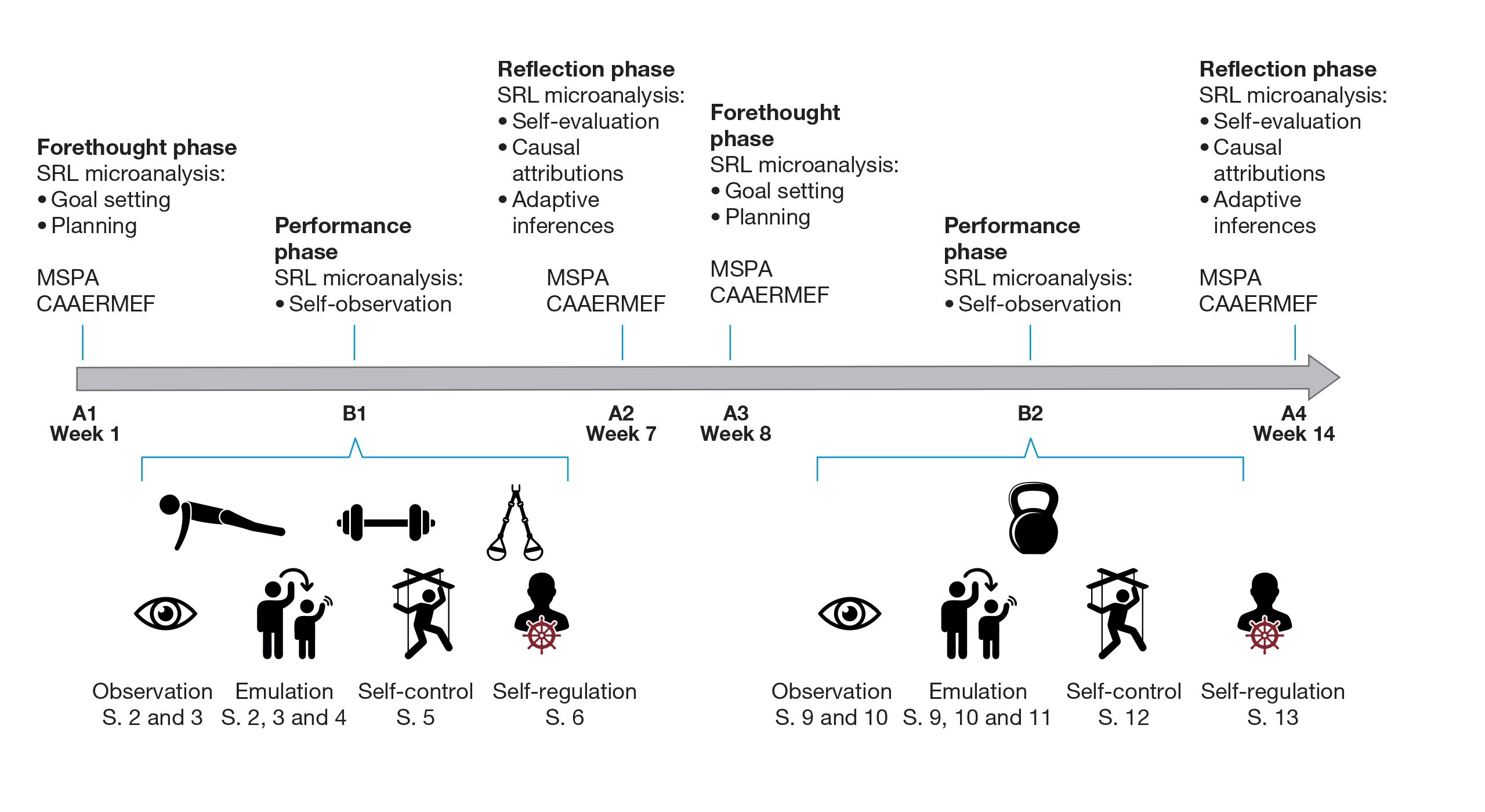
Note. MSPA = Muscle-strengthening physical activity; S = Session; SRL = Self-regulated learning; CAAERMEF = Self-Regulated Learning Questionnaire for Muscular Endurance Exercises in Physical Education.
Intervention Program
The “Self-Regulate Your Muscle Strengthening” intervention (phases B1 and B2 of the study; Table 2) was developed over 10 weeks, throughout 10 PE sessions (2 hours each), organized into two cycles of five sessions. The proposal combined explicit instruction (review of prior knowledge, presentation of content, initial practice, feedback, independent practice and periodic reviews (Rosenshine, 1983, cited in Metzler y Colquitt, 2021) with an approach aimed at developing self-regulation (Zimmerman y Kitsantas, 2005) in muscular endurance exercises (Kitsantas et al., 2018).
The sessions included four key components: (1) dynamic warm-up with cooperative games; (2) didactic progression adapted to SRL, from teacher-directed to more autonomous approaches, with modeling, guided practice, independent practice and autonomous routine design; (3) circuits, games and challenges for the development of muscular strength-endurance, using body weight, resistance bands, dumbbells and TRX in the first cycle, and kettlebells in the second cycle; and (4) relaxation with static stretching. Resources such as music, information cards and reciprocal teaching, self-evaluation and routine planning worksheets were used.
Data Analysis
To verify initial equivalence between the subgroups, pretest scores (A1) were compared using a one-way ANOVA, considering the three levels of MSPA (no practice, little practice and practice according to the WHO recommendations).
Quantitative data were obtained through the application of two mixed repeated-measures ANOVAs, where the MSPA subgroup acted as the between-participants factor and the evaluation time point (A1, A2, A3, A4) as the within-subject factor. The first model analyzed the evolution of the perceived MSPA, and the second analyzed the evolution of the total self-regulation score. Before interpreting the main models, the relevant statistical assumptions were checked, including normality and homogeneity of variances. The analyses were performed using jamovi software (version 2.6.26), and the results were presented as mean (M) and standard deviation (SD).
Qualitative data were collected through semi-structured interviews in the forethought (A1 and A3), performance (B1 and B2) and reflection (A2 and A4) phases, followingCleary y Russo (2024) SRL microanalysis approach. The responses were transcribed, coded dichotomously (1 = present, 0 = absent) and analyzed with NVivo 14 to examine the frequency and evolution of the self-regulatory subprocesses.
Chi-square tests were applied independently to identify significant differences in frequencies between the first cycle of the intervention (A1, B1 and A2) and the second (A3, B2 and A4), for the total sample (n = 61) and each of the three initial MSPA performance subgroups (no MSPA, n = 10; low MSPA, n = 28; and MSPA according to the WHO recommendations, n = 23). Previously, to meet statistical assumptions, the responses were regrouped into broad categories while respecting the self-regulatory subprocesses of the phases of Zimmerman & Moylan (2009) SRL model. In the forethought phase, the categories of the goal-setting subprocess were grouped into process, outcome or other goals; in strategic planning, they were grouped into technical planning and general planning. In the performance phase, the self-observation subprocess was coded into self-observation of external references or guidelines; self-observation of pace, load and physical sensations; self-observation of performance; and self-observation of technique. In the reflection phase, causal attributions were regrouped into causal attribution of effort and concentration, of planning and class context, technical causal attribution, and causal attribution to external factors; the categories of the self-regulatory subprocess of self-evaluation were regrouped into self-evaluation of internal or external factors; finally, the categories of the self-regulatory subprocess of adaptive inferences were regrouped into behavioral adaptive inferences in practice, adaptive inferences of personal factors or absence of inferences.
Results
The one-way ANOVA applied to the pretest scores (n = 61) revealed no significant differences between the three subgroups according to their initial level of MSPA (p > .05), indicating a homogeneous baseline.
The repeated-measures ANOVA with perceived MSPA as the dependent variable (Figure 2) showed significant differences between time points and groups (F = 6.19; p < .001). The no MSPA group increased from 0 in A1 to 2 (± 1.25) in A2, 2 (± 1.49) in A3 and 1.80 (± 1.48) in A4. The low MSPA group increased from 1.57 (± 0.50) in A1 to 2.71 (± 1.65) in A2, 2.54 (± 1.07) in A3 and 2.61 (± 1.20) in A4. The group with MSPA according to WHO recommendations went from 4 (± 0.90) in A1 to 3.78 (± 1.13) in A2, 4.04 (± 1.26) in A3 and 3.74 (± 1.29) in A4.
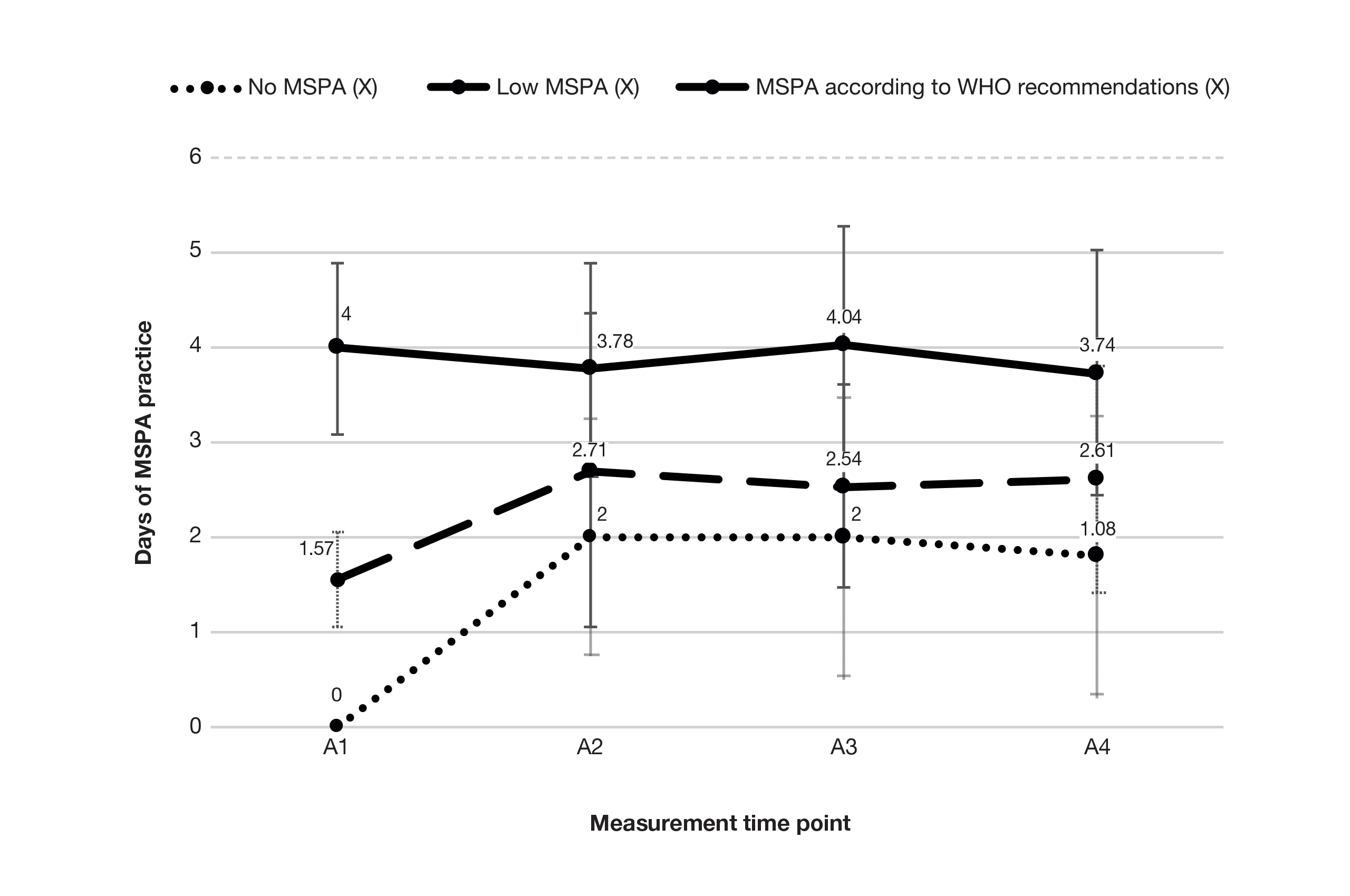
Note. A1 = pretest; A2 = posttest; A3 = follow-up 1; A4 = follow-up 2. Scores show the mean (0–7 scale) with error bars (± SD). Statistically significant differences were observed according to measurement time point and MSPA group (p < .001).
The repeated-measures ANOVA with the total self-regulation score as the dependent variable (Figure 3) reflected significant differences (F = 3.87; p = .005): the no MSPA group increased from 206 (± 37.3) in A1, to 234 (± 23.1) in A2, and from 234 (± 14.4) in A3, reaching 241 (± 17.2) in A4; the low MSPA group increased from 211 (± 28.9) in A1, to 232 (± 24.6) in A2, and from 236 (± 23.2) in A3, to 245 (± 28.3) in A4; finally, the high MSPA group evolved from 232 (± 23.7) in A1, to 241 (± 19.4) in A2, and from 244 (± 19.8) in A3 to 243 (± 20.6) in A4.
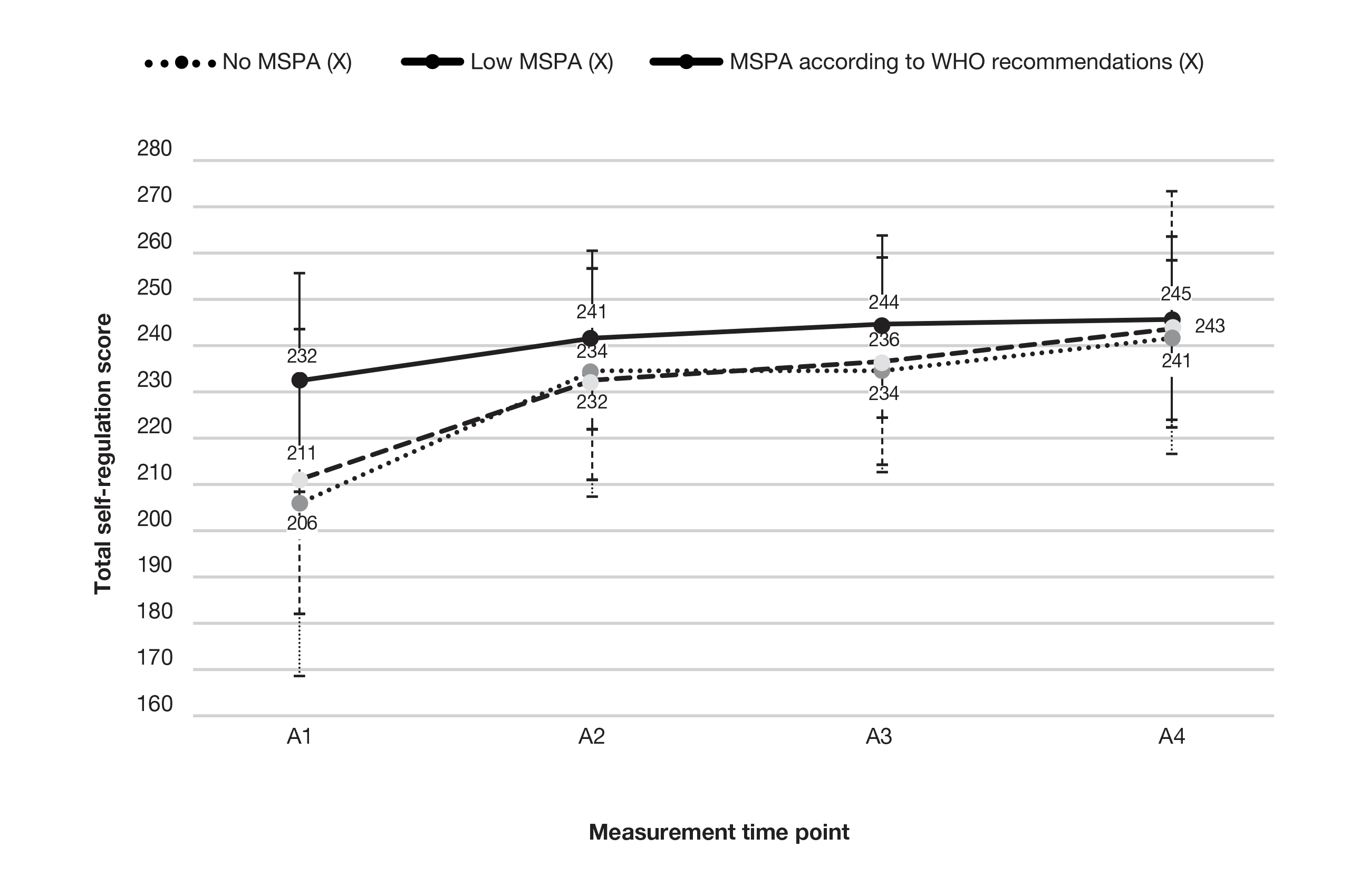
Note. A1 = pretest; A2 = posttest; A3 = follow-up 1; A4 = follow-up 2. Scores correspond to means from the repeated-measures ANOVA. Error bars represent the standard deviation. Significant differences were identified according to measurement time point and MSPA group (p < .005).
Table 3 shows the frequency of the self-regulatory subprocesses of the forethought phase (goal setting and planning) obtained at two time points of the intervention (phases A1 and A3), according to the subgroups of initial MSPA performance.
Table 3
Frequencies of goal-setting and strategic planning attributions in the forethought phases of the intervention (A1 and A3), according to initial MSPA performance subgroup .
No significant differences were observed in goal setting between phases A1 and A3 for the whole sample (χ²(2) = 1.45, p = .484, n = 82), nor in the subgroups: no MSPA: χ² = 1.23, p = .542; low MSPA: χ² = 0.66, p = .719; and MSPA according to WHO recommendations: χ² = 0.62, p = .732. No differences were found in strategic planning between phases A1 and A3 either, for the whole sample (χ²(1) = 0.089, p = .765), nor by subgroups: no MSPA: χ² = 2.49, p = .114; low MSPA: χ² = 0.354, p = .552; and MSPA according to WHO recommendations: χ² = 0.431, p = .212.
Table 4 shows the frequency of the self-regulatory subprocesses of the performance phase (self-observation or metacognitive monitoring) obtained at two time points of the intervention (phases B1 and B2), according to the subgroups of initial MSPA performance.
Table 4
Frequencies of self-observation attributions in the performance phases of the intervention (B1 and B2), according to initial MSPA performance subgroup
No significant differences were found in the observation categories for the whole sample (χ² total = 3.11, p = .375), nor by subgroups (no MSPA: χ² = 2.82, p = .420; low MSPA: χ² = 1.66, p = .646; MSPA according to WHO recommendations: χ² = 1.61, p = .657).
Table 5 shows the frequency of the self-regulatory subprocesses of the reflection phase (causal attributions, self-evaluation and adaptive inferences) obtained at two time points of the intervention (phases A2 and A4), according to the subgroups of initial MSPA performance.
Table 5
Frequencies of causal attributions, self-evaluation and adaptive inferences in the reflection phases of the intervention (A2 and A4), according to initial MSPA performance subgroup
Causal attributions showed no significant differences in the total sample (χ²(2) = 2.72, p = .257), nor in the no MSPA (χ²(2) = 1.11, p = .574) and low MSPA (χ²(2) = 2.14, p = .343) subgroups. In the subgroup with MSPA according to WHO recommendations, the analysis could not be performed due to the presence of empty cells.
No significant differences were found in self-evaluation in the total sample (χ²(1) = 0.90, p = .342), nor in the no MSPA (χ²(1) = 3.28, p = .070) and low MSPA (χ²(1) = 0.03, p = .853) subgroups. By contrast, the subgroup meeting WHO recommendations for MSPA showed a significant change (χ²(1) = 8.57, p = .003), shifting from self-evaluations focused on internal factors in A2 to evaluations based on external factors in A4.
Regarding adaptive inferences, no significant differences were observed either overall (χ²(2) = 3.13, p = .209) or in the no MSPA (χ²(2) = 0.42, p = .809) and MSPA according to WHO recommendations (χ²(2) = 3.47, p = .177) subgroups. In the low MSPA subgroup, it was not possible to perform the analysis due to the absence of cases in some categories.
Discussion
This study implemented and evaluated the impact of a pedagogical intervention based on the integration of explicit teaching and a sequential model of self-regulation, aimed at adolescents in PE. The main findings showed a significant improvement in the frequency of MSPA and in overall self-regulation, particularly in students with lower initial levels of MSPA. Qualitatively, only the group that met the WHO recommendations for MSPA showed changes in the reflection phase, changing its self-evaluations from internal factors to external factors.
These results derive from an intervention that combined a direct and systematic instructional sequence (Rosenshine, 1983, cited in Metzler y Colquitt, 2021) with the progressive development of self-regulation through Zimmerman y Kitsantas (2005) four-level model, applied to strength-endurance tasks (Kitsantas et al., 2018). This methodological integration facilitated the learning of key strength-endurance skills (such as technique, effort control and progression) through modeling, guided practice and autonomous performance (Wheldall et al., 2014), while promoting student autonomy through the metacognitive and motivational development inherent to the self-regulatory cycle (Zimmerman y Moylan, 2009).
The research design used (mixed-methods) made it possible to address in a complementary way both the quantitative effects of the intervention on self-regulation and MSPA practice, and the qualitative processes involved in how students experienced and made sense of their SRL in a real educational environment. In this regard, Kermarrec et al. (2022) state that mixed approaches to SRL in PE offer greater interpretive richness by integrating observable performance with the way students understand and value their learning.
These findings support the efficacy of the sequential model of self-regulation development (observation, emulation, self-control and self-regulation) proposed by Zimmerman y Kitsantas (2005) as an effective pedagogical approach to fostering the gradual development of SRL and its transfer to MSPA practice outside the school setting. In particular, the improvement observed in students with less initial MSPA experience supports the usefulness of scaffolding and direct instruction as key strategies for facilitating access to essential knowledge in PE, necessary for engaging in physically active lifestyles. As Cale y Harris (2018) note, without adequate knowledge and understanding, people are unlikely to be able to make informed decisions about PA or participate in it in a meaningful and sustainable way.
This evidence partially coincides with previous studies reporting benefits of the developmental model of SRL in the context of a PE class group, in which multiple skills and games are developed. In particular, the study by Susaki (2021) analyzed the effects of an intervention based on the sequential model of SRL on motor skills, learning strategies and self-efficacy, applied in PE classes focused on soccer-specific motor skills. It reported significant improvements in dribbling skills (p = .01, η² = .16) and evaluation strategies (p = .01) in university students with low initial performance. Likewise, the study by Sproule et al. (2017) evaluated the effect of an intervention, based on Zimmerman y Kitsantas (2005) 4-level model of self-regulation, in PE students in Taiwan, measuring changes in motivation, learning strategies and self-regulation. The intervention improved goal setting, and the application and monitoring of self-regulatory strategies, with variable effects according to prior experience, confirming the value of progressive and adapted interventions for strengthening self-regulation in PE.
Along similar lines, in the area of promoting PA habits, Calkins (2015) noted that the development of SRL significantly increased students’ use of self-regulatory strategies and improved their muscular endurance, underscoring the pedagogical value of integrating these strategies into the secondary PE curriculum. Along the same lines, the recent study byLi et al. (2023) showed that a PE course based on SRL produced significant improvements in all dimensions of physical literacy (cognition, skill, experience and behavior), reinforcing the value of this approach for promoting sustainable and autonomous PA habits in university students.
The study suggests that integrating two complete cycles of the self-regulatory process (forethought, performance and reflection phases) enhances the effect of the intervention on self-regulation and MSPA practice. These results coincide with Cleary et al. (2006), who showed a progressive improvement in motor performance when multiple phases were addressed, underscoring the greater effectiveness of programs that integrate them comprehensively.
Although no significant changes were observed in the overall frequency of the self-regulatory subprocesses between the two intervention cycles (A1, B1, A2 vs. A3, B2, A4), the subgroup that met the WHO recommendations for MSPA showed significant development in its self-evaluation (χ² = 8.57, p = .003), shifting from internal to comparative judgments. This pattern differs from that observed by Cleary et al. (2006), who found an increase in process-oriented self-evaluations in controlled settings. The differences could be attributed to contextual and methodological factors. Whereas the study by Cleary et al. (2006) focused on simple tasks such as free throws in basketball, this research was conducted in group PE classes with more complex activities such as the design of muscular endurance routines, which could explain a more contextualized, though less introspective, form of self-regulation.
This work is in line with the body of studies that implement instruction in PE grounded in the social-cognitive perspective of SRL, which emphasizes the dynamic interaction between cognitive, motivational and contextual processes that influence learning and PA practice (Hendrayana, 2010; Calkins, 2017; Kolovelonis & Goudas, 2014). This approach recognizes that the development of SRL in PE involves not only the acquisition of motor skills, but also the strengthening of metacognition, self-efficacy and students’ ability to plan, monitor and adjust their own learning in real and socially contextualized environments.
The study supports the efficacy of explicit teaching oriented toward the development of self-regulation for increasing MSPA practice in adolescents. It also expands the evidence on the effectiveness of the model proposed by Zimmerman & Kitsantas (2005), whose sequential progression in phases (observation, emulation, self-control and self-regulation) guided the intervention and favored improvements both in MSPA performance and in students’ active involvement in their learning process.
Regarding the limitations of the study, the absence of a control group should be highlighted, which suggests caution when generalizing the results. Future research should consider experimental designs with parallel groups, extend the follow-up period and further explore the contextual factors that influence the effectiveness of self-regulatory strategies, including the motivational climate in the classroom, the level of autonomy promoted by the teacher, or students’ socioeconomic characteristics. It would be relevant to compare this intervention with other active methodologies, such as cooperative learning, sport education or challenge-based learning, to assess their impact on self-regulation and muscle-strengthening habits. Furthermore, it is recommended to explore the potential of formative feedback and educational technologies (such as mobile applications or tutorial videos) as support for fostering self-regulation in the practice of strength-endurance exercises, both in school and out-of-school settings.
On the other hand, measurement of MSPA was based on weekly self-reports, which may be subject to biases such as social desirability or inaccurate recall. Although this limitation is relevant, there are currently no validated instruments that more precisely measure the frequency, intensity, duration or type of MSPA in adolescents (Bennie et al., 2022).
Conclusion
The pedagogical intervention, based on a structured combination of explicit instruction and a progressive model of self-regulation, proved effective in increasing muscle-strengthening habits and self-regulation capacity in adolescents within the PE context. This approach was particularly beneficial for students with lower initial MSPA practice, underscoring its potential to promote equity and adherence to PA through PE. Consequently, the integration of this hybrid approach (explicit instruction and progressive development of self-regulation) into PE programs is proposed as a viable strategy to foster student autonomy and sustainable strength-endurance habits beyond the school context.
References
[1] Barnett, L. M., Jerebine, A., Keegan, R., Watson-Mackie, K., Arundell, L., Ridgers, N. D., Salmon, J. & Dudley, D. (2023). Validity, Reliability, and Feasibility of Physical Literacy Assessments Designed for School Children: A Systematic Review. Sports Medicine, 53(10), 1905-1929. doi.org/10.1007/s40279-023-01867-4
[2] Bennie, J. A., Faulkner, G., & Smith, J. J. (2022). The epidemiology of muscle-strengthening activity among adolescents from 28 European countries. Scandinavian Journal of Public Health, 50(2), 295–302. doi.org/10.1177/14034948211031392
[3] Bujosa-Quetglas, G., Tirado-Ramos, M. Á., & Vidal-Conti, J. (2024). Diseño y validación del cuestionario de aprendizaje autorregulado para ejercicios de resistencia muscular en Educación Física. Journal of Sport and Health Research, 16(3), 469–486. doi.org/10.58727/jshr.105456
[4] Bujosa-Quetglas, G., Tirado-Ramos, M. Á., & Vidal-Conti, J. (2025). Preliminary effectiveness and acceptability of a pilot self-regulation intervention in resistance training exercises. Sportis. Scientific Technical Journal of School Sport, Physical Education and Psychomotricity, 11(4), 1–30. doi.org/10.17979/sportis.2025.11.4.11647
[5] Bull, F. C., Al-Ansari, S. S., Biddle, S., Borodulin, K., Buman, M. P., Cardon, G., Carty, C., Chaput, J.-P., Chastin, S., Chou, R., Dempsey, P. C., DiPietro, L., Ekelund, U., Firth, J., Friedenreich, C. M., Garcia, L., Gichu, M., Jago, R., Katzmarzyk, P. T., Lambert, E., Leitzmann, M., Milton, K., Ortega, F. B., Ranasinghe, C., Stamatakis, E., Tiedemann, A., Troiano, R. P., van der Ploeg, H. P., Wari, V., & Willumsen, J. F. (2020). World Health Organization 2020 guidelines on physical activity and sedentary behaviour. British Journal of Sports Medicine, 54(24), 1451–1462. doi.org/10.1136/bjsports-2020-102955
[6] Cale, L., & Harris, J. (2018). The Role of Knowledge and Understanding in Fostering Physical Literacy. Journal of Teaching in Physical Education, 37(3), 280–287. doi.org/10.1123/jtpe.2018-0134
[7] Calkins, N. D. (2015). The Impact of Self-Regulation Strategy Training on Secondary Physical Education Students’ Physical Fitness Performance. (Doctoral thesis, Seattle Pacific University). www.proquest.com/openview/b9f1fb6472098e0836323eb84043214d/1?pq-origsite=gscholar&cbl=18750
[8] Calkins, N. D. (2017). Self-Regulation Strategy Development as an Instructional Approach for Motor Skill Acquisition: Column Editor: Anthony Parish. Strategies, 30(5), 41–44. doi.org/10.1080/08924562.2017.1345262
[9] Cleary, T. J., & Zimmerman, B. J. (2001). Self-regulation Differences during Athletic Practice by Experts, Non-Experts, and Novices. Journal of applied sport psychology, 13(2), 185–206. doi.org/10.1080/104132001753149883
[10] Cleary, T. J., Zimmerman, B. J., & Keating, T. (2006). Training Physical Education Students to Self-regulate During Basketball Free Throw Practice. Research Quarterly for Exercise and sport, 77(2), 251–262. doi.org/10.1080/02701367.2006.10599358
[11] Cleary, T. J., Platten, P., & Nelson, A. (2008). Effectiveness of the Self-Regulation Empowerment Program With Urban High School Students. Journal of advanced academics, 20(1), 70–107. doi.org/10.4219/jaa-2008-866
[12] Cleary, T. J., & Russo, M. R. (2024). A multilevel framework for assessing self-regulated learning in school contexts: Innovations, challenges, and future directions. Psychology in the Schools, 61(1), 80–102. doi.org/10.1002/pits.23035
[13] Cope, E., & Cushion, C. (2020). A move towards reconceptualising direct instruction in sport coaching pedagogy. Impact, Journal of the Chartered College of Teaching, 10. my.chartered.college/impact_article/a-move-towards-reconceptualising-direct-instruction-in-sport-coaching-pedagogy/
[14] Ennis, C. D. (2015). Knowledge, transfer, and innovation in physical literacy curricula. Journal of sport and health science, 4(2), 119–124. doi.org/10.1016/j.jshs.2015.03.001
[15] Faigenbaum, A. D., & McFarland, J. E. (2023). Developing Resistance Training Skill Literacy in Youth. Journal of Physical Education, Recreation & Dance, 94(2), 5–10. doi.org/10.1080/07303084.2022.2146610
[16] Finger, J. D., Tafforeau, J., Gisle, L., Oja, L., Ziese, T., Thelen, J., Mensink, G.B.M. & Lange, C. (2015). Development of the European Health Interview Survey - Physical Activity Questionnaire (EHIS-PAQ) to monitor physical activity in the European Union. Archives of Public Health, 73, 1–11. dx.doi.org/10.1186/s13690-015-0110-z
[17] Gori, A., Diuk, B., & Feldman, D. (2022). The explicit teaching in current didactic discussion. Estudios Pedagógicos, 48(4), 377–396. doi.org/10.4067/s0718-07052022000400377
[18] Greene, J. A. (2018). Self-regulation in education. Routledge.
[19] Hendrayana, Y. (2010). The Basic Design of Physical Education Instructional Model Based on Self-Regulated Learning Approach. International Journal for Educational Studies, 3(1), 35–44.
[20] Kermarrec, G., Regaieg, G., & Clayton, R. (2022). Mixed-methods approaches to learning strategies and self-regulation in Physical Education: a literature review. Physical Education and Sport Pedagogy, 27(2), 172–185. doi.org/10.1080/17408989.2021.1999916
[21] Kitsantas, A., & Zimmerman, B. J. (2002). Comparing Self-Regulatory Processes Among Novice, Non-Expert, and Expert Volleyball Players: A Microanalytic Study. Journal of applied sport psychology, 14(2), 91–105. doi.org/10.1080/10413200252907761
[22] Kitsantas, A., Kolovelonis, A., Gorozidis, G. S., & Kosmidou, E. (2018). Connecting Self-regulated Learning and Performance with High School Instruction in Health and Physical Education. In M. DiBenedetto (Ed.), Connecting Self-regulated Learning and Performance with Instruction Across High School Content Areas (pp. 351–373). Springer, Cham. doi.org/10.1007/978-3-319-90928-8_12
[23] Kolovelonis, A., & Goudas, M. (2013). The development of self-regulated learning of motor and sport skills in physical education: A review. Hellenic Journal of Psychology, 10(3), 193–210.
[24] Kolovelonis, A., & Goudas, M. (2014). A Teaching Model in Physical Education Based on the Social Cognitive Perspective of Self-Regulated Learning. Inquiries in Sport & Physical Education, 12(1), 26–39.
[25] Li, K., Onyon, N., Choichareon, T., & Charoontham, O. (2023). Physical Education Course Based on Self-Regulated Learning to Improve Students’ Physical Literacy. International Journal of Sociologies and Anthropologies Science Reviews, 3(3), 143–152. doi.org/10.14456/jsasr.2023.42
[26] Losada, A., & Marmo, J. (2022). Classification of research methods in psychology. Psicología Unemi, 6(11), 13–31. doi.org/10.29076/issn.2602-8379vol6iss11.2022pp13-31p
[27] Metzler, M., & Colquitt, G. (2021). Instructional models for physical education (1st ed.). Routledge. doi.org/10.4324/9781003081098
[28] Robinson, K., Riley, N., Owen, K., Drew, R., Mavilidi, M. F., Hillman, C. H., Faigenbaum, A.D., García-Hermoso, A. & Lubans, D. R. (2023). Effects of Resistance Training on Academic Outcomes in School-Aged Youth: A Systematic Review and Meta-Analysis. Sports Medicine, 53(11), 2095–2109. doi.org/10.1007/s40279-023-01881-6
[29] Rosenshine, B. (1983). Teaching Functions in Instructional Programs. Elementary School Journal, 83(4). 335–350. doi.org/10.1086/461321
[30] Schunk, D. H., Journell, W., Alford, A., Watson, J., & Belter, M. (2018). Self-regulated Learning in the Social Studies Classroom. In M. DiBenedetto (Ed.), Connecting Self-regulated Learning and Performance with Instruction Across High School Content Areas (pp. 89–124). Springer, Cham. doi.org/10.1007/978-3-319-90928-8_4
[31] Siedentop, D. (1998). Aprender a enseñar la Educación Física. INDE PUBLICACIONES.
[32] Sproule, J., Lin, C. P., Martindale, R., & Morgan, K. (2017). Physical education in Taiwan: when students begin to take control. International Sport Studies, 39(1), 4–18. doi.org/10.30819/iss.39-1.02
[33] Susaki, Y. (2021). Self-regulated learning and motor skills: Effects of a physical education intervention program on Japanese college students. Journal of Physical Education and Sport, 21(6), 3593–3598. doi.org/10.7752/jpes.2021.06485
[34] Wheldall, K., Stephenson, J., & Carter, M. (2014). What is Direct Instruction? MUSEC Briefings,(39). researchers.mq.edu.au/en/publications/what-is-direct-instruction-2/
[35] Zimmerman, B. J., & Kitsantas, A. (2005). The hidden dimension of personal competence: Self-regulated learning and practice. In A. J. Elliot & C. S. Dweck (Eds.), Handbook of competence and motivation (pp. 509–526). The Guilford Press.
[36] Zimmerman, B. J., & Moylan, A. R. (2009). Self-regulation: Where Metacognition and Motivation Intersect. In D. J. Hacker, J. Dunlosky, & A. C. Graesser (Eds.), Handbook of Metacognition in Education (1st. ed., pp. 299–315). Routledge. doi.org/10.4324/9780203876428
[37] Zwolski, C., Quatman-Yates, C., & Paterno, M. V. (2017). Resistance Training in Youth: Laying the Foundation for Injury Prevention and Physical Literacy. Sports health, 9(5), 436–443. doi.org/10.1177/1941738117704153
ISSN: 2014-0983
Received: July 4, 2025
Accepted: January 29, 2026
Published: July 1, 2026
Editor: © Generalitat de Catalunya Departament de la Presidència Institut Nacional d’Educació Física de Catalunya (INEFC)
© Copyright Generalitat de Catalunya (INEFC). This article is available from url https://www.revista-apunts.com/. This work is licensed under a Creative Commons Attribution-NonCommercial-NoDerivatives 4.0 International License. The images or other third party material in this article are included in the article’s Creative Commons license, unless indicated otherwise in the credit line; if the material is not included under the Creative Commons license, users will need to obtain permission from the license holder to reproduce the material. To view a copy of this license, visit https://creativecommons.org/licenses/by-nc-nd/4.0/deed.en


