Teachers’ (De)motivating Styles in Physical Education from a Circumplex Approach: An Analysis of the Gap Between Theory and Practice
Khaled Omar Mohamad El Tassa

Rafael Burgueño
Álvaro Sicilia
*Corresponding author: Álvaro Sicilia-Camacho asicilia@ual.es
Cite this article
El Tassa, K. O. M., Burgueño, R., & Sicilia, Á. (2026). Teachers’ (de)motivating styles in physical education from a circumplex approach: An analysis of the gap between theory and practice. Apunts. Educación Física y Deportes, 165, 36-46. https://doi.org/10.5672/apunts.2014-0983.es.2026.165.04
Abstract
This theoretical article integrates Self-Determination Theory and the Circumplex Model to examine didactic interaction in physical education, questioning whether abstract constructs can delimit an inherently messy reality. The central aim is to evaluate the capacity of this bidimensional framework to organize dynamic and interpersonal teaching practices. The paper makes contributions in four key directions: (i) it identifies diffuse conceptual boundaries and overlaps between the eight proposed teaching approaches; (ii) it reveals critical perceptual discrepancies between teachers’ intentions and students’ experiences; (iii) it contrasts theory with practice by observing that reality manifests itself in asymmetric structures (oval or rhomboid) rather than perfect circles; and (iv) it proposes the model as a reflective framework for teachers to adjust their directiveness and support for basic psychological needs in a contextualized way. The study’s main contribution lies in moving beyond mere technical classification, offering a tool to understand how subtle variations in teacher behavior impact students’ motivation and learning. It is concluded that the circumplex model should not become a rigid system, but rather an essential heuristic tool for teacher training, facilitating a dynamic and sensitive calibration of didactic practice.
Introduction
In the educational context, the teaching style adopted by the teacher is a determining factor in promoting students’ motivation and learning, both in general education and, more specifically, in school physical education (PE) (Vasconcellos et al., 2020). PE teachers occupy a central position in the classroom in guiding students through their learning process (White et al., 2021). Research on teaching styles has had significant historical relevance in the field of PE, exemplified by the continuing influence of Muska Mosston’s Spectrum of Teaching Styles (see Spectrum Institute for Teaching and Learning, s.f.) since the mid-1960s (Mosston, 1966). This research tradition has highlighted the complexity of educational reality, underscoring the need to move beyond reductionist conceptions of styles as mere techniques (Sicilia-Camacho, 2001).
Teacher–student interaction in the classroom is the most concrete expression of pedagogical practice, where abstract constructs, such as teaching style, seek to address its inherent complexity (Sicilia-Camacho & Delgado-Noguera, 2002). Nevertheless, no classification system can capture this reality in its entirety. In this context, Self-Determination Theory (SDT) (Deci & Ryan, 1985; Ryan & Deci, 2017) and, more particularly, the Circumplex Model of (De)motivating Styles (Aelterman et al., 2019) emerge as robust theoretical models for analyzing this complex classroom interaction, highlighting the importance both of supporting basic psychological needs (BPN) and of teacher directiveness. However, the plurality of existing models and divergent interpretations between teachers and researchers hinder their coherent implementation in educational practice.
This limitation is not so much due to a theoretical weakness inherent to the SDT-based circumplex model as it is to the dynamic, contextual and interpersonal nature of didactic interaction, which defies any attempt at exhaustive delimitation. From this perspective, theoretical proposals should be understood as analytical frameworks that make it possible to describe teachers’ motivating tendencies and interaction patterns, rather than as rigid or mutually exclusive categories (Sicilia-Camacho, 2001). Consequently, although they constitute necessary theoretical models for interpreting educational reality, they inevitably simplify a complex, variable and contextualized teaching practice.
In light of SDT, the present theoretical study aims to analyze the complexity of didactic interaction in the PE classroom by integrating SDT and the circumplex model of (de)motivating styles. Through this analysis, it seeks to examine the capacity of this bidimensional framework to organize and identify teaching practices characterized by their dynamism and interpersonal nuance, questioning the extent to which these abstract constructs can delimit an educational reality that is, by nature, “messy.” This work aims to provide a mapping that highlights the gap between the model and the reality of interaction in the PE classroom. To this end, the study will identify the existence of diffuse conceptual boundaries between the eight teaching approaches, as well as the perception gap between the teacher’s didactic intentions and the student’s experiences. By showing that educational reality often manifests itself in structures that are not perfectly circular and in overlaps between adjacent styles, this work moves beyond mere theoretical classification to offer a reflective framework on the limited usefulness of the circumplex model for capturing classroom reality.
To address the objective, the theoretical assumptions of SDT are first reviewed, and then, based on empirical evidence, tensions, overlaps and discrepancies are highlighted. The paper concludes by discussing the implications for teacher training, didactic intervention and future lines of research in the field of PE.
Theoretical Foundations
Self-Determination Theory
SDT, formulated by Richard M. Ryan and Edward L. Deci (Deci & Ryan, 1985; Ryan & Deci, 2017), is a motivational macrotheory that emerged in the 1980s. A fundamental postulate of SDT is that all human activity takes place in a social context, such as a class (Ryan & Deci, 2017). Unlike theories that prioritize the quantity of motivation, SDT emphasizes its quality. In this regard, the theory distinguishes three qualities of motivation, located along a continuum of self-determination, according to the level of autonomy present in each one. At one end of this continuum would be autonomous motivation, which, as the prototype of human motivation, refers to the performance of a behavior guided by experiences based on enjoyment, curiosity and the search for new challenges, as well as by its alignment with the person’s system of values and goals, and by the recognition of the benefits it entails. In the central part would be controlled motivation, which implies that behavior is regulated by experiences based both on self-imposed pressure to improve self-esteem and avoid negative feelings, and on social pressure to obtain rewards or avoid punishments. At the opposite end, and in contrast to forms of autonomous and controlled motivation, would be amotivation, which reflects the absence of regulation and self-determination when undertaking a behavior.
SDT proposes a dual-process model based on the distinguishable perception between satisfaction and frustration of the BPN of autonomy, competence and relatedness (Vansteenkiste et al., 2020). Thus, satisfaction of the need for autonomy (feeling initiative and choice in one’s own actions), competence (feeling effectiveness and mastery in the activities performed), and relatedness (feeling connection and security in interpersonal relationships with others) would represent the heart of the bright side of human existence, fostering autonomous motivation. By contrast, frustration of the need for autonomy (feeling pressured and pushed toward unwanted directions), competence (feeling ineffective and clumsy when engaging in activities), and relatedness (feeling lonely and excluded in interpersonal interactions) would constitute the heart of the dark side, facilitating controlled motivation and amotivation. According to SDT, a person’s perception of the satisfaction and frustration of their BPN is formed from their interpretation of their social environment in general and, more specifically, of the combination of the styles of each socializing agent present in that environment.
Circumplex Model of (De)motivating Styles
The circumplex model represents a conceptual and methodological advance in the understanding of teachers’ motivating and demotivating styles (Aelterman et al., 2019). This perspective provides a more integrated and refined view of teachers’ classroom styles, moving beyond the traditional tendency to examine teaching styles (such as autonomy support, structure, control and chaos) categorically, through a black-and-white perspective based exclusively on their BPN-supportive or BPN-thwarting nature.
The circumplex model has substantially advanced the understanding of the effects of teaching styles by recognizing the need for a more integrative and detailed perspective that clarifies how the different styles relate to one another and allows for more precise differentiation. To this end, it uses a descriptive analytical strategy based on multidimensional scaling (Aelterman et al., 2019), which makes it possible to visualize the similarities and differences between various teaching practices in the PE classroom by placing them within a multidimensional structure. The underlying rationale is that teaching practices are not simply “supportive” or “thwarting” of students’ BPN, but also vary according to the level of teacher directiveness.
This multidimensional scaling analysis led Aelterman et al., (2019) to suggest that teachers’ styles could be optimally represented through a bidimensional configuration. The model defines each style not only in terms of the degree to which it supports or thwarts BPN, but also according to the degree of high or low directiveness that the teacher assumes in the classroom (Aelterman et al., 2019; Escriva-Boulley et al., 2021a). Figure 1 shows a graphical representation of the circumplex model and illustrates this structure with two perpendicular axes, making it possible to identify in an integrated way the degree of support for or thwarting of BPN and the level of teacher directiveness.
When observing Figure 1, the horizontal axis that crosses the circle (x-axis) reflects the teacher’s capacity to support or thwart students’ BPN. Within this axis, on the right-hand side (positive coordinates) would be the styles that support BPN (autonomy support and structure), while on the left-hand side of this axis (negative coordinates) the styles that thwart BPN are represented (control and chaos). It should be borne in mind that this axis reflects the degree of support or thwarting of BPN in general, regardless of the combination of the three needs that exist in each case. The vertical axis that crosses the circle (y-axis) represents teacher directiveness, that is, the degree to which teachers assume leadership or give students space to take the initiative in didactic interactions. In the upper coordinates would be teaching styles that imply low directiveness on the part of teachers (autonomy support and chaos), while in the lower coordinates would be teaching styles that imply high directiveness (structure and control).
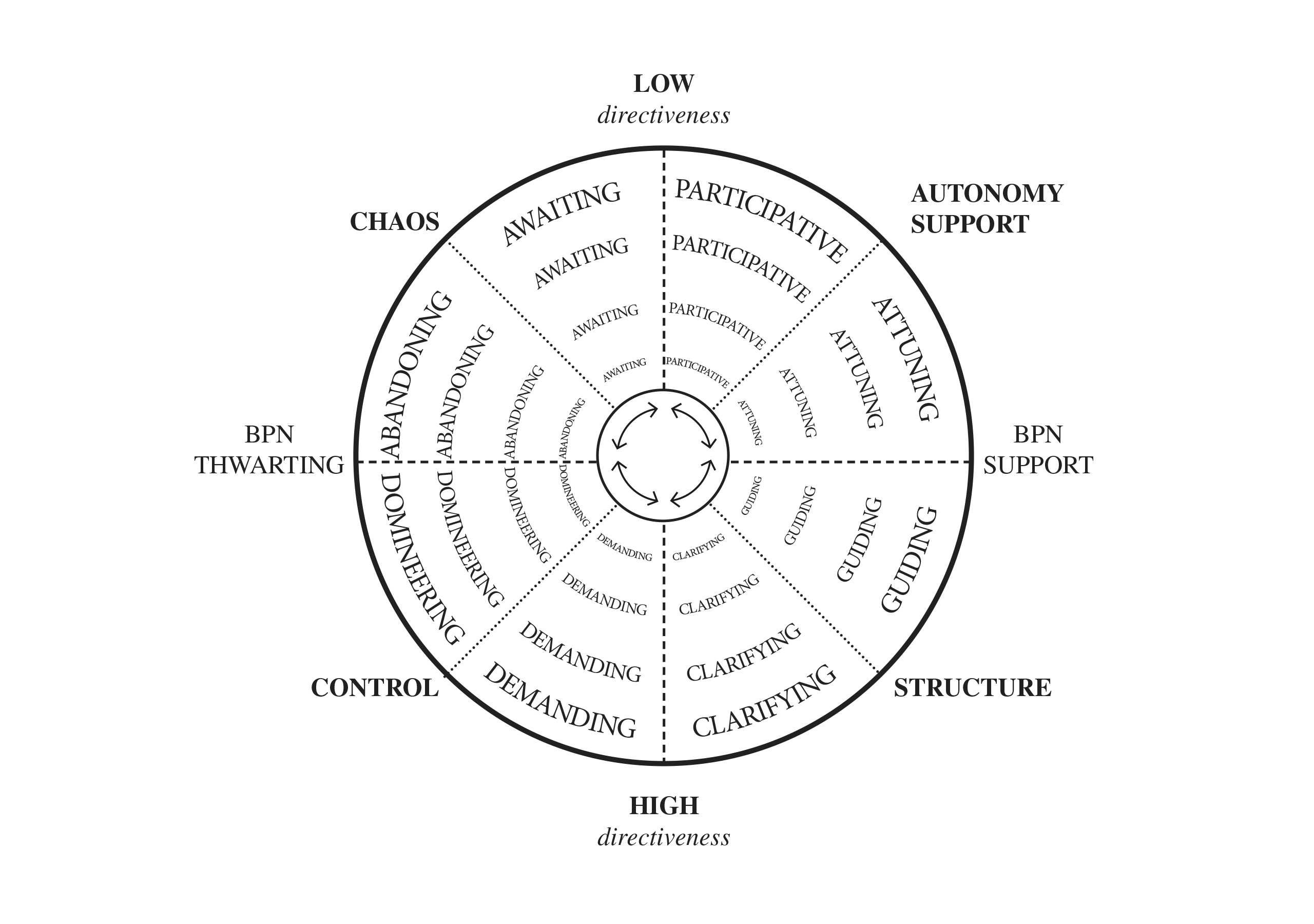
Source: Translated and adapted from Aelterman et al. (2019).
Note. BPN = basic psychological needs. The dashed contour lines mark the four main styles. The more discreet dotted lines subdivide each style into its two specific approaches, suggesting less rigid boundaries between the components of the same style. The curved double arrows in the center indicate possible transitions between the approaches that make up the same style, evidencing the dynamism of teaching practices and the difficulty of precisely delimiting the contours of each approach.
Considering the two axes described above, relative to the vertical plane, the model identifies autonomy support and structure as motivating styles, insofar as both are BPN-supportive in nature, but qualitatively different, the former (autonomy support) being low in directiveness and the latter (structure) highly directive (Aelterman et al., 2019). On the other hand, the model labels control and chaos as demotivating styles, given that both are BPN-thwarting in nature, but qualitatively different, in the sense that the former is high in directiveness and the latter is low in this dimension (Aelterman et al., 2019). In this way, the proposal is located in coordinates diametrically opposed to the autonomy-supportive and controlling styles and, on the other hand, to the structure and chaos styles.
Beyond the four teaching styles identified by the model, a key contribution of this approach is the identification of eight more precise subareas or approaches within the four broader styles (Aelterman et al., 2019). These approaches are articulated around the circular structure, allowing for a more refined understanding of teaching practices. The logic of the model proposes that, for example, not all autonomy-supportive practices are identical; some may be more related to structure, while others lean more toward chaos (Van Doren, 2025).
Considering the four main teachers’ (de)motivating styles, each could be addressed through two more specific teaching approaches, resulting in a total of eight. Table 1 presents each of the four teachers’ (de)motivating styles and their respective specific teaching approaches, defined on the basis of concrete teaching behaviors to facilitate their identification in the real context of the PE classroom.

Table 1
Teachers’ (de)motivating styles and their respective teaching approaches described in the circumplex model
The circumplex model makes an important contribution to previous proposals in SDT. First, it integrates different proposals in such a way that it provides a unified proposal of teaching styles previously studied in isolation or in less detail, offering a more precise conceptual description. Second, the model helps to understand, at least conceptually, how the different ways of approaching PE teaching may be related. Third, by defining forms of teaching as a continuum, the model aligns better with a complex view of classroom reality. Fourth, and in line with the previous point, the model makes it possible to name classroom reality and thus constitutes a conceptual tool for teacher training. Fifth, it establishes a coherent theoretical framework for classroom research into teacher behavior and its outcomes in student learning.
At a practical level, and within initial and continuing PE teacher training, the circumplex model can be used as a reflective tool that helps teachers identify habitual patterns of motivating interactions in the classroom, as well as analyze possible variations and shifts between motivating approaches, and become aware of how subtle variations, both in the degree of directiveness and in the promotion of BPN, can have a significant impact on students’ learning variables in PE (García-Cazorla et al., 2024a; Mayo-Rota et al., 2025).
Conceptual Delimitation and Assessment of Teaching Styles
To assess perceptions of teachers’ (de)motivating styles within the circumplex structure, Aelterman et al. (2019) developed the Situations in School questionnaire (SIS; Situations-In-School). This instrument, originally designed for secondary students and teachers, has been adapted to various contexts, including sport and higher education (Delrue et al., 2019; Vermote et al., 2020). In the specific context of PE, a modified version called SIS-PE, Situations-In-School-Physical Education; Escriva-Boulley et al., 2021a) was developed. It has been validated in various languages and contexts (Burgueño et al., 2024a; Escriva-Boulley et al., 2021a; Tilga et al., 2023), and showed a good level of reliability in the four (de)motivating styles, making it possible to measure the complex reality of teacher behavior in the PE classroom.
Studies based on SDT have documented the importance of teachers’ motivating and demotivating styles in students’ outcomes in PE (Vasconcellos et al., 2020; White et al., 2021). The results of these studies have shown that a motivating, highly structured and autonomy-supportive style is associated with positive outcomes such as autonomous motivation, engagement, learning and well-being (Vasconcellos et al., 2020; White et al., 2021). By contrast, a controlling style has been related to negative outcomes (Abós et al., 2022; Haerens et al., 2015; Vasconcellos et al., 2020), with the chaos style being the most harmful for students’ experiences in the PE classroom (Bouten et al., 2025; García-Cazorla et al., 2024b). Intervention research has shown that teachers can be trained to adopt both an autonomy-supportive and a structured style, which benefits both the teachers themselves and their students (Aelterman et al., 2014; García-Cazorla et al., 2026; Reeve, 2016). Teachers generally recognize the benefits of autonomy support, although they sometimes fear that too much support may generate chaos, and that too much structure may be perceived as control (Aelterman et al., 2014; Reeve, 2016).
The approaches of each teaching style—motivating and demotivating—are manifested in concrete behaviors. In particular, an autonomy-supportive teacher may ask for suggestions (participative), or help make tasks interesting (attuning). A structuring teacher may offer individual progressions (guiding), or communicate clear expectations (clarifying). A controlling teacher may use authoritarian language (demanding), or induce guilt (domineering). A chaotic teacher may leave students alone (abandoning), or wait for them to lead the class (awaiting) (Van Doren et al., 2025). By way of example, in the PE classroom, a guiding approach may be put into practice when the teacher adapts the learning progressions of a specific activity to different levels of student competence throughout a learning unit, supporting competence satisfaction. By contrast, a demanding approach may be implemented when the teacher imposes a strict way of completing the activity in question, with little room for students to make decisions, especially in situations of motor competence assessment, which increases the teacher’s controlling didactic tone.
The circumplex model provides a detailed view of teacher behavior, which plays an important role in students’ experiences (Escriva-Boulley et al., 2021a). However, research indicates that not all motivating styles nurture BPN to the same extent, nor do all demotivating styles produce a similar effect of BPN frustration (Aelterman et al., 2019; Vansteenkiste et al., 2019). Specifically, the attuning and guiding approaches are theorized to be better representatives of BPN support, while the participative and clarifying approaches are hypothesized to facilitate BPN (Burgueño et al., 2024a), in the sense that both approaches create the necessary conditions for students to perceive that satisfaction of their BPN is supported (Aelterman et al., 2019; Vansteenkiste et al., 2019). On the other hand, the domineering and abandoning approaches are believed to thwart students’ BPN, while the demanding and awaiting approaches undermine them (Burgueño et al., 2024a), since, although they do not directly thwart them, they do hinder and obstruct the potential support of these needs (Aelterman et al., 2019; Vansteenkiste et al., 2019).
In general terms, the empirical data support, among students, the theorized relationships between teachers’ (de)motivating teaching approaches and the perception of their BPN in the PE classroom (Burgueño et al., 2024a; Diloy-Peña et al., 2024b, 2025, 2026). The autonomy-supportive and structuring approaches are related to students’ BPN satisfaction, with a stronger association for the attuning and guiding approaches than for the participative and clarifying approaches. On the other hand, controlling and chaotic approaches are associated with BPN frustration, with a stronger relationship for the domineering and abandoning approaches than for the demanding and awaiting approaches. Nevertheless, the distinctive role played by the demanding approach in PE class should be highlighted, as it may also be positively associated with students’ competence satisfaction in the short term (Diloy-Peña et al., 2024b, 2025). This could explain why the teacher adopts a tunnel perspective when introducing the task; that is, the teacher limits the way to perform it successfully to such an extent that it helps students feel that they are performing it well. However, as a counterpart, this entails a cost to their autonomy (Vansteenkiste et al., 2019). In contrast with the hypothesized relationships between teaching approaches and BPN experiences, one line of research suggests that the clarifying and awaiting approaches could, in some way, represent a type of neutral approach insofar as they have no relationship with either perception of BPN in the eyes of PE students (Diloy-Peña et al., 2026; Van Doren et al., 2025). For PE teachers, the growing evidence base indicates that teachers’ use of (de)motivating styles in the PE classroom is conditioned by their perception of their own BPN at work (Burgueño et al., 2024a; García-Cazorla et al., 2025). In general, teachers’ BPN satisfaction is associated with the use of the four motivating approaches in the classroom, just as frustration of their BPN is linked to the implementation of the four demotivating approaches in the PE classroom (García-Cazorla et al., 2025). It is also worth noting that teachers’ use of the demanding approach was preceded not only by frustration of their BPN, but also by satisfaction of their BPN (Burgueño et al., 2024a).
The circumplex model thus seeks to identify which autonomy-supportive or structuring practices could come close to more demotivating approaches, as well as to detect which rigorously controlling practices could come close to more motivating approaches. This offers clear clues as to how teachers can modify and calibrate their classroom strategies to obtain optimal results with groups of students with different characteristics (Van Doren, 2025; Vansteenkiste et al., 2019). This perspective highlights that didactic intervention should not be understood as the implementation of “pure” (de)motivating styles, but rather as a dynamic and contextualized calibration of teaching practices throughout both the class and the learning units, and according to the characteristics of the group (García-Cazorla et al., 2026; Ocete et al., 2025). In this regard, the need to combine autonomy-supportive and structuring styles in teaching in a balanced way is highlighted, avoiding both excessively controlling practices and chaotic practices, characterized by a lack of guidance or teacher involvement (Burgueño et al., 2024b).
Critical Analysis
From Theory to Practice: Problems, Criticisms and Tensions
Despite the theoretical and methodological advances contributed by the circumplex model, there is an inherent tension between theoretical abstraction and the complexity of pedagogical practice. Theoretical models are abstract constructs that represent ideal extremes, which may hinder their application to the multifaceted reality of the classroom (Sicilia-Camacho & Delgado-Noguera, 2002). The diversity of styles adopted by teachers, influenced by variables such as students’ profile, teachers’ beliefs, the school environment and resources, can generate confusion in didactic practice. Thus, despite the theoretical coherence presented by the circumplex model, some limitations should be highlighted that evidence the discrepancy between theoretical models and classroom complexity.
Diffuse boundaries and collapse between approaches
A central problem in the circumplex model seems to lie in the difficulty of clearly conceptualizing and empirically delimiting the four teaching styles and, especially, the eight approaches, both for teachers and for students (Van Doren, 2025). Although the theory suggests a “thin line” between adjacent teaching approaches (García-Cazorla et al., 2026), the empirical evidence shows an inherent difficulty in maintaining clear separations in real practice in the PE classroom.
Several multidimensional scaling studies have failed to reproduce a perfect circle, instead producing oval or rhomboid structures (Burgueño et al., 2024a; Escriva-Boulley et al., 2021a). These alternative structures reflect asymmetric patterns in the organization of styles, possibly conditioned by the degree of perceived directiveness and by its impact on BPN satisfaction or frustration. Moreover, certain approaches show unexpected correlations: for example, from the students’ perspective, the attuning approach is more closely related to the clarifying approach (within the structure style) than to the participative approach (within the autonomy-supportive style) (Burgueño et al., 2024a; Vansteenkiste et al., 2019). Similarly, in pre-service or in-service teachers, the domineering approach (within the control style) shows stronger associations with the abandoning approach (within the chaos style) than with the demanding approach (within the control style), which blurs the expected boundaries between styles. This evidence points to conceptual overlap between adjacent approaches and calls into question the discriminant validity of the model in its current form.
When observing the conceptualization of the approaches, it can be seen that some of them appear to overlap with one another. For example, the attuning and guiding approaches are often perceived very similarly, which makes them difficult to differentiate statistically (Van Doren et al., 2025). The thin line between styles becomes evident when observing the gray area formed in the transition between need support and need thwarting. Approaches that act as facilitators (e.g., participative, clarifying) can easily shift toward deprivation and thwarting (e.g., awaiting, demanding) if the teacher does not calibrate their intervention well (Van Doren, 2025). For example, offering too much freedom (which can be framed as a participative approach) may be interpreted by students as a lack of guidance or negligence (more in line with the chaos style and the awaiting approach) if they do not have sufficient competence to decide.
Discrepancies in the perception of the different actors
Another of the main tensions in the circumplex model is the perception gap between what the teacher believes they are doing and what students experience. Thus, perceptual discrepancies between the different educational actors add further tension to the connection between the theoretical model and practical reality (Coterón et al., 2025; Van Doren et al., 2026).
What a teacher considers a structured practice may be perceived by students as a form of control (Van Doren, 2025). For example, a teacher may feel that they are being clarifying by establishing strict rules for the proper functioning of the class, but students may perceive this as a demanding approach (García-González et al., 2023). This can be interpreted based on the ambiguous role that demandingness may have, given that the demanding approach (control) presents a certain paradox. In certain contexts, such as the Spanish context, it has been observed that it may be positively associated with competence satisfaction in the short term, since students interpret high directiveness as a sign of teacher commitment and concern for their learning, although this entails a cost to their autonomy (Tilga et al., 2023; Van Doren et al., 2026). Along these lines, it should be recalled that some studies have suggested that the clarifying and awaiting approaches sometimes function as neutral approaches that predict neither BPN satisfaction nor BPN frustration, which calls into question their direct motivational weight in the model (Diloy-Peña et al., 2026; Tilga et al., 2023).
Differences in the way teachers and students understand classroom reality constitute a limitation faced by any proposal of teaching styles. This happens because, as Sicilia-Camacho & Brown (2008) had already argued, while the teacher or the curriculum may want to follow or propose a variety of styles, classroom reality shows that students are not passive recipients of a universal learning framework, but often show resistance or negotiate teaching styles based on what is familiar or normal to them. The gap occurs because theories that seek to predict classroom reality often bracket out interpersonal interaction and students’ capacity to influence class dynamics, which causes theoretical prescriptions to move away from what actually happens in everyday classroom practice.
The teacher as a flesh-and-blood subject. Pressures and personal well-being
Theoretical teaching models, such as the circumplex model, which attempt to reflect classroom reality, often ignore that the teacher’s style is the result of an ecosystem of pressures. Along these lines, it should be recalled that research has emphasized that a teacher’s capacity to be motivating depends on the satisfaction of their own BPN at work (Burgueño et al., 2024a; García-Cazorla et al., 2025). If teachers feel frustrated at work, whether due to a lack of resources or institutional support, they are much more likely to resort to controlling and chaotic styles (Escriva-Boulley et al., 2021b; Franco et al., 2025). It should not be overlooked that, although teachers may have theoretical knowledge about active methodologies and believe in them, they may come to adopt traditional (reproductive) approaches due to a lack of time, limitations in working with large groups, or feeling some pressure to maintain authority in the face of disruptive student behaviors (Escriva-Boulley et al., 2021b; Franco et al., 2025).
Methodological and Assessment Limitations of Teacher Behavior
Finally, in addition to the limitations noted above, it should be borne in mind that, in most cases, assessment of reality is subordinated to psychometric instruments such as the SIS-PE. This raises certain criticisms about the model’s capacity to represent classroom reality for several reasons.
First, teachers’ self-reports are often biased, so what is probably considered “good teaching” is that in which they report more autonomy support and less control than their students actually perceive (Coterón et al., 2025; Van Doren et al., 2026). This distortion makes it difficult to interpret their true practices or beliefs accurately. Second, there is a certain quantitative reductionism, given that existing instruments quantify behaviors but render invisible the creativity, adaptability and affective nuance of didactic interaction. Finally, most studies on the circumplex model proposal are limited to the perception of only one of the parties. It is evident that this can only represent one segment of reality, and progress is needed to obtain measures from different agents. In this regard, future research could integrate objective observations (such as the SIS-PE-Coder) to contrast teaching intentions with experiences (García-Cazorla et al., 2026; Van Doren et al., 2025).
Conclusions and Future Perspectives
The circumplex model has become established as a robust and very useful theoretical framework for unraveling the complexity of interactions in the PE classroom (Aelterman et al., 2019; White et al., 2021). By integrating the dimensions of both BPN support and teacher directiveness, this model allows for a detailed understanding of eight teaching approaches, moving beyond traditional categorical black-and-white views (Burgueño et al., 2024a). The evidence suggests that, while autonomy-supportive and structuring styles activate the bright side of motivation, the chaos, style, especially through the abandoning approach, emerges as the dark or most harmful side for students’ BPN satisfaction, sometimes exceeding the negative impact of the controlling style. Nevertheless, the role of the demandingapproach (one of the controlling style approaches) reveals a relevant paradox: its high directiveness may be interpreted by students as a sign of teacher commitment and be associated with competence satisfaction in the short term, although the risk of frustrating autonomy persists (Diloy-Peña et al., 2024a).
The transition from theory to practice shows that the teacher is a flesh-and-blood subject whose style is intrinsically linked to their own well-being. Research confirms that a teacher’s capacity to be motivating depends on the satisfaction of their own BPN in the school environment. Thus, if teachers feel frustrated by institutional pressures or a lack of resources, they are more likely to drift into controlling or chaotic styles. Continuing education programs such as MotivaDosEF (García-Cazorla et al., 2026) have shown that it is possible to transform these tendencies, generating bidirectional benefits that improve both the student experience and teachers’ performance and job satisfaction. These findings reinforce the idea that teacher training should not be limited to the transmission of techniques, but should foster awareness of the changing action of their practice.
Despite the robustness of the model, the present work has highlighted methodological tensions and perception gaps that will shape the future research agenda. There is a critical disconnect between the teacher’s intention and the student’s experience, where what the former designs as structure may be experienced by the latter as coercive control. Furthermore, classroom reality often overflows the geometry of the model, manifesting itself in empirical oval or rhomboid structures rather than perfect circles, due to the overlap of adjacent approaches such as attuning and guiding. For this reason, it is essential that future studies move beyond self-reports and use a type of methodological triangulation, integrating subjectivities and objective observations (such as the SIS-PE-Coder) to capture the transactional nature of teaching, in which students are not passive recipients, but agents who also shape the teacher’s style.
In conclusion, based on the arguments presented in this theoretical review, we understand that the circumplex model should be used fundamentally as a heuristic tool and as a framework for professional reflection. Its value lies in providing a map for teachers to identify their interaction patterns and learn to move toward more nurturing approaches, recognizing that pedagogical effectiveness depends on implementation that is contextualized and sensitive to the needs of the group. Research should continue to explore these reciprocal dynamics and the weight of cultural factors to close the gap between theoretical prescriptions and the messy but vibrant reality of the PE classroom.
Acknowledgment
This work was funded by the Conselho Nacional de Desenvolvimento Científico e Tecnológico (CNPq), Brazil, under the international cooperation research grant modality (402936/2024-8), for the development of the project entitled “Self-Determination Theory and Physical Education: Relationships between teaching styles and motivation in the construction of teaching and learning environments in regular and special schools”.
References
[1] Abós, Á., Burgueño, R., García-González, L., & Sevil-Serrano, J. (2022). Influence of internal and external controlling teaching behaviors on students’ motivational outcomes in physical education: Is there a gender difference? Journal of Teaching in Physical Education, 41(3), 502–512. doi.org/10.1123/jtpe.2020-0316
[2] Aelterman, N., Vansteenkiste, M., Haerens, L., Soenens, B., Fontaine, J. R. J., & Reeve, J. (2019). Toward an integrative and fine-grained insight in motivating and demotivating teaching styles: The merits of a circumplex approach. Journal of Educational Psychology, 111(3), 497–521. doi.org/10.1037/edu0000293
[3] Aelterman, N., Vansteenkiste, M., Van den Berghe, L., De Meyer, J., & Haerens, L. (2014). Fostering a need-supportive teaching style: intervention effects on physical education teachers’ beliefs and teaching behaviors. Journal of Sport and Exercise Psychology, 36(6), 595–609. doi.org/10.1123/jsep.2013-0229
[4] Bouten, A., Diloy-Peña, S., Abós, Á., García-González, L., Haerens, L., & De Cocker, K. (2025). Chaotic (laissez-faire) teaching: The most harmful style for students’ psychological needs? International Journal of Educational Research, 133, 102717. doi.org/10.1016/j.ijer.2025.102717
[5] Burgueño, R., Abós, Á., Sevil-Serrano, J., Haerens, L., De Cocker, K., & García-González, L. (2024a). A circumplex approach to (de)motivating styles in physical education: Situations-In-School–Physical Education Questionnaire in Spanish students, pre-service, and in-service teachers. Measurement in Physical Education and Exercise Science, 28(1), 86–108. doi.org/10.1080/1091367X.2023.2248098
[6] Burgueño, R., García-González, L., Abós, Á., & Sevil-Serrano, J. (2024b). Students’ motivational experiences across profiles of perceived need-supportive and need-thwarting teaching behaviors in physical education. Physical Education and Sport Pedagogy, 29(1), 82–96. doi.org/10.1080/17408989.2022.2028757
[7] Coterón, J., González-Peño, A., Martín-Hoz, L., & Franco, E. (2025). Predicting students ’ engagement through (de) motivating teaching styles: A multi- perspective pilot approach. The Journal of Educational Research, 118(3), 243–256. doi.org/10.1080/00220671.2025.2464010
[8] Deci, E. L., & Ryan, R. M. (1985). Intrinsic motivation and self-determination in human behavior. Springer. doi.org/10.1007/978-1-4899-2271-7
[9] Delrue, J., Reynders, B., Broek, G. Vande, Aelterman, N., De Backer, M., Decroos, S., De Muynck, G. J., Fontaine, J., Fransen, K., van Puyenbroeck, S., Haerens, L., & Vansteenkiste, M. (2019). Adopting a helicopter-perspective towards motivating and demotivating coaching: A circumplex approach. Psychology of Sport and Exercise, 40, 110–126. doi.org/10.1016/j.psychsport.2018.08.008
[10] Diloy-Peña, S., Abós, Á., García-Cazorla, J., García-González, L., & Sevil-Serrano, J. (2024a). Students’ perceptions of physical education teachers’ (de)motivating styles via the circumplex approach: Differences by gender, grade level, experiences, intention to be active, and learning. European Physical Education Review, 30(4), 563–583. doi.org/10.1177/1356336X241229353
[11] Diloy-Peña, S., García-González, L., Burgueño, R., Tilga, H., Koka, A., & Abós, Á. (2024b). A cross-cultural examination of the role of (de-)motivating teaching styles in predicting students’ basic psychological needs in Physical Education: A circumplex approach. Journal of Teaching in Physical Education, 44(22), 272–284. doi.org/10.1123/jtpe.2023-0036
[12] Diloy-Peña, S., García-González, L., Haerens, L., De Cocker, K., Burgueño, R., & Abós, Á. (2025). Exploring (de-)motivating teaching profiles from a fine-grained directiveness approach: Differences in students’ need-based experiences. Teaching and Teacher Education, 159(September 2024). doi.org/10.1016/j.tate.2025.105003
[13] Diloy-Peña, S., García-González, L., Tilga, H., Koka, A., Burgueño, R., & Abós, Á. (2026). Relationships between (de-)motivating teaching approaches with students’ need-based experiences and affective outcomes in physical education: a circumplex approach. Physical Education and Sport Pedagogy, 8989, 1–26. doi.org/10.1080/17408989.2026.2612970
[14] Escriva-Boulley, G., Guillet-Descas, E., Aelterman, N., Vansteenkiste, M., Van Doren, N., Lentillon-Kaestner, V., & Haerens, L. (2021a). Adopting the situation in school questionnaire to examine physical education teachers’ motivating and demotivating styles using a circumplex approach. International Journal of Environmental Research and Public Health, 18(14). doi.org/10.3390/ijerph18147342
[15] Escriva-Boulley, G., Haerens, L., Tessier, D., & Sarrazin, P. (2021b). Antecedents of primary school teachers’ need-supportive and need-thwarting styles in physical education. European Physical Education Review, 27(4), 961–980. doi.org/10.1177/1356336X211004627
[16] Franco, E., Coterón, J., & Spray, C. (2025). Antecedents of teachers’ motivational behaviours in physical education: a scoping review utilising achievement goal and self-determination theory perspectives. International Review of Sport and Exercise Psychology, 18(2), 1123–1162. doi.org/10.1080/1750984X.2024.2366835
[17] García-Cazorla, J., Diloy-Peña, S., Mayo-Rota, C., García-González, L., & Abós, Á. (2024a). How many Physical Education hours do students desire? It depends on the (de-)motivating teaching style perceived. Apunts. Educacion Fisica y Deportes, 156, 30–38. doi.org/10.5672/apunts.2014-0983.es.(2024/2).156.04
[18] García-Cazorla, J., García-González, L., Burgueño, R., Diloy-Peña, S., & Abós, Á. (2025). What factors are associated with physical education teachers’ (de)motivating teaching style? A circumplex approach. European Physical Education Review, 31(1), 87–108. doi.org/10.1177/1356336X241248262
[19] García-Cazorla, J., García-González, L., Sevil-Serrano, J., Mayo-Rota, C., Villafaña-Samper, Z., & Abós, Á. (2026). Transforming Physical Education teaching through “MotivaDosEF”: A circumplex model-based training program with benefits for teachers and students. Teaching and Teacher Education, 172(April), 105399. doi.org/10.1016/j.tate.2026.105399
[20] García-Cazorla, J., Sevil-Serrano, J., García-González, L., & Abós, Á. (2024b). A motivational training program for secondary physical education teachers based on the circumplex model: a study protocol of a randomised controlled trial. Frontiers in Public Health, 12(August), 1–12. doi.org/10.3389/fpubh.2024.1461630
[21] García-González, L., Haerens, L., Abós, Á., Sevil-Serrano, J., & Burgueño, R. (2023). Is high teacher directiveness always negative? Associations with students’ motivational outcomes in physical education. Teaching and Teacher Education, 132(October), 104216. doi.org/10.1016/j.tate.2023.104216
[22] Haerens, L., Aelterman, N., Vansteenkiste, M., Soenens, B., & Van Petegem, S. (2015). Do perceived autonomy-supportive and controlling teaching relate to physical education students’ motivational experiences through unique pathways? Distinguishing between the bright and dark side of motivation. Psychology of Sport and Exercise, 16(3), 26–36. doi.org/10.1016/j.psychsport.2014.08.013
[23] Mayo-Rota, C., Abós, Á., García-Cazorla, J., Villafaña-Samper, Z., & García-González, L. (2025). Study protocol of a non-randomized controlled trial on a circumplex model-based motivational training program for pre-service physical education teachers. Frontiers in Public Health, 13(July), 1–11. doi.org/10.3389/fpubh.2025.1611556
[24] Mosston, M. (1966) Teaching physical education. Merrill.
[25] Mosston, M., & Sara Ashworth. (2008). Teaching physical education creatively. Spectrum Institute for Teaching and Learning. doi.org/10.4324/9781315780351
[26] Ocete, C., González-Peño, A., Gutiérrez-Suárez, A., & Franco, E. (2025). The effects of an SDT-based training program on teaching styles adapted to inclusive Physical Education. Does previous contact with students with intellectual disabilities matter? Espiral. Cuadernos Del Profesorado, 18(37), 1–14. doi.org/10.25115/ecp.v18i37.10242
[27] Reeve, J. (2016). Autonomy-Supportive Teaching: what it is, how to do it. In Liu, W., Wang, J., Ryan, R. (Eds.), Building Autonomous Learners. (pp. 129–152). Springer. doi.org/10.1007/978-981-287-630-0_7
[28] Ryan, R. M., & Deci, E. L. (2017). Self-determination theory. Basic psychological needs in motivation, development and wellness. Guilford Press. doi.org/10.7202/1041847ar
[29] Sicilia-Camacho, Á. (2001). La investigacion de los estilos de enseñanza en la educacion fisica: un viejo tema para un nuevo siglo.Wanceulen.
[30] Sicilia-Camacho, A., & Brown, D. (2008). Revisiting the paradigm shift from the versus to the non-versus notion of Mosston’s Spectrum of teaching styles in physical education pedagogy: a critical pedagogical perspective . Physical Education & Sport Pedagogy, 13(1), 85–108. doi.org/10.1080/17408980701345626
[31] Sicilia-Camacho, Á., & Delgado-Noguera, M. Á. (2002). Educación física y estilos de enseñanza: análisis de la participación del alumnado desde un modelo socio-cultural del conocimiento escolar.INDE.
[32] Spectrum Institute for Teaching and Learning. (s.f.). Spectrum of TeachingStyles. spectrumofteachingstyles.org/
[33] Tilga, H., Vahtra, K., & Koka, A. (2023). The role of teachers (de-)motivational styles on students’ autonomous motivation in physical education and leisure time. Baltic Journal of Health and Physical Activity, 15(4), 1–13. doi.org/10.29359/bjhpa.15.4.05
[34] Van Doren, N. (2025). The circumplex model of need-supportive and need-thwarting teaching: A guide for research and practice. E-Motion. Revista de Educación, Motricidad e Investigación, 25, 73–85. doi.org/10.33776/EUHU/remo.vi25.9354
[35] Van Doren, N., De Cocker, K., Flamant, N., Compernolle, S., Vanderlinde, R., & Haerens, L. (2025). Observing physical education teachers’ need-supportive and need-thwarting styles using a circumplex approach: how does it relate to student outcomes? Physical Education and Sport Pedagogy, 30(4), 365–389. doi.org/10.1080/17408989.2023.2230256
[36] Van Doren, N., Haerens, L., Reeve, J., Jang, H.-R., Bouten, A., Compernolle, S., & De Cocker, K. (2026). Who influences whom: Do students’ perceptions of physical education teacher’s (de)motivating styles shape student motivation, vice versa, or both? Physical Education and Sport Pedagogy. 1–20. doi.org/10.1080/17408989.2026.2616627
[37] Vansteenkiste, M., Aelterman, N., Haerens, L., & Soenens, B. (2019). Seeking stability in stormy educational times: A need-based perspective on (de)motivating teaching grounded in self-determination theory. Advances in Motivation and Achievement, 20, 53–80. doi.org/10.1108/S0749-742320190000020004
[38] Vansteenkiste, M., Ryan, R. M., & Soenens, B. (2020). Basic psychological need theory: Advancements, critical themes, and future directions. Motivation and Emotion, 44(1), 1–31. doi.org/10.1007/s11031-019-09818-1
[39] Vasconcellos, D., Parker, P. D., Hilland, T., Cinelli, R., Owen, K. B., Kapsal, N., Lee, J., Antczak, D., Ntoumanis, N., Ryan, R. M., & Lonsdale, C. (2020). Self-Determination theory applied to physical education: A systematic review and meta-analysis. Journal of Educational Psychology, 112(7), 1444–1469. doi.org/10.1037/edu0000420
[40] Vermote, B., Aelterman, N., Beyers, W., Aper, L., Buysschaert, F., & Vansteenkiste, M. (2020). The role of teachers’ motivation and mindsets in predicting a (de)motivating teaching style in higher education: A circumplex approach. Motivation and Emotion, 44(2), 270–294. doi.org/10.1007/S11031-020-09827-5
[41] White, R. L., Bennie, A., Vasconcellos, D., Cinelli, R., Hilland, T., Owen, K. B., & Lonsdale, C. (2021). Self-determination theory in physical education: A systematic review of qualitative studies. Teaching and Teacher Education, 99, 103247. doi.org/10.1016/j.tate.2020.103247
ISSN: 2014-0983
Received: July 18, 2025
Accepted: February 20, 2026
Published: July 1, 2026
Editor: © Generalitat de Catalunya Departament de la Presidència Institut Nacional d’Educació Física de Catalunya (INEFC)
© Copyright Generalitat de Catalunya (INEFC). This article is available from url https://www.revista-apunts.com/. This work is licensed under a Creative Commons Attribution-NonCommercial-NoDerivatives 4.0 International License. The images or other third party material in this article are included in the article’s Creative Commons license, unless indicated otherwise in the credit line; if the material is not included under the Creative Commons license, users will need to obtain permission from the license holder to reproduce the material. To view a copy of this license, visit https://creativecommons.org/licenses/by-nc-nd/4.0/deed.en


