Effects of Competitive and Non-Competitive HIIT on Psychological and Sleep-Related Variables in Adolescents
David Carbonell-Escalas

Josep Vidal-Conti
Aina Galmes-Panades
*Corresponding author: David Carbonell-Escalas david.carbonell@uib.es
Cite this article
Carbonell-Escalas, D., Vidal-Conti, J., & Galmes-Panades, A. (2026). Effects of competitive and non-competitive HIIT on psychological and sleep-related variables in adolescents. Apunts. Educación Física y Deportes, 166, 32-42. https://doi.org/10.5672/apunts.2014-0983.es.2026.166.04
Abstract
Adolescence is a key stage for consolidating active habits and developing psychological variables related to well-being. In the school context, high-intensity interval training (HIIT) has been proposed as an efficient strategy for increasing physical activity; however, evidence regarding the influence of different pedagogical formats, such as competitive formats, on psychological variables and sleep quality and duration remains limited. The aim of this study was to analyze the effects of competitive and non-competitive HIIT programs on motivation toward physical activity, self-esteem, enjoyment, perceived stress, and sleep quality and duration in adolescents. A quasi-experimental pretest–posttest design with three parallel groups (competitive, non-competitive and control) was used. A total of 189 students aged 15 to 17 years from two schools participated, of whom 46.7% were female and 53.3% were male. The intervention lasted 10 weeks, with two weekly sessions integrated into physical education classes. The variables were assessed using validated questionnaires, and within-group analyses and between-group comparisons adjusted for sex were performed. The results showed significant between-group differences in identified regulation and self-esteem. The non-competitive group showed a significant increase in identified regulation, whereas the competitive group showed a significant decrease in self-esteem. No between-group differences were observed in the remaining variables, although the competitive group showed a significant reduction in sleep duration in the within-group analysis. Overall, the results indicated that the design of the HIIT program was a determining factor in the students’ psychological responses.
Keywords: mental health, physical education, school-based physical activity, self-determined motivation, self-esteem
Introduction
Adolescence is a critical period for the overall development of individuals, during which lifestyle habits that influence present and future health are consolidated (Banati et al., 2025). Among these behaviors, regular physical activity plays a fundamental role, not only because of its benefits for physical fitness and disease prevention (Anderson & Durstine, 2019), but also because of its relationship with various psychological variables, such as self-esteem, motivation, enjoyment and perceived stress, as well as sleep-related variables, including sleep quality and duration (Fu et al., 2025). However, despite this evidence, most adolescents do not meet the recommended levels of physical activity (Guthold et al., 2020), highlighting the need to develop effective school-based interventions that provide sufficient opportunities for movement during school hours (Alalawi et al., 2023).
Psychosocial and well-being variables related to physical activity, such as sleep quality and duration, motivation toward physical activity, self-esteem, enjoyment and perceived stress, play a fundamental role in active behavior (Master et al., 2019; Yan et al., 2023). Sleep quality and duration are considered key indicators of physical and mental health (World Health Organization, 2019), and several studies have shown that they may be positively influenced by higher levels of physical activity (Carbonell-Escalas et al., 2025).
In the motivational domain, Self-Determination Theory proposes that sustained participation in physical exercise is promoted when young people experience autonomy, competence and positive relationships, thereby increasing their self-determined motivation and adherence (Barbosa-Cano & Gomez-Baya, 2025). Factors such as self-esteem, enjoyment and perceived stress play an important role in the exercise experience and have been associated with how adolescents respond emotionally to physical activity (Yan et al., 2023). Therefore, understanding how these psychological dimensions change in response to different exercise programs is essential for assessing the true effectiveness of school-based interventions aimed at improving psychological well-being and motivation toward physical activity in adolescents. In this respect, analyzing how different types of exercise influence psychological dimensions such as self-esteem, enjoyment and perceived stress is key to identifying which intervention formats promote greater adherence to physical activity and the development of active behaviors in the school context.
High-intensity interval training (HIIT) has become established as an efficient and feasible alternative for promoting physical activity among adolescents (Costigan et al., 2015). This type of training is characterized by short intervals of intense effort interspersed with brief recovery periods, allowing meaningful benefits to be achieved in a short amount of time (Ito, 2019). Its high time efficiency, lack of equipment requirements and easy adaptation to physical education classes make it a particularly suitable strategy for the school setting (Bento et al., 2022). Furthermore, HIIT has been shown to promote student engagement and participation (Duncombe et al., 2023).
One of the most common challenges when implementing HIIT programs with adolescents is the progressive decline in motivation and adherence over the course of the intervention, which may limit the benefits of the program (Bento et al., 2021). In response to this issue, incorporating competitive elements has been proposed as an extrinsic motivational strategy to increase students’ effort, engagement and continued participation (Bento et al., 2021). The literature suggests that competition may act as a reinforcer that increases engagement and the intensity achieved (Guo et al., 2022). However, there is limited evidence directly assessing whether integrating competition into school-based HIIT programs improves students’ psychological outcomes or subjective experience compared with non-competitive formats.
In addition, most previous studies have focused primarily on the effects of HIIT on physical fitness and physiological variables (Costigan et al., 2015), without addressing its effects on psychological variables such as motivation, enjoyment, self-esteem and perceived stress, or on sleep-related variables. This knowledge gap is particularly relevant in educational settings, where these dimensions may influence adherence to and the effectiveness of interventions in the medium and long term.
Therefore, the aim of the present study was to analyze the effects of two HIIT formats, competitive and non-competitive, on psychological variables (motivation toward physical activity, self-esteem, enjoyment and perceived stress) and sleep-related variables (sleep quality and duration) in adolescents, compared with a control group receiving regular physical education classes. It was hypothesized that non-competitive HIIT would promote more adaptive psychological responses, whereas the inclusion of competitive components based on rankings and peer comparison might be associated with a less favorable response in self-esteem.
Method
Study Design
A quasi-experimental study with a pretest–posttest design and parallel groups (control, non-competitive HIIT and competitive HIIT) was conducted. The study was conducted as part of the Burn2Learn Mallorca project (ClinicalTrials.gov: NCT06699862), a school-based intervention implemented in schools in Mallorca and based on the integration of brief HIIT sessions into physical education classes. The present study specifically compared competitive and non-competitive HIIT formats in terms of their effects on psychological and sleep-related variables in adolescents.
Participants
The sample comprised 189 students in the fourth year of compulsory secondary education from two public secondary schools in Mallorca, one urban and one rural. Of the total number of participants, 46.7% were female and 53.3% were male. The mean age was 15.1 ± 0.80 years, mean body weight was 62.1 ± 10.9 kg and mean height was 168.0 ± 8.70 cm. Among female and male participants, respectively, mean age was 15.0 ± 0.79 and 15.2 ± 0.81 years, mean body weight was 58.8 ± 9.68 and 64.7 ± 11.1 kg, and mean height was 162.0 ± 6.11 and 173.0 ± 6.74 cm.
A convenience sample was drawn from intact fourth-year compulsory secondary education classes at two public schools in Mallorca that agreed to participate in the project. This strategy was adopted for reasons of feasibility within the school setting and enabled the intervention to be implemented within the usual organization of physical education classes. The intervention lasted 10 weeks, with two weekly sessions integrated into the regular physical education schedule.
The inclusion criteria were: (a) being in the fourth year of compulsory secondary education at the beginning of the study, (b) providing their own informed consent and that of their legal guardian, (c) having no medical contraindications to performing high-intensity exercise and (d) attending at least 80% of the scheduled sessions. Participants were excluded if they had an injury or illness that prevented safe participation or if they did not complete the pre- or post-intervention assessments.
Students in the selected intact classes who did not meet the inclusion criteria, did not provide informed consent or did not complete the pretest and posttest assessments were not included in the analyses. However, as the interventions were integrated into regular physical education activities, these students were able to participate in the sessions provided that there were no medical contraindications and at the teachers’ discretion. The absence of medical contraindications to high-intensity physical exercise and the exclusion criterion relating to injuries or illnesses that prevented safe participation were verified using the information provided by families in the informed consent form, in which they were required to disclose any relevant conditions. The physical education teachers also informed the research team of any incidents that were known or identified during the intervention.
Procedure
The study was approved by the Ethics Committee of the University of the Balearic Islands (Ref. 385CER23) and the Research Ethics Committee for Medicinal Products of the Balearic Islands (Ref. IB5511/24PI). All procedures were conducted in accordance with the ethical principles governing research involving human participants, and data confidentiality was ensured.
Participants were allocated to the study conditions by intact class, in accordance with the schools’ usual organization. The classes were assigned to three conditions: control group, non-competitive HIIT and competitive HIIT. This decision was made for reasons of feasibility within the school setting and avoided reorganizing students individually, thereby preserving the usual dynamics of physical education classes. The participation of two schools, one urban and one rural, enabled the intervention to be implemented in different school contexts; however, school type was neither experimentally manipulated nor used as an allocation criterion.
Data were collected before and after the intervention using self-report questionnaires assessing sleep quality and duration, enjoyment, motivation toward physical activity, self-esteem and perceived stress. The assessments were conducted in groups during school hours and in the presence of the research team.
The intervention followed the same general structure as previous studies conducted as part of the Burn2Learn Mallorca project (Carbonell-Escalas et al., 2026). Each HIIT session lasted approximately 8–12 minutes and included aerobic and bodyweight strength exercises organized into stations and performed at high intensity. Figure 1 provides a schematic example of a session, including the exercise sequence, the duration of the work intervals and the recovery periods.

In the competitive group, the sessions were organized as a competition within each class and between classes. Heart rate was recorded during the sessions using Polar H10 heart-rate monitors and the color-coded intensity-zone system available on the Polar platform. The scoring system was based on the time accumulated in the high-intensity zones (orange and red zones) as an indicator of relative intensity. The score was calculated from the percentage of the session time that each participant spent in these zones; for example, if 8.5 minutes of a 10-minute session were accumulated in the orange and red zones, 85 points were awarded. The results were displayed on weekly individual and group leaderboards. The training structure was the same in the non-competitive group, but without comparison or scoring. The control group continued with the regular physical education program designed by the school’s teachers and did not receive HIIT sessions or use an intensity-based scoring system. The content of these classes was not prescribed by the research team and followed the physical education department’s regular planning.
The teachers supervised the sessions and recorded attendance and the intensity achieved, while the researchers coordinated data collection and provided technical support throughout the process.
Instruments
The Pittsburgh Sleep Quality Index (PSQI) (Buysse et al., 1989), validated for use in a Spanish population (Royuela Rico & Macías Fernández, 1997), was used to assess sleep quality and duration. The PSQI is a self-report questionnaire that assesses sleep quality over the previous month using 19 items grouped into seven components: subjective sleep quality, sleep latency, sleep duration, habitual sleep efficiency, sleep disturbances, use of sleeping medication, and daytime dysfunction. Each component is scored from 0 to 3, and the sum provides a global score ranging from 0 to 21, with higher values indicating poorer sleep quality. Sleep duration, expressed in hours per night, was also analyzed separately. An example item is: “During the past month, how many hours of actual sleep did you get at night?”
Self-esteem was assessed using the Rosenberg Self-Esteem Scale (Rosenberg, 1965), adapted and validated for use in a Spanish population (Vázquez-Morejón et al., 2004). It consists of 10 items rated on a 4-point Likert scale (from “strongly agree” to “strongly disagree”). The total score reflects the perceived level of self-esteem, with higher values indicating a more positive self-evaluation. An example item is: “I feel that I am a person of worth, at least on an equal plane with others.”
Perceived stress was measured using the 10-item Perceived Stress Scale (PSS-10) (Cohen et al., 1983), adapted and validated for use in a Spanish population (Remor, 2006). It assesses the subjective perception of stress over the previous month, with responses ranging from 0 (“never”) to 4 (“very often”). The sum of the items provides a global score ranging from 0 to 40, with higher values indicating a higher level of perceived stress. An example item is: “In the last month, how often have you felt that you were unable to control the important things in your life?”
Enjoyment during physical activity was assessed using the Physical Activity Enjoyment Scale (PACES) (Kendzierski & DeCarlo, 1991), adapted and validated for Spanish adolescents (Fernández García et al., 2008). This scale consists of 16 items rated on a 5-point scale. Negatively worded items were reverse-scored so that higher scores reflected greater enjoyment of physical activity. An example item is: “I enjoy physical activity.”
Motivation toward physical activity was assessed using the Behavioral Regulation in Exercise Questionnaire-2 (BREQ-2) (Markland & Tobin, 2004), adapted and validated for use in a Spanish population (Murcia et al., 2007), which is based on Self-Determination Theory. The questionnaire includes 19 items (0 = “not true for me” to 4 = “very true for me”) distributed across five dimensions: amotivation, external regulation, introjected regulation, identified regulation and intrinsic regulation. The subscales were analyzed independently to explore the different types of motivational regulation. An example item for identified regulation is: “I value the benefits of exercise.”
Statistical Analysis
Descriptive statistics (mean and standard deviation) were calculated for all variables and stratified by group (competitive HIIT, non-competitive HIIT and control group) and sex to provide an initial characterization of the sample.
Paired-samples t-tests were performed to examine within-group changes between the pretest and posttest. Cohen’s d was also calculated as an estimate of effect size to assess the magnitude of within-group pretest–posttest changes beyond statistical significance.
Between-group differences in absolute changes (Post–Pre) were analyzed using ANCOVA, with sex included as a covariate, to determine whether there were significant differences between the groups. The F values, significance levels (p values) and effect sizes were reported. The results were presented in figures illustrating pretest–posttest changes in variables with and without significant differences.
Statistical analyses were performed using jamovi software (version 2.7.15), and the level of statistical significance was set at p < .05.
Results
Baseline descriptive statistics showed similar values across the three groups for the psychological and sleep-related variables. Regarding sleep, both sleep duration and sleep quality showed similar values across the three conditions. The competitive HIIT group had higher perceived stress, amotivation and self-esteem scores than the other groups, while enjoyment and the different types of motivation were similar across groups in both female and male participants.

The pretest–posttest analyses revealed significant changes depending on the intervention group (Table 2). The competitive HIIT group showed a significant decrease in sleep duration (p = .038), as well as decreases in identified regulation (p = .042) and self-esteem (p < .001). By contrast, the non-competitive HIIT group showed significant increases in identified regulation (p = .028), external regulation (p = .013) and self-esteem (p = .037). In the control group, only self-esteem increased significantly (p < .001).
Table 2
Pre- and post-intervention changes in the study variables within each group (control, non-competitive HIIT and competitive HIIT)
No statistically significant changes were detected in any group for the remaining variables. Perceived stress showed a slight reduction in the competitive HIIT group, although this did not reach statistical significance, while sleep quality and intrinsic regulation remained stable across all three groups.
Likewise, introjected regulation, amotivation and enjoyment of physical activity showed no significant changes following the intervention.
Mean pre–post changes (Post–Pre) in the psychological and sleep-related variables according to intervention group are shown in Figures 2 and 3. Between-group comparisons of pretest–posttest changes were performed using analyses of covariance (ANCOVA) adjusted for sex, in order to examine potential differences attributable to the type of intervention.
Variables With Significant Between-Group Differences
The ANCOVA analyses revealed significant differences in identified regulation and self-esteem, the changes in which are shown in Figure 2. For identified regulation, a significant main effect of group was observed (F(2, 173) = 5.93, p = .003). Post hoc comparisons with Bonferroni correction indicated that the non-competitive HIIT group experienced a significantly greater increase in this variable than the competitive HIIT group (p = .003; d = 0.63), with no significant differences between the control group and either intervention group.
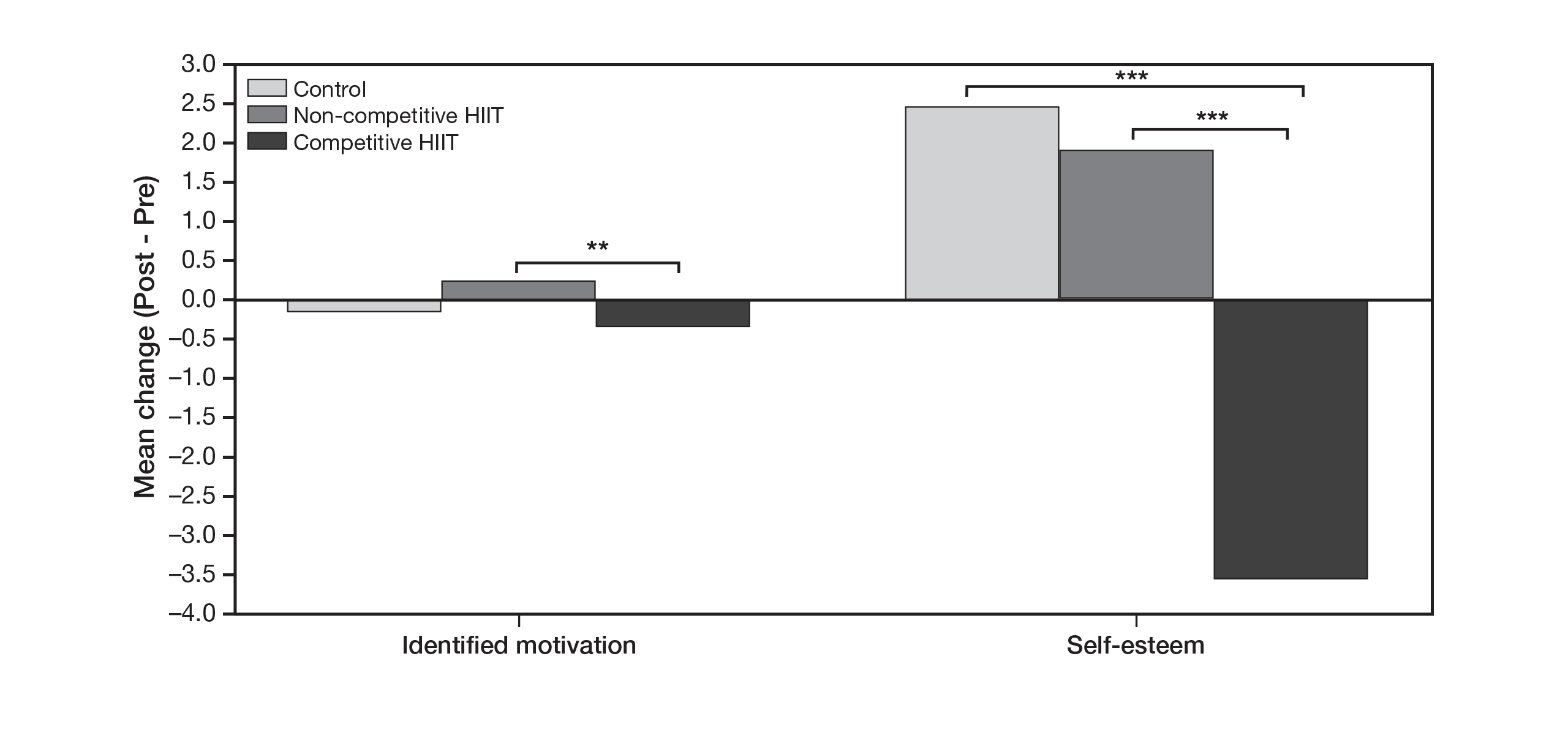
Note. The bars represent sex-adjusted mean pre–post changes (Post–Pre) obtained using analysis of covariance (ANCOVA). The brackets indicate significant post hoc between-group comparisons following Bonferroni correction (*p < .01; **p < .001).
For self-esteem, a highly significant main effect of group was identified (F(2, 172) = 15.86, p < .001). Bonferroni-adjusted post hoc analyses showed that the competitive HIIT group experienced a significantly greater decrease in self-esteem than both the control group (p < .001; d = 1.02) and the non-competitive HIIT group (p < .001; d = 0.89), while no significant differences were observed between the control group and the non-competitive HIIT group.
Variables Without Significant Between-Group Differences
By contrast, no statistically significant between-group differences were observed in the pre–post changes in perceived stress, sleep quality, sleep duration, intrinsic regulation, introjected regulation, external regulation, amotivation or enjoyment of physical activity after adjustment for sex (p > .05 in all cases). The mean changes observed in these variables are presented descriptively in Figure 3.
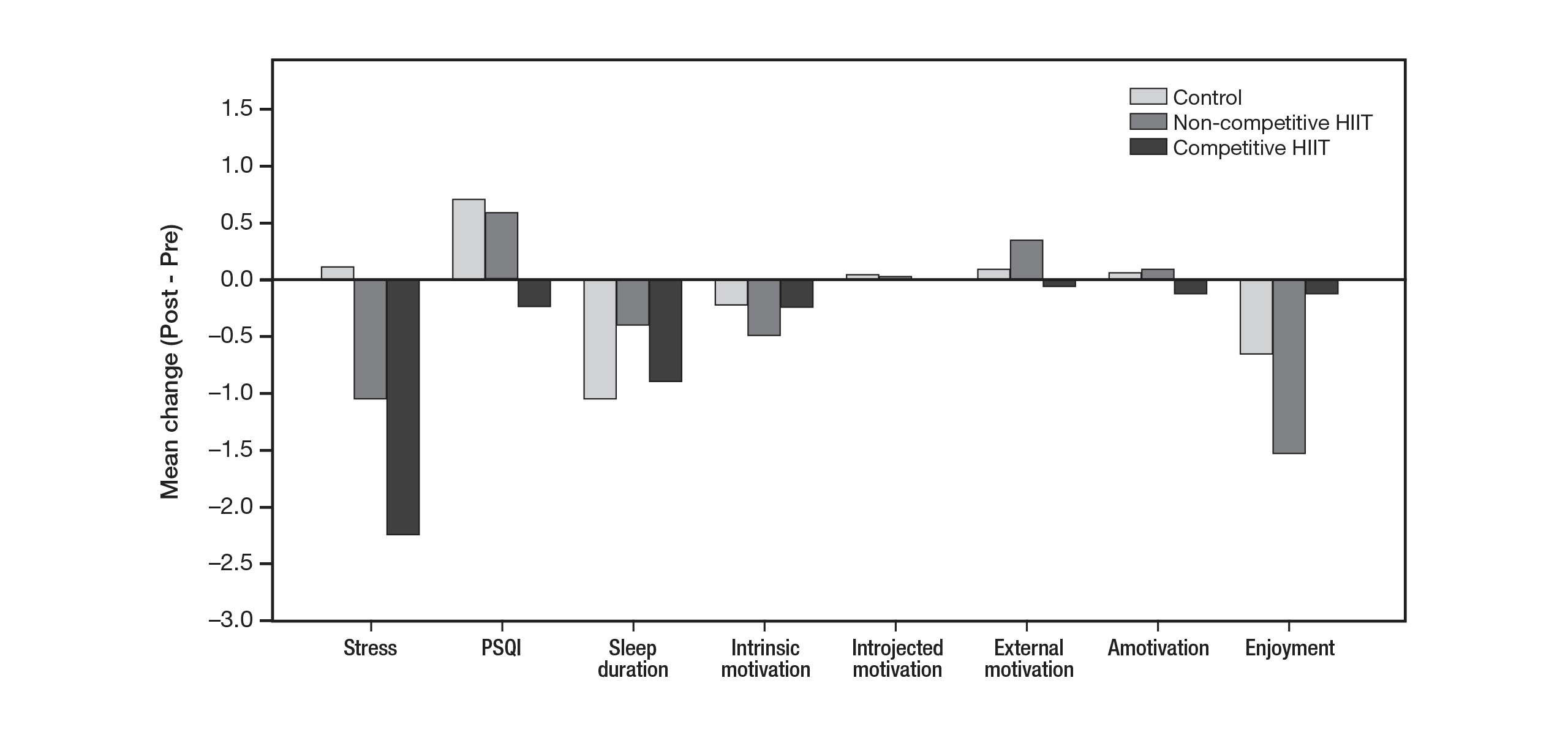
Note. The bars represent sex-adjusted mean pre–post changes (Post–Pre) obtained using analysis of covariance (ANCOVA). No statistically significant between-group differences were observed after adjustment for sex.
Discussion
The aim of the present study was to analyze the effects of two HIIT formats, competitive and non-competitive, on psychological and sleep-related variables in adolescents in a school setting. Unlike previous research focused on physical fitness or general comparisons with control groups (Duncombe et al., 2022), this study included a comparison between intervention formats, making it possible to explore the role of the competitive component in students’ psychological responses. The results showed significant between-group changes in self-esteem and identified regulation: the competitive format was associated with a decrease in self-esteem, whereas non-competitive HIIT promoted an increase in identified regulation, with no relevant differences in the remaining variables.
Self-esteem emerged as the psychological variable most sensitive to the intervention format, showing clear between-group differences according to the competitive component of HIIT. Specifically, the competitive HIIT group showed a significant decrease in self-esteem compared with both the control group and the non-competitive HIIT group, whereas the latter did not differ from the control group. This finding is particularly relevant in adolescents, a population characterized by greater vulnerability to social comparison and external evaluation processes, factors closely linked to the development of self-concept and self-esteem (Gibbons & Buunk, 1999; Liu et al., 2025). In educational settings, where physical performance and the public display of abilities carry considerable symbolic weight, the introduction of structured competitive dynamics may intensify the social comparison processes inherent in physical education, with potential implications for students’ sensitive psychological variables (Spray et al., 2023). This result is consistent with previous studies conducted in competitive educational settings, which have indicated that performance-oriented and social comparison climates may be associated with more negative perceptions of self-concept and self-esteem in adolescents (Fülöp et al., 2025; Melguizo-Ibáñez et al., 2025).
From a theoretical perspective, these results can be interpreted through Self-Determination Theory, which proposes that environments oriented toward outcomes and social comparison may undermine the satisfaction of basic psychological needs, particularly perceived competence, when there are marked individual differences in ability or physical fitness (Ryan & Deci, 2000; Valero-Valenzuela et al., 2021). In this respect, the competitive format used in the present study, based on rankings and explicit comparisons, may have reinforced perceptions of relative incompetence among some students, thereby negatively affecting their self-esteem. By contrast, the absence of differences between non-competitive HIIT and the control group suggests that high-intensity programs can be implemented in school settings without compromising self-esteem, provided that the pedagogical design prioritizes participation, individual effort and personal improvement over comparative performance (Vasconcellos et al., 2020).
Regarding identified regulation, the results showed that the non-competitive HIIT format was associated with a significantly greater increase in this form of motivational regulation than competitive HIIT, with no relevant differences compared with the control group. This finding is particularly relevant from an educational perspective, as identified regulation reflects a process through which the personal and functional value of physical activity is internalized, even when the activity itself is not intrinsically enjoyable. Against this background, non-competitive HIIT may have created a context that was more conducive to perceptions of autonomy and the personal meaningfulness of the task by reducing the pressure associated with social comparison and relative performance. This interpretation is consistent with previous studies highlighting the importance of task-oriented motivational climates in physical education for promoting more adaptive internalization processes (Milton et al., 2025). Conversely, the competitive format, which focused on rankings and outcomes, may have shifted the motivational focus toward more controlled forms of regulation, thereby limiting the development of more self-determined forms of motivation (Wu et al., 2021). Overall, these results reinforce the idea that the pedagogical design of HIIT is a key element in promoting not only participation but also the motivational quality of students’ experiences in school physical education.
With regard to sleep, the results should be interpreted from an exploratory perspective, given the limited body of previous evidence on the relationship between school-based HIIT interventions and sleep-related variables in adolescents, particularly with respect to comparisons between competitive and non-competitive formats. The stability observed in sleep quality across the three groups suggests that the intervention had no relevant impact on the subjective perception of rest. However, the reduction in sleep duration observed only in the competitive HIIT group suggests possible differences in responses to different exercise formats, although this finding should be interpreted with caution. One possible explanation is that weekly exposure to rankings, public scores and peer comparison may have increased psychological arousal or concerns about performance, at least among some students, which could have interfered with their sleep habits. This interpretation should nonetheless be regarded as exploratory, as perceived stress showed no significant between-group differences and specific variables such as competitive anxiety, pre-sleep arousal or anticipatory worry were not assessed. In addition, contextual factors inherent to the school setting, such as the stage of the academic year or assessment demands, may also have influenced this variable (Carbonell-Escalas et al., 2025). Overall, these results provide preliminary insight into sleep outcomes in school-based HIIT interventions and highlight the need for future research incorporating longitudinal designs and objective measures of sleep.
Beyond the effects observed on self-esteem and identified regulation, perceived stress, enjoyment, the remaining forms of motivational regulation and sleep quality showed no significant between-group changes. The absence of changes in these variables may be explained, on the one hand, by the high temporal stability of some psychological constructs (Röglin et al., 2023), particularly in short-term interventions, and, on the other, by the fact that the intervention was conducted in a real school setting and integrated into the regular physical education curriculum, which may have helped maintain stable levels of psychological well-being across all groups (Lubans et al., 2021). In the case of perceived stress, although no statistically significant between-group differences were observed, the competitive HIIT format showed the greatest reduction in this variable.
The within-group analyses showed patterns of change consistent with the observed between-group effects, with increases in self-esteem and more self-determined forms of motivation in the non-competitive HIIT group, and decreases in variables such as identified regulation and self-esteem in the competitive format, reinforcing the relevance of the pedagogical design of the intervention. Taken together, these results suggest that certain psychological aspects may require longer or more specific interventions in order for detectable changes to emerge in adolescents.
The results of the present study have relevant implications for the design of HIIT interventions in school physical education. The findings suggest that the pedagogical format of HIIT is a key element beyond exercise intensity, as different approaches may generate different psychological responses among students. In this respect, non-competitive HIIT emerges as a particularly suitable alternative in educational settings, as it promotes more self-determined forms of motivation without compromising sensitive psychological variables such as self-esteem. By contrast, the inclusion of competitive components based on rankings and explicit comparisons requires careful planning, particularly in adolescents, among whom individual differences in ability and physical fitness may amplify social comparison processes. From an educational perspective, these results reinforce the need to prioritize approaches that promote participation, personal improvement and the meaningfulness of physical activity, aligning interventions with the educational aims of physical education and the promotion of healthy active habits in the long term.
Regarding the control group, the results show that participation in regular physical education classes was not associated with a deterioration in the psychological variables assessed over the 10-week intervention period. However, as the specific content of these classes was neither prescribed by the research team nor systematically recorded, these results should be interpreted with caution. Therefore, the changes observed in the control group cannot be attributed to any specific characteristics of regular physical education and can only be described as the pattern observed in this group during the study period.
Limitations and Future Research Directions
This study has several limitations that should be considered when interpreting the results. First, the duration of the intervention and its integration into the school schedule may have limited the magnitude of the changes observed in some psychological and sleep-related variables. As the intervention was conducted during regular physical education classes, it was constrained by the actual duration of the sessions, school organization, the academic calendar, student attendance and the time available to implement the HIIT protocol, which may have reduced effective exposure to the program. Furthermore, although the effect of sex was controlled for, no information was available on other relevant contextual variables, such as socioeconomic status, extracurricular sport participation or the participants’ sporting background. In this context, no detailed information was collected on previous sporting experience, competitive level, familiarity with high-intensity exercise or participation in organized sport, variables that may have influenced the intensity achieved during the sessions, as well as motivation and perceived enjoyment after the activity. Likewise, the exact content and internal load of the regular physical education classes attended by the control group were not systematically recorded, as these classes followed the teachers’ regular program. This issue should be considered when interpreting comparisons between the control group and the HIIT groups. Another limitation is the use of self-report measures to assess psychological and sleep-related variables, which may introduce perceptual bias. In this respect, future research should incorporate longer interventions, longitudinal designs and objective measures, particularly in relation to sleep, an area that remains underexplored in school-based HIIT interventions. It would also be useful to analyze different competitive designs in order to optimize physical and psychological benefits in educational settings, comparing, for example, formats based on individual rankings, cooperative team competition, challenges based on personal progress, private or public feedback, and scoring systems focused on personal improvement rather than direct peer comparison.
Conclusions
The findings of this study show that the competitive HIIT format was associated with a significant decrease in self-esteem compared with the control group and non-competitive HIIT, whereas the latter produced a greater increase in identified regulation. These results confirm that the pedagogical component of HIIT modulates its psychological impact on adolescents, with the non-competitive approach being more suitable in educational settings. Although no significant effects were observed for the sleep-related variables, their inclusion represents a novel contribution to an area that remains underexplored and opens up a promising avenue for future research. The conclusions were drawn after controlling for the effect of sex in the analyses.
Conflict of interest
No conflict of interest was reported by the authors.
References
[1] Alalawi, A., Blank, L., & Goyder, E. (2023). School-based physical activity interventions among children and adolescents in the Middle East and Arabic speaking countries: A systematic review. PLoS ONE, 18(7), e0288135. doi.org/10.1371/journal.pone.0288135
[2] Anderson, E., & Durstine, J. L. (2019). Physical activity, exercise, and chronic diseases: A brief review. Sports Medicine and Health Science, 1(1), 3–10. doi.org/10.1016/j.smhs.2019.08.006
[3] Banati, P., Vedechkina, M., De Rubeis, V., Kalai, S., Massaquoi, L., Sadana, R., Baltag, V., & Baird, S. (2025). Adolescent experiences and exposures: a systematic review of life course outcomes. EClinicalMedicine, 88, 103453. doi.org/10.1016/j.eclinm.2025.103453
[4] Barbosa Cano, D., & Gomez-Baya, D. (2025). Self-Determination Theory-Based Interventions to Promote Physical Activity and Sport in Adolescents: A Scoping Review. Youth, 5(3), 98. doi.org/10.3390/youth5030098
[5] Bento, A. F. P. da S., Carrasco Páez, L., & Raimundo, A. M. de M. (2021). High-intensity interval training in high-school physical education classes: Study protocol for a randomized controlled trial. Contemporary Clinical Trials Communications, 24, 100867. doi.org/10.1016/j.conctc.2021.100867
[6] Bento, A. F. P. da S., Carrasco Páez, L., & Raimundo, A. M. de M. (2022). School-Based High-Intensity Interval Training Programs for Promoting Physical Activity and Fitness in Adolescents: A Systematic Review. Journal of Teaching in Physical Education, 41(2), 288–300. doi.org/10.1123/jtpe.2020–0187
[7] Buysse, D. J., Reynolds, C. F., Monk, T. H., Berman, S. R., & Kupfer, D. J. (1989). The Pittsburgh sleep quality index: A new instrument for psychiatric practice and research. Psychiatry Research, 28(2), 193–213. doi.org/10.1016/0165–1781(89)90047–4
[8] Carbonell-Escalas, D., Vidal-Conti, J., & Galmés-Panadés, A. (2025). Association between sleep quality and duration and physical fitness among children and adolescents. A systematic review of cross-sectional studies. Sportis. Scientific Journal of School Sport, Physical Education and Psychomotricity, 11(4), 1–26. doi.org/10.17979/sportis.2025.11.4.11951
[9] Carbonell-Escalas, D., Vidal-Conti, J., & Galmes-Panades, A. (2026). High-Intensity Interval Training: competitive and non-competitive effects on physical fitness in school adolescents. Retos, 76, 211–224. doi.org/10.47197/retos.v76.117930
[10] Cohen, S., Kamarck, T., & Mermelstein, R. (1983). A global measure of perceived stress. Journal of Health and Social Behavior, 24(4), 385–396.
[11] Costigan, S. A., Eather, N., Plotnikoff, R. C., Taaffe, D. R., & Lubans, D. R. (2015). High-intensity interval training for improving health-related fitness in adolescents: a systematic review and meta-analysis. British Journal of Sports Medicine, 49(19), 1253–1261. doi.org/10.1136/bjsports-2014–094490
[12] Duncombe, S. L., Barker, A. R., Bond, B., Earle, R., Varley-Campbell, J., Vlachopoulos, D., Walker, J. L., Weston, K. L., & Stylianou, M. (2022). School-based high-intensity interval training programs in children and adolescents: A systematic review and meta-analysis. PLoS ONE, 17(5), e0266427. doi.org/10.1371/journal.pone.0266427
[13] Duncombe, S. L., Barker, A. R., Price, L., Walker, J. L., Liu, Y., Paris, D., & Stylianou, M. (2023). Making a HIIT: co-design of high-intensity interval training workouts with students & teachers within the curriculum. BMC Public Health, 23,1795. doi.org/10.1186/s12889-023–16613-8
[14] Fernández García, E., Sánchez Bañuelos, F., & Salinero Martín, J. J. (2008). Validación y adaptación de la escala PACES de disfrute con la práctica de la actividad física para adolescentes española. Psicothema, 20(4), 890–895. reunido.uniovi.es/index.php/PST/article/view/8746
[15] Fu, Q., Li, L., Li, Q., & Wang, J. (2025). The effects of physical activity on the mental health of typically developing children and adolescents: a systematic review and meta-analysis. BMC Public Health, 25,1514. doi.org/10.1186/s12889-025–22690-8
[16] Fülöp, M., Varga, B. A., & Sebestyén, N. (2025). Competitive and non-competitive school climate and students' well-being. Learning and Instruction, 95, 102036. doi.org/10.1016/j.learninstruc.2024.102036
[17] Gibbons, F. X., & Buunk, B. P. (1999). Individual differences in social comparison: Development of a scale of social comparison orientation. Journal of Personality and Social Psychology, 76(1), 129–142. doi.org/10.1037/0022–3514.76.1.129
[18] Guo, F., Bostean, G., Berardi, V., Velasquez, A. J., & Robinette, J. W. (2022). Obesogenic environments and cardiovascular disease: a path analysis using US nationally representative data. BMC Public Health, 22,703. doi.org/10.1186/s12889-022–13100-4
[19] Guthold, R., Stevens, G. A., Riley, L. M., & Bull, F. C. (2020). Global trends in insufficient physical activity among adolescents: a pooled analysis of 298 population-based surveys with 1·6 million participants. The Lancet Child & Adolescent Health, 4(1), 23–35. doi.org/10.1016/S2352-4642(19)30323–2
[20] Ito, S. (2019). High-intensity interval training for health benefits and care of cardiac diseases - The key to an efficient exercise protocol. World Journal of Cardiology, 11(7), 171–188. doi.org/10.4330/wjc.v11.i7.171
[21] Kendzierski, D., & DeCarlo, K. J. (1991). Physical Activity Enjoyment Scale: Two validation studies. Journal of Sport & Exercise Psychology, 13(1), 50–64. doi.org/10.1123/jsep.13.1.50
[22] Liu, H., Kvintova, J., & Vachova, L. (2025). Parents' social comparisons and adolescent self-esteem: the mediating effect of upward social comparison and the moderating influence of optimism. Frontiers in Psychology, 16. doi.org/10.3389/fpsyg.2025.1473318
[23] Lubans, D. R., Smith, J. J., Eather, N., Leahy, A. A., Morgan, P. J., Lonsdale, C., Plotnikoff, R. C., Nilsson, M., Kennedy, S. G., Holliday, E. G., Weaver, N., Noetel, M., Shigeta, T. T., Mavilidi, M. F., Valkenborghs, S. R., Gyawali, P., Walker, F. R., Costigan, S. A., & Hillman, C. H. (2021). Time-efficient intervention to improve older adolescents' cardiorespiratory fitness: findings from the 'Burn 2 Learn' cluster randomised controlled trial. British Journal of Sports Medicine, 55(13), 751–758. doi.org/10.1136/bjsports-2020–103277
[24] Markland, D., & Tobin, V. (2004). A Modification to the Behavioural Regulation in Exercise Questionnaire to Include an Assessment of Amotivation. Journal of Sport and Exercise Psychology, 26(2), 191–196. doi.org/10.1123/jsep.26.2.191
[25] Master, L., Nye, R. T., Lee, S., Nahmod, N. G., Mariani, S., Hale, L., & Buxton, O. M. (2019). Bidirectional, Daily Temporal Associations between Sleep and Physical Activity in Adolescents. Scientific Reports, 9, 7732. doi.org/10.1038/s41598-019–44059-9
[26] Melguizo-Ibáñez, E., González-Valero, G., Badicu, G., Yagin, F. H., Alonso-Vargas, J. M., Ardigò, L. P., & Puertas-Molero, P. (2025). Relationship between motivational climate, anxiety and average mark in pre-service physical education teachers: a cross-sectional study based on structural equation modelling approach. BMC Medical Education, 25, 55. doi.org/10.1186/s12909-025–06646-5
[27] Milton, D., Appleton, P. R., Bryant, A., & Duda, J. L. (2025). Promoting a more empowering motivational climate in physical education: a mixed-methods study on the impact of a theory-based professional development programme. Frontiers in Psychology, 16. doi.org/10.3389/fpsyg.2025.1564671
[28] Murcia, J. A. M., Gimeno, E. C., & Camacho, A. M. (2007). Measuring self-determination motivation in a physical fitness setting: validation of the Behavioral Regulation in Exercise Questionnaire-2 (BREQ-2) in a Spanish sample. The Journal of Sports Medicine and Physical Fitness, 47(3), 366–374.
[29] Remor, E. (2006). Psychometric Properties of a European Spanish Version of the Perceived Stress Scale (PSS). The Spanish Journal of Psychology, 9(1), 86–93. doi.org/10.1017/S1138741600006004
[30] Röglin, L., Stoll, O., Ketelhut, K., Martin-Niedecken, A. L., & Ketelhut, S. (2023). Evaluating Changes in Perceived Enjoyment throughout a 12-Week School-Based Exergaming Intervention. Children, 10(1), 144. doi.org/10.3390/children10010144
[31] Rosenberg, M. (1965). Society and the adolescent self-image. Princeton University Press.
[32] Royuela Rico, A., & Macías Fernández, J. A. (1997). Propiedades clinimétricas de la versión castellana del cuestionario de Pittsburgh. Vigilia-Sueño, 9, 81–94.
[33] Ryan, R. M., & Deci, E. L. (2000). Self-determination theory and the facilitation of intrinsic motivation, social development, and well-being. American Psychologist, 55(1), 68–78. doi.org/10.1037/0003-066X.55.1.68
[34] Spray, C. M., Franco, E., & Barnes, J. S. (2023). Social comparison in physical education: Impact of frames of reference, motives to compare, and self-determined motivation. Asian Journal of Sport and Exercise Psychology, 3(2), 65–73. doi.org/10.1016/j.ajsep.2023.06.001
[35] Valero-Valenzuela, A., Huéscar, E., Núñez, J. L., León, J., Conte, L., & Moreno-Murcia, J. A. (2021). The Role of Controlled Motivation in the Self-Esteem of Adolescent Students in Physical Education Classes. International Journal of Environmental Research and Public Health, 18(21), 11602. doi.org/10.3390/ijerph182111602
[36] Vasconcellos, D., Parker, P. D., Hilland, T., Cinelli, R., Owen, K. B., Kapsal, N., Lee, J., Antczak, D., Ntoumanis, N., Ryan, R. M., & Lonsdale, C. (2020). Self-determination theory applied to physical education: A systematic review and meta-analysis. Journal of Educational Psychology, 112(7), 1444–1469. doi.org/10.1037/edu0000420
[37] Vázquez-Morejón, A. J., Jiménez García-Bóveda, R., & Vázquez-Morejón Jiménez, R. (2004). Rosenberg Self-Esteem Scale: Reliability and validity of an adaptation to the Spanish population. Apuntes de Psicología, 22(2), 247–255. doi.org/10.55414/bsxyn321
[38] World Health Organization. (2019). Guidelines on Physical Activity, Sedentary Behaviour and Sleep for Children under 5 Years of Age [Brochure]. www.who.int/publications/i/item/9789241550536
[39] Wu, X., Gai, X., Yu, T., Yu, H., & Zhang, Y. (2021). Perceived Motivational Climate and Stages of Exercise Behavior Change: Mediating Roles of Motivation Within and Beyond Physical Education Class. Frontiers in Psychology, 12. doi.org/10.3389/fpsyg.2021.737461
[40] Yan, W., Chen, L., Wang, L., Meng, Y., Zhang, T., & Li, H. (2023). Association between enjoyment, physical activity, and physical literacy among college students: a mediation analysis. Frontiers in Public Health, 11. doi.org/10.3389/fpubh.2023.1156160
ISSN: 2014-0983
Received: February 17, 2026
Accepted: May 18, 2026
Published: October 1, 2026
Editor: © Generalitat de Catalunya Departament de la Presidència Institut Nacional d’Educació Física de Catalunya (INEFC)
© Copyright Generalitat de Catalunya (INEFC). This article is available from url https://www.revista-apunts.com/. This work is licensed under a Creative Commons Attribution-NonCommercial-NoDerivatives 4.0 International License. The images or other third party material in this article are included in the article’s Creative Commons license, unless indicated otherwise in the credit line; if the material is not included under the Creative Commons license, users will need to obtain permission from the license holder to reproduce the material. To view a copy of this license, visit https://creativecommons.org/licenses/by-nc-nd/4.0/deed.en


