Initial Validation of the Teachers’ Perception of the Students’ Academic Motivation Scale in Physical Education
Iván Ramírez-Bravo

Francisco Miguel Leo Marcos
Miguel Ángel López-Gajardo
Rubén Llanos-Muñoz
Juan J. Pulido
*Corresponding author: Juan J Pulido jjpulido@unex.es
Cite this article
Ramírez-Bravo, I., Leo, F.M., López-Gajardo, M. Á., Llanos-Muñoz, R., & Pulido, J. J. (2026). Initial validation of the teachers’ perception of the students’ academic motivation scale in Physical Education. Apunts. Educación Física y Deportes, 164, 61-72. https://doi.org/10.5672/apunts.2014-0983.es.2026.164.06
Abstract
Teachers’ perceptions of their students’ motivation play a key role in shaping the teaching–learning process. In Physical Education (PE), these perceptions can influence how teachers design their classes, experience their own motivation, and ultimately impact students’ engagement and learning outcomes. Following the framework of self-determination theory, this study aimed to adapt and validate the Teachers’ Perceptions of Students’ Academic Motivation Scale (TPSAMS). The validation process included two studies. Study 1 assessed content validity through expert review and a pilot test with 6 PE teachers. Study 2 evaluated the psychometric properties of the scale, including factorial validity, internal consistency, discriminant validity, nomological validity, and measurement invariance by gender, using data from 350 PE teachers. The findings indicated that the TPSAMS shows acceptable psychometric properties, supporting its potential usefulness for assessing teachers’ perceptions of students’ motivation. Nevertheless, further research with broader samples and educational contexts is needed to confirm and extend these results.
Keywords: motivation, physical education, teacher, scale, validation
Introduction
In the educational context, motivational processes play a fundamental role in achieving academic goals and fostering a successful and enriching teaching-learning process among students (Ryan & Deci, 2020). In Physical Education (PE), increasing evidence has demonstrated that motivation can be a key factor in engaging students with the subject, enhancing their satisfaction with learning, and ensuring that this education becomes meaningful and enduring (Leo et al., 2022; Vansteenkiste et al., 2020).
However, it is common for teachers to aim for learning to extend beyond class time and become integrated into students’ lifestyles, making motivation toward this subject doubly important. Specifically, a growing body of research shows that students with higher motivation toward PE also exhibit greater levels of personal and emotional satisfaction and well-being (Lei et al., 2018). Furthermore, higher motivation for PE is associated with increased levels of physical activity and the adoption of healthy lifestyle habits among students (Barkoukis et al., 2010; Hagger et al., 2009; Taylor et al., 2010).
Nevertheless, students’ motivational processes do not solely influence the emergence of positive and/or negative outcomes for students but can also affect PE teachers themselves (Franco et al., 2024; Taylor & Ntoumanis, 2007. When students demonstrate high levels of motivation and interest in class, teachers may become more engaged and develop a more self-determined motivation to optimize the teaching-learning process (Franco et al., 2024; Pelletier et al., 2002). In fact, teachers’ perceptions of students’ motivation can be a key factor influencing their own motivation and teaching practices (Matosic et al., 2016; Pelletier et al., 2002). Nevertheless, to our knowledge, few studies have examined teachers’ perceptions of students’ motivation (Taylor & Ntoumanis, 2007), and there are no validated and reliable instruments specifically designed to measure this construct (Franco et al., 2024).Thus, the purpose of this study was to validate an instrument that assesses PE teachers’ perceptions of their students’ motivation.
Students’ Motivation From Teachers’ Perceptions
To rigorously understand the types of motivation developed by students in PE lessons, this study is based on self-determination theory (SDT; Deci & Ryan, 2000), which allows for the differentiation of various types of motivational regulation—from motivation driven by personal interest and values to motivation driven by external pressures or even a lack of motivation—considering both their quantity and quality in relation to students’ behavioral, affective, and cognitive outcomes.
Specifically, according to SDT (Deci & Ryan, 2000), individuals can be intrinsically motivated, extrinsically motivated, or simply amotivated. PE teachers may perceive different types of students’ motivation, which can influence their behaviors and actions to varying degrees (Abós, Haerens et al., 2018; Roth et al., 2007). By addressing the entire motivation continuum—from its most self-determined perspective to the lack of self-determination or amotivation (Deci & Ryan, 2000; Ryan & Deci, 2020)—the highest level of self-determination corresponds to intrinsic motivation. This type of motivational regulation represents the purest form of motivation and is associated with intrinsic desire, personal interest, pleasure, and satisfaction inherent in the activity (e.g., teachers perceive that their students are interested in learning new things).
Extrinsic motivation is characterized by behaviors driven by the achievement of a specific purpose (instrumental motivation). That is, this type of motivation is primarily driven by external factors, such as the need to satisfy external demands, obtain a reward, or avoid feelings of guilt (Bartholomew et al., 2018; Ryan & Deci, 2020; Vallerand et al., 2003). Following the motivation continuum, extrinsic motivation can be divided into four types of behavioral regulation (i.e., integrated regulation, identified regulation, introjected regulation and external regulation), each representing a different level of internalization— the process through which external motives are transformed into personally endorsed values and goals (Deci & Ryan, 2000; Ryan & Deci, 2020). Integrated regulation1 is the most self-determined form of extrinsic motivation and is associated with aspects related to values, beliefs, personality, interests, etc., which require a degree of cognitive, social, and emotional maturity that is still developing during adolescence (Deci & Ryan, 2000; Vallerand, 2007). In addition, this type of regulation presents numerous similarities and a strong correlation with intrinsic motivation (Ryan & Deci, 2020; Vallerand & Rousseau, 2001; Vansteenkiste & Ryan, 2013). Identified regulation is observed when the importance of the action or behavior itself is recognized (e.g., teachers perceive that their students. engage in the subject because it is essential for their future). Introjected regulation occurs when behaviors or attitudes are adopted to avoid feelings of guilt or shame, or to attain contingent self-esteem or pride (e.g., teachers perceive that their students participate in PE to avoid feeling bad or out of pride; Assor et al., 2009; Deci & Ryan, 2000). Subsequently, external regulation occurs when an activity or behavior is carried out to obtain a reward or to avoid punishment (Deci & Ryan, 2000; e.g., teachers perceive that their students complete tasks solely to achieve a good grade). Finally, amotivation is characterized by the absence of intrinsic and/or extrinsic reasons, as well as by a lack of purpose or goals to continue (Ntoumanis, 2001; Ryan & Deci, 2000; e.g., teachers perceive that their students believe that what they are studying has no value to them).
The motivation that teachers perceive in their students can influence classroom behaviors and the degree to which they support or thwart their students’ basic psychological needs (Franco et al., 2024; Matosic et al., 2016; Pelletier et al., 2002). In an initial approach, Pelletier et al. (2002) pointed out the existence of “bottom-up pressures”, which are linked to students’ intrinsic motivation and directly impact teachers’ motivation and behaviors in the classroom (Franco et al., 2024). In turn, Matosic et al. (2016) proposed a classification of teachers’ motivational antecedents, highlighting their perceptions of the degree of student’s self-determined motivation (within the perception of others’ behaviors) as a relevant antecedent for teachers’ own motivation. Finally, Franco et al. (2024) defined a category of contextual antecedents perceived by teachers, identifying students’ motivation as a variable that shapes teachers’ motivational processes and behaviors.
Although student motivation is highly valued by teachers, it has traditionally been assessed from the students’ perspective. Vallerand et al. (1992) developed the Academic Motivation Scale (AMS) to assess student motivation, which has since been widely used and adapted across countries (e.g., Spanish: EME-E, Núñez et al., 2005) and educational stages (e.g., secondary education: EME-S, Núñez et al., 2010), demonstrating strong validity and reliability. Similarly, Moreno-Murcia et al. (2009) validated the Spanish version of the Perceived Locus of Causality Scale (PLOC; Goudas et al., 1994) to examine motivational regulation and behavior perception in secondary students. Additionally, Sánchez-Oliva et al. (2012) developed and validated the CMEF to assess student motivation in secondary PE, demonstrating strong internal consistency and a robust factorial structure. Later, Leo et al. (2016) adapted it for primary education (CMEF-EP) to explore students’ emotional regulation at this stage.
By contrast, student motivation from the teacher’s perspective has been scarcely assessed (Franco et al., 2024). To our knowledge, only Taylor and Ntoumanis (2007) have evaluated teachers’ perceptions of students’ motivation, although they asked teachers exclusively about students’ motivation individually, using a single item for each type of motivation. They also calculated the self-determination index (SDI) to reflect teachers’ perceptions of students’ self-determination. Furthermore, attempts have been made to evaluate teachers’ perceptions of students’ general motivation (i.e., participation, motivation, task completion, attention, and punctuality/reliability), but they were conducted without a validated instrument or theoretical framework (Brandmiller et al., 2023).
Therefore, developing an instrument to assess teachers’ perceptions of students’ types of motivation can help understand how these variables influence both the teacher and the teaching-learning process. It also allows us to examine whether the students’ types of motivation perceived by teachers correspond to their perceptions of students’ engagement in PE lessons. Research has shown that students’ motivation is associated with their engagement. Specifically, students with more self-determined motivation showed higher behavioral and emotional engagement in PE lessons, whereas students experiencing amotivation displayed lower engagement (Leo et al., 2022). This suggests that teachers’ perceptions of student motivation may similarly be related to their perceptions of students’ engagement.
The Present Study
Based on the reviewed literature, there is consensus on the importance of teachers’ perceptions of their students’ behavior and their influence on the teaching–learning process (Franco et al., 2024; Taylor & Ntoumanis, 2007). While questionnaires have been used to explore motivation from the students’ perspective, no instrument systematically assesses teachers’ perceptions of their students’ motivation. Understanding this perception with appropriate validity and reliability criteria can provide key insights into how it shapes teachers’ own motivational practices and interactions with students (Reeve & Cheon, 2021). Therefore, based on Spanish version of the Academic Motivation Scale (EME-S; Núñez et al., 2010), the objective of this study was to adapt and develop an initial version of a questionnaire to examine student motivation from the teacher’s perspective. This instrument seeks to expand the study and understanding of motivational dynamics in the classroom from the teacher’s perspective, providing a useful tool for PE research.
Study 1
The objective of the Study 1 was to adapt and examine the content validity and comprehension of the scale in a pilot study developed with PE teachers. A three-phase process was carried out. In Phase 1, the items were adapted by a panel of experts who assessed the content’s relevance. Phase 2 involved a pilot study with 6 PE teachers to evaluate the comprehension of the proposed scale. Finally, in Phase 3, adjustments were made following evaluations of the instrument.
Method and Results
The adaptation of the EME-S followed a three-phase procedure (translation and adaptation, content validity and comprehension, and readjustment), in line with international guidelines for test adaptation and validation (Bartram et al., 2018; Lynn, 1986; McGartland et al., 2003; Sireci & Faulkner-Bond, 2014).
Phase 1 -Scale translation and adaptation. We adapted the EME-S (Núñez et al., 2010; Vallerand et al., 1992) to assess the PE teachers’ perception about the students’ motivation.2 The original scale was developed to directly examine students’ motivation and is composed of 28 items that measure intrinsic motivation–knowledge, intrinsic motivation–achievement, intrinsic motivation–stimulation, identified regulation, introjected regulation, external regulation and amotivation. For this adaptation, we only used one type of intrinsic motivation: knowledge (four items). The other two intrinsic subfactors (achievement and stimulating experiences; eight items) were not included because knowledge is the most relevant for assessing teachers’ perceptions of students’ academic motivation in the context of PE, and focusing on this subfactor allows for a clearer and more interpretable measure of motivation.
Previously, we obtained the necessary permissions from the original authors of the instrument to adapt and reproduce this scale. Then, the 20-item EME-S was adapted by three independent experts. They were selected for their expertise in SDT-based research and teacher education, and they evaluated the items for relevance, representation, and appropriateness (Bartram et al., 2018; Lynn, 1986; McGartland et al., 2003; Sireci & Faulkner-Bond, 2014). These experts carried out an individual adaptation of the scale and shared it. Specifically, a think-aloud protocol with the three proposals about the modifications of the questionnaires was held to highlight the different experts’ perspectives, and discus any discrepancies until a satisfactory version was reached.
No items were removed during this phase, and all modifications involved rewording items to adapt them to teachers’ perceptions. The main modifications focused on changing words that referred to the students’ motivation so that they referred to PE teachers’ perceptions of students’ motivations. For instance, the stem sentence used in the EME-S “Why do you study…?” was replaced with “Why do you think that students study…?” Some words in the items were modified to assess teachers’ perceptions of students’ motivations. For example, “…because my studies allow me to continue learning many things that interest me” was changed to “…because studying will allow them to continue learning many things that interest them.”
Phase 2 – Content validity and comprehension. Next, the first version of the scale was administered to 6 PE teachers, selected through convenience sampling, aged between 27 and 40 years (M = 32.17, SD = 4.98) from primary (n = 1) and secondary (n = 5) schools. Previously, PE teachers were contacted, informed about the procedure, and asked to participate in the study after providing informed consent. Those who agreed to participate received information about the meaning of each dimension, but they did not know which items belonged to each factor. They were asked to suggest improvements to the items or propose alternatives.
Phase 3 – Readjustment of the scale. We received the revised version of the scale from each PE teacher, indicating whether to maintain, modify/revise, or eliminate the items.The three experts identified and discussed these modifications proposed by the PE teachers. No items were removed during this phase. All changes involved adjustments to wording to improve clarity and comprehension. Finally, this phase supported the content validity based on experts’ judgments of the other items of the questionnaire and served to establish the scale’s name: Teachers’ Perception of the Students’ Academic Motivation Scale (TPSAMS).
Study 2
The main aim of Study 2 was to test the psychometric properties of the TPSAMS, which analyzes PE teachers’ perceptions of students’ motivation. Specifically, we tested the factorial validity, internal consistency, discriminant validity, nomological validity and sex invariance of the scale.
Method
Participants
The final version of the TPSAMS was completed by 350 PE teachers (125 females), aged between 24 and 64 years (M = 39.93, SD = 9.17). The teachers were recruited from various schools across different Spanish regions, ensuring a diverse representation. To assess teaching experience, participants were categorized into three levels: a) High experience (> 10 years), with 45.14% of participants reporting extensive teaching experience; b) Medium experience (5-10 years), with 22.86% of participants indicating moderate teaching experience; c) Low experience (< 5 years), with 31.14% of participants reporting limited teaching experience, and 0.86% having less than one year of teaching experience. The sample was intentionally selected based on prior contact with schools and PE teachers. Regarding the employment status of the teachers, 54.29% were permanent teachers, 35.14% were intern teachers, 8% were substitute teachers, and 2.57% were not actively employed at the time of data collection. The response rate was 98.31%, and all participants provided informed consent prior to completing the questionnaire.
Procedure
First, ethical approval for both projects (Study 1 and Study 2) was obtained from the Bioethics Committee of the first author’s University of Extremadura (Protocol number: 3/2025). Second, the researchers contacted the PE teachers to explain the objectives of the studies and request their participation, following the American Psychological Association’s (2009) ethical guidelines regarding consent, confidentiality, and anonymity. Finally, all the PE teachers completed the questionnaires online with the help of a research assistant (via email) to guarantee the quality of the measures. Data collection lasted 10–14 minutes. Two control questions were included in the questionnaires to ensure the accuracy of the teachers’ responses (e.g., “Dear teacher, this is a control question, please mark number 4”). Finally, a total of six responses (1.69%) were excluded because they were not considered valid (e.g., more than 50% were not completed or were completed randomly, the control questions were not marked, or a clear response pattern was not observed).
Instruments
PE teachers’ perceptions of students’ motivation. The final version of the TPSAMS was used. This instrument is composed of the initial stem “Why do you think that students study?…” and is followed by 20 items and five factors (i.e., four items for each variable) to assess intrinsic motivation–knowledge (e.g., “… for the pleasure of learning more about the topics that interest them”), identified regulation (e.g., “… because according to students, education will help them better prepare for the career they are going to choose”), introjected regulation (e.g., “… because being successful in their studies allows them to feel important”), external regulation (e.g., “… so that they can get a more prestigious job later on”), and amotivation (e.g., “… students do not see any reason why they go to school and, frankly, they do not care”). The reasons were scored on a 7-point scale anchored from 1 (strongly disagree) to 7 (strongly agree), with an average score of 4 (moderately agree).
PE teachers’ perceptions of students’ engagement. An adapted Spanish version of the Engagement Versus Disaffection with Learning—Teacher Report for the whole class was used (Skinner et al., 2008). The main changes were based on words that referred to teachers’ perceptions of the class as a whole rather than individual students’ engagement. The questionnaire is composed of 10 items (i.e., five items for each subscale) to assess behavioral engagement (e.g., “In my class, students work as hard as they can”) and emotional engagement (e.g., “In my class, students are enthusiastic”). All responses are rated on a 5-point scale ranging from 1 (strongly disagree) to 5 (strongly agree). A confirmatory factor analysis (CFA) to analyze the psychometric properties was performed: χ2(34) = 157.64, p < .001, CFI = .94, TLI = .92, RMSEA = .10 (95% CI [.08, .13])3, SRMR = .04.
Data Analysis
A first-order five-factor CFA was conducted using Mplus 7.4 (Muthén & Muthén, 2012–2022). Due to the Likert nature of the items and non-normality (i.e., with some kurtosis and skewness values out of the +1 to -1 range), a robust maximum likelihood (MLR) estimator was used, which provides standard errors and robust fit indices. Specifically, we used the following fit indices to carry out the preliminary validation: chi-square (χ2), degrees of freedom of the model (df), the significance (p), the Comparative Fit Index (CFI), the Tucker-Lewis Index (TLI), the Standardized Root Mean Residual (SRMR), and the Root Mean Square Error of Approximation (RMSEA). Values between .90 and .95 for CFI and TLI, and between .06 and .08 for RMSEA and SRMR are considered adequate, whereas values greater than .95 for CFI and TLI, and values smaller than .06 for RMSEA and SRMR, are considered excellent (Hu & Bentler, 1999).
In addition, descriptive statistics and scale reliability were calculated using Cronbach’s alpha (α) and omega (ω) coefficients (Cronbach, 1951; McDonald, 1999) (see Table 1; Brown, 2006). Internal consistency values higher than .70 were considered acceptable (Nunnally & Bernstein, 1994). Furthermore, discriminant validity was examined using latent correlations between factors and the nomological validity was assessed using latent correlations between the TPSAMS factors and teachers’ perceptions of students’ engagement. In both cases, correlations below .85 were considered acceptable, indicating that factors are related but still represent distinct constructs (Kline, 2023). Finally, factor invariance of the TPSAMS was analyzed as a function of sex, using the following model sequence according to the instrument’s multidimensional structure (Bruner & Benson, 2018). Following Cheung and Rensvold (2002), models were considered invariant if they showed adequate fit and changes in CFI and TLI (ΔCFI and ΔTLI) were smaller than .01.

Results
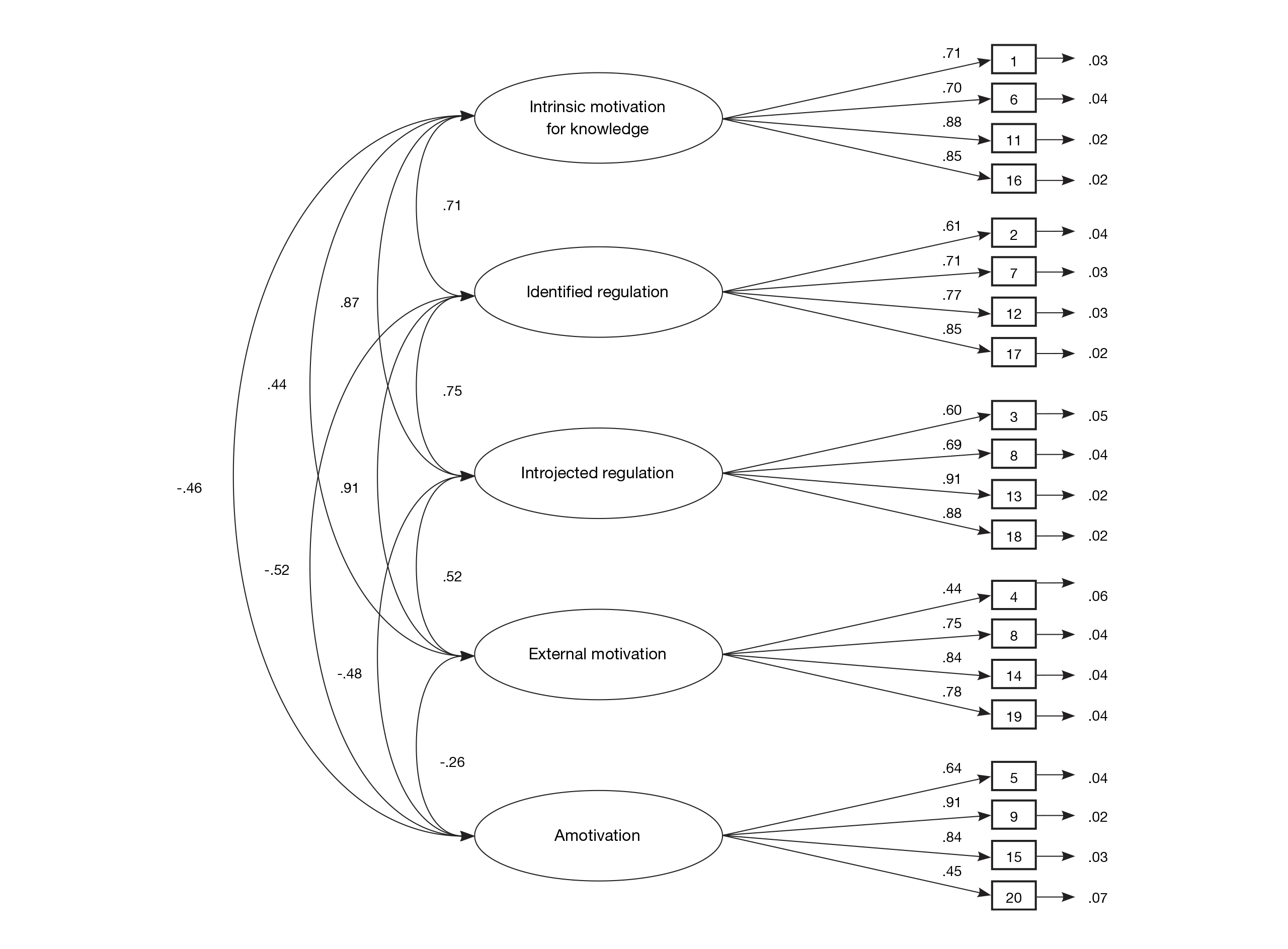
Confirmatory factor analysis. First, the goodness-of-fit statistics and information criteria for the irst-order five-factor solution of the TPSAMS showed adequate fit indices: χ2(160) = 386.95, p < .001, CFI = .92, TLI = .91, RMSEA = .06 (95% CI [.05, .06]), SRMR = .06. The standardized factor loadings for the first-order five-factor solution of TPSAMS are presented in Figure 1. Five factors were positively significant and higher than .44 (Brown, 2006): intrinsic motivation–knowledge, λ = .70 – .88; identified regulation, λ = .61 – .85; introjected regulation, λ = .60 – .910; external regulation, λ = .44 – .84; amotivation, λ = .45 – .91. All five factors were significantly correlated with each other (p < .001).
Descriptive statistics and reliability. Table 2 displays the descriptive statistics and reliability of the scales. As can be observed regarding teachers’ perceptions of students’ motivation (range 1–7), although with very similar values, extrinsic regulation and identified regulation showed higher scores than intrinsic motivation, introjected regulation, and amotivation, respectively. On the other hand, behavioral engagement showed a higher score than emotional engagement. Table 2 also shows the internal consistency of all the variables via Cronbach’s alpha and omega coefficients (Cronbach, 1951; McDonald, 1985, 1999): all the factors obtained scored higher than .76 in both reliability analyses.
Table 2
Descriptive Statistics, Internal Consistency, Discriminant Validity, and Nomological Validity of the Study of the TPSAMS and Students’ Engagement
Discriminant validity. Regarding discriminant validity, positive correlations were found among teachers’ perceptions of intrinsic motivation and extrinsic regulations (r = .44 – .87), and also among teachers’ perceptions of extrinsic regulations (r = .52 – .91). In addition, negative relationships were found among teachers’ perceptions of all types of regulations (r = -.26 – -.45).
Nomological validity. Regarding nomological validity, using latent correlations between factors of the TPSAMS and teachers’ perceptions of students’ behavioral and emotional engagement, the most self-determined types of motivation positively correlated with each other and with both types of students’ engagement, and negatively correlated with amotivation. In addition, amotivation was also negatively correlated with both types of engagement. Finally, students’ behavioral and emotional engagement were positively correlated with each other (r = .81).
Sex invariance. We tested the invariance of the scale as a function of sex: configural invariance, weak invariance, strong measurement, and strict invariance. Specifically, measurement invariance assesses the presence of different types of measurement biases in the context of group comparisons of these four models (Cheung & Rensvold, 2002). The results supported configural invariance for sex, indicating that the questionnaire has the same factor structure for females and males. Findings indicated that factor loadings (metric invariance), item intercepts (scalar invariance), and item uniqueness (strict invariance) were not significantly different across the groups (male vs. female).
Discussion
This study aimed to design and validate a scale to assess PE teachers’ perceptions of the motivation displayed by their students (TPSAMS). Specifically, the EME-S scale (Nuñez et al., 2010) was used as a reference, and content validity, factorial validity, internal consistency, nomological validity, reliability, as well as factorial invariance based on gender (male and female) were examined (Bartram et al., 2018; Lynn, 1986; McGartland et al., 2003; Sireci & Faulkner-Bond, 2014). Overall, the results indicated that the TPSAMS scale is a valid and reliable instrument for evaluating PE teachers’ perceptions of their students’ level of motivation.
First, the CFA results showed a good fit for the TPSAMS with five correlated factors (intrinsic motivation, identified regulation, introjected regulation, external regulation, and amotivation). The factor loadings for each item were appropriate and significantly positive (Brown, 2006). These findings are consistent with other scales measuring student motivation in both primary (CMEF-EP; Leo et al., 2016) and secondary education (PLOC, Moreno-Murcia et al., 2009; EME-S, Nuñez et al., 2010; CMEF, Sánchez-Oliva et al., 2012). For example, Sánchez-Oliva et al., 2012 confirmed the factorial validity of a 20-item model divided into five motivational factors, with excellent item loadings. Similarly, the TPSAMS aligns with the CMEF-EP (Leo et al., 2016) and EME-S (Nuñez et al., 2010) scales, both of which also showed high construct validity and appropriate factor loadings for most items.
Regarding the reliability of the instrument, the TPSAMS has proven to be a reliable tool for measuring the perceptions of primary and secondary education teachers regarding students’ motivation. All motivation factors demonstrated adequate reliability values, supporting the internal consistency of the instrument for each type of motivation. These reliability results are similar to, and slightly higher than those of the previously mentioned scales (Leo et al., 2016; Sánchez-Oliva et al., 2012), which could be attributed to the maturity of teachers in both educational stages. Therefore, the TPSAMS scale is proposed as a reliable instrument for measuring teachers’ perceptions of their students’ types of motivation.
Regarding discriminant validity, the results indicate that, while some positive correlations exist among teachers’ perceptions of different types of motivation, most correlations are moderate and consistent with theoretical expectations. Specifically, intrinsic motivation was positively associated with extrinsic regulations, and different forms of extrinsic regulation were also positively interrelated. One notable exception was the relatively high correlation between identified regulation and external regulation, and between intrinsic motivation and introjected regulation, suggesting a slight overlap between these constructs in teachers’ perceptions. At the same time, negative associations were observed between the types of regulation and amotivation, supporting the distinction among motivational constructs. Overall, these findings suggest that teachers can differentiate among the various forms of student motivation to a reasonable extent. However, future studies should further investigate discriminant validity, particularly regarding identified and external regulation, to better understand the conceptual distinctions among motivational constructs.
With regard to nomological validity, latent correlations were conducted between each of the TPSAMS factors and teachers’ perceptions of their students’ behavioral and emotional engagement. Specifically, it is worth noting that motivations classified along the motivational gradient as more self-determined, or certain extrinsic motivations (i.e., intrinsic motivation and/or identified regulation) showed a positive and significant correlation with students’ behavioral and emotional engagement (Leo et al., 2022; Vansteenkiste et al., 2006). The significance of these correlations suggests that the validity of the instrument aligns with the expected outcomes for each type of motivation, as well as with teachers’ perceptions of their students’ engagement.
On the other hand, and contrary to expectations, external regulation was also positively related to behavioral and emotional engagement, although it showed lower correlation values and less significance compared to other types of motivations. Previous research (Brandmiller et al., 2023; Leo et al., 2022) has also found positive relationships between external regulation and student engagement. This may be attributed to positive reinforcement by teachers regarding extrinsic aspects of learning. For example, offering external rewards for student behavior or emphasizing academic grades during activities may foster greater extrinsic motivation and higher student engagement for these reasons.
Conversely, student amotivation, as perceived by teachers, was negatively related to students’ behavioral and emotional engagement. This finding further supports the nomological validity of the instrument, given the expected inverse relationship between amotivation and teacher-perceived student engagement. Previous studies have examined nomological validity with other student outcomes, finding positive relationships between intrinsic and extrinsic types of motivation (i.e., intrinsic motivation, identified regulation, and introjected regulation) and the satisfaction of basic psychological needs (Sánchez-Oliva et al., 2012), positive student behaviors (Leo et al., 2016), or self-concept (Núñez et al., 2005), as well as negative relationships between amotivation and these same variables.
Finally, the TPSAMS scale demonstrated gender invariance. The model showed an adequate fit, and no notable changes or substantial increases were observed in the fit indices. According to Cheung and Rensvold (2002), the fit index values were appropriate, with increases in CFI and TLI below .01. Thus, it can be stated that the instrument is invariant regarding gender (male and female). In this regard, this study follows the line of other authors who recommend reporting invariance across gender (Lukaszewski & Stone, 2012; Jiménez-Cortés, 2025). Furthermore, it is consistent with other studies in the Spanish context, such as the validated scale that measures teacher motivation in secondary education (Abós, Sevil et al., 2018), which also demonstrated gender invariance.
Lastly, teachers’ perceptions of their students’ motivation can impact their own motivation and teaching approach (Matosic et al., 2016). For example, teachers who view their students as motivated and engaged are more likely to support their needs (Franco et al., 2023, 2024). Thus, the TPSAMS effectively measures teachers’ perceptions of student motivation. Other studies have explored teachers’ perceptions of overall student motivation without a specific theoretical framework, often mixing items related to engagement (e.g., Brandmiller et al., 2023). This instrument contributes to such research by enabling the assessment of these dimensions from the teachers’ perspective.
Limitations and Future Directions
Despite the need for an instrument to measure teachers’ perceptions of student motivation, some limitations of the present study should be acknowledged. First, we used a cross-sectional design, with each teacher providing only a single response. As a result, it was not possible to evaluate the temporal stability of the instrument. Second, all participating teachers were Spanish, with the majority teaching in secondary education, which may limit the generalizability of the results and the applicability of this instrument to other educational contexts or countries. Future studies involving a larger number of PE teachers from different educational stages are needed to revalidate the factorial structure and reliability of this instrument in other contexts and countries. Finally, the analysis of nomological validity should be interpreted with caution, as the instrument employed to assess teacher engagement showed model fit indices close to, but not fully within, the recommended thresholds. Future studies should further examine this aspect to provide stronger evidence of nomological validity.
Practical Applications
Given the predominantly practical nature of the educational context and the professional trajectory of PE teachers, the TPSAMS instrument can offer a series of practical applications to contribute to the improvement of teaching practices and to the applied study of student motivation from the teachers’ perspective. First, at the academic level, this instrument can be used to develop new educational research that analyzes the relationship between students’ motivation and the teachers’ perceptions of that motivation during the teaching–learning process. This analysis can provide valuable insights into how teachers’ perceptions impact students’ motivation levels and, in turn, how these perceptions influence the development and effectiveness of educational processes. By better understanding this relationship, strategies can be designed to improve motivation in the classroom, fostering an environment more conducive to learning. Second, this instrument can also serve to assess the impact of educational programs and interventions. Quantifying students’ motivation from the teacher’s perspective can help evaluate how interventions modify teachers’ perceptions of student motivation and whether these changes enhance academic outcomes or increase student engagement and commitment. Finally, using the TPSAMS to develop teacher training programs can be particularly valuable for training educators in motivation and learning, as well as for quantifying their perceptions of students’ motivation. Designing these training programs can enhance teachers’ understanding of the motivational processes occurring in the classroom, which, in turn, could optimize the teaching–learning process, making it more effective and enriching.
Conclusion
To sum up, the TPSAMS demonstrates adequate psychometric properties in terms of construct and nomological validity, reliability, and gender invariance among teachers. As such, it stands out as a pioneering instrument for assessing teachers’ perceptions of student motivation. Furthermore, the validity demonstrated by the TPSAMS facilitates the measurement and collection of data on teachers’ perceptions, thereby promoting the development of further studies analyzing teachers’ views on student motivation across primary and secondary education.
References
[1] Abós, Á., Haerens, L., Sevil, J., Aelterman, N., & García-González, L. (2018). Teachers’ motivation in relation to their psychological functioning and interpersonal style: A variable-and person-centered approach. Teaching and Teacher Education, 74, 21–34. doi.org/10.1016/j.tate.2018.04.010
[2] Abós, Á., Sevil, J., Martín-Albo, J., Aibar, A., & García-González, L. (2018). Validation evidence of the Motivation for Teaching Scale in Secondary Education. The Spanish Journal of Psychology, 21(E9). doi.org/10.1017/sjp.2018.11
[3] American Psychological Association. (2009). Publication manual of the American Psychological Association (6th ed.). American Psychological Association.
[4] Assor, A., Vansteenkiste, M., & Kaplan, A. (2009). Identified versus introjected approach and introjected avoidance motivations in school and in sports: The limited benefits of self-worth strivings. Journal of Educational Psychology, 101(2), 482–497. doi.org/10.1037/a0014236
[5] Barkoukis, V., Hagger, M. S., Lambropoulos, G., & Tsorbatzoudis, H. (2010). Extending the trans-contextual model in physical education and leisure-time contexts: Examining the role of basic psychological need satisfaction. British Journal of Educational Psychology, 80(4), 647–670. doi.org/10.1348/000709910X487023
[6] Bartholomew, K. J., Ntoumanis, N., Mouratidis, A., Katartzi, E., Thøgersen-Ntoumani, C., & Vlachopoulos, S. (2018). Beware of your teaching style: A school-year long investigation of controlling teaching and student motivational experiences. Learning and Instruction, 53, 50–63. doi.org/10.1016/j.learninstruc.2017.07.006
[7] Bartram, D., Berberoglu, G., Grégoire, J., Hambleton, R., Muniz, J., & van de Vijver, F. (2018). ITC guidelines for translating and adapting tests (Second edition). International Journal of Testing, 18(2), 101–134. doi.org/10.1080/15305058.2017.1398166
[8] Brandmiller, C., Schnitzler, K., & Dumont, H. (2023). Teacher perceptions of student motivation and engagement: Longitudinal associations with student outcomes. European Journal of Psychology of Education, 39, 1397–1420. doi.org/10.1007/s10212-023-00741-1
[9] Brown, T. A. (2006). Confirmatory factor analysis for applied research. Guilford Press.
[10] Bruner, M. W., & Benson, A. J. (2018). Evaluating the psychometric properties of the Social Identity Questionnaire for Sport (SIQS). Psychology of Sport and Exercise, 35, 181– 188. doi.org/10.1016/j.psychsport.2017.12.006
[11] Cheung, G. W., & Rensvold, R. B. (2002). Evaluating goodness-of-fit indexes for testing measurement invariance. Structural Equation Modeling: A Multidisciplinary Journal, 9(2), 233–255. doi.org/10.1207/S15328007SEM0902_5
[12] Cronbach, L. J. (1951). Coefficient alpha and the internal structure of tests. Psychometrika, 16(3), 297–334. doi.org/10.1007/BF02310555
[13] Deci, E. L., & Ryan, R. M. (2000). The “what” and “why” of goal pursuits: Human needs and the self-determination of behavior. Psychological Inquiry, 11(4), 227–268. doi.org/10.1207/S15327965PLI1104_01
[14] e, E., Coterón, J., & Spray, C. (2024). Antecedents of teachers’ motivational behaviours in physical education: A scoping review utilising achievement goal and self-determination theory perspectives. International Review of Sport and Exercise Psychology, 18(2), 1123–1162. doi.org/10.1080/1750984X.2024.2366835
[15] Franco, E., González-Peño, A., & Coterón, J. (2023). Understanding physical education teachers’ motivational outcomes and feasibility beliefs to implement motivational strategies: The role of perceived pressures from a variable-and person-centered approach. Psychology of Sport and Exercise, 64, 102337. doi.org/10.1016/j.psychsport.2022.102337
[16] Goudas, M., Biddle, S. J. H., & Fox, K. (1994). Perceived locus of causality, goal orientations and perceived competence in school physical education classes. British Journal of Educational Psychology, 64(3), 453–463. doi.org/10.1111/j.2044-8279.1994.tb01116.x
[17] Hagger, M. S., Chatzisarantis, N. L. D., Hein, V., Pihu, M., Soós, I., Karsai, I., Lintunen, T., & Leemans, S. (2009). Teacher, peer, and parent autonomy support in physical education and leisure-time physical activity: A trans-contextual model of motivation in four nations. Psychology & Health, 24(6), 689–711. doi.org/10.1080/08870440801956192
[18] Hu, L. T., & Bentler, P. M. (1999). Cut-off criteria for fit indexes in covariance structure analysis: Conventional criteria versus new alternatives. Structural Equation Modeling: A Multidisciplinary Journal, 6(1), 1–55. doi.org/10.1080/10705519909540118
[19] Jiménez-Cortés, R. (2025). Teacher Digital Empowerment Scale: Study of validity and measurement invariance by gender and educational level. Social Sciences & Humanities Open. doi.org/10.2139/ssrn.5279392
[20] Kline, R. B. (2023). Principles and practice of structural equation modeling (5th ed.). Guilford Publications.
[21] Lei, H., Cui, Y., & Chiu, M. M. (2018). The relationship between teacher support and students’ academic emotions: A meta-analysis. Frontiers in Psychology, 8, 2288. doi.org/10.3389/fpsyg.2017.02288
[22] Leo, F. M., García-Fernández, J. M., Sánchez-Oliva, D., Pulido, J. J., & García-Calvo, T. (2016). Validation of the motivation in physical education questionnaire in Primary Education (CMEF-EP). Universitas Psychologica, 15(1), 315–326. doi.org/10.11144/Javeriana.upsy15-1.vmpe
[23] Leo, F. M., Mouratidis, A., Pulido, J. J., López-Gajardo, M. A., & Sánchez-Oliva, D. (2022). Perceived teachers’ behavior and students’ engagement in physical education: The mediating role of basic psychological needs and self-determined motivation. Physical Education and Sport Pedagogy, 27(1), 59–76. doi.org/10.1080/17408989.2020.1850667
[24] Lonsdale, C., Sabiston, C. M., Taylor, I. M., & Ntoumanis, N. (2011). Measuring student motivation for physical education: Examining the psychometric properties of the Perceived Locus of Causality Questionnaire and the Situational Motivation Scale. Psychology of Sport and Exercise, 12(3), 284–292. doi.org/10.1016/j.psychsport.2010.11.003
[25] Lukaszewski, K. M., & Stone, D. L. (2012). Theory and research on social issues in organizations. Journal of Managerial Psychology, 27(4), 324–329. doi.org/10.1108/02683941211220216
[26] Lynn, M. R. (1986). Determination and quantification of content validity. Nursing Research, 35(6), 382–386. doi.org/10.1097/00006199-198611000-00017
[27] Matosic, D., Ntoumanis, N., & Quested, E. (2016). Antecedents of need supportive and controlling interpersonal styles from a self-determination theory perspective: A review and implications for sport psychology research. In M. Raab, P. Wylleman, R. Seiler, A. M. Elbe, & A. Hatzigeorgiadis (Eds.), New perspectives on sport and exercise psychology (pp. 145–180). Elsevier.
[28] McDonald, R. P. (1985). Factor analysis and related methods. Lawrence Erlbaum.
[29] McDonald, R. P. (1999). Test theory: A unified treatment. NJ: Erlbaum.
[30] McGartland, D., Berg-Weger, M., Tebb, S. S., Lee, E. S., & Rauch, S. (2003). Objectifying content validity: Conducting a content validity study in social work research. Social Work Research, 27(2), 94–104. doi.org/10.1093/swr/27.2.94
[31] Moreno-Murcia, J. A., González-Cutre, D., & Chillón, M. (2009). Preliminary validation in Spanish of a scale designed to measure motivation in physical education classes: The Perceived Locus of Causality (PLOC) Scale. The Spanish Journal of Psychology, 12(1), 327–337. doi.org/10.1017/s1138741600001724
[32] Muthén, L., & Muthén, B. (n.d.). Mplus statistical modeling software 1998–2019. Muthén & Muthén.
[33] Ntoumanis, N. (2001). A self‐determination approach to the understanding of motivation in physical education. British Journal of Educational Psychology, 71(2), 225–242. doi.org/10.1348/000709901158497
[34] Nunnally, J. C., & Bernstein, I. H. (1994). The assessment of reliability. In J. C. Nunnally & I. H. Bernstein (Eds.), Psychometric theory (3rd ed., pp. 248–292). McGraw-Hill.
[35] Núñez, J. L., Martín-Albo, J., & Navarro, J. G. (2005). Validación de la versión española de la Échelle de Motivation en Éducation (Validity of the Spanish version of the Échelle de Motivation en Éducation). Psicothema, 17(2), 344–349.
[36] Núñez, J. L., Martín-Albo, J., Navarro, J. G., & Suárez, Z. (2010). Adaptación y validación de la versión española de la Escala de Motivación Educativa en estudiantes de educación secundaria postobligatoria (Adaptation and validation of the Spanish version of the Academic Motivation Scale in post-compulsory secondary education students). Studies in Psychology: Estudios de Psicología, 31(1), 89–100. doi.org//10.1174/021093910790744590
[37] Pelletier, L. G., Séguin-Lévesque, C., & Legault, L. (2002). Pressure from above and pressure from below as determinants of teachers’ motivation and teaching behaviors. Journal of Educational Psychology, 94(1), 186–196. psycnet.apa.org/doi/10.1037/0022-0663.94.1.186
[38] Reeve, J., & Cheon, S. H. (2021). Autonomy-supportive teaching: Its malleability, benefits, and potential to improve educational practice. Educational Psychologist, 56(1), 54–77. doi.org/10.1080/00461520.2020.1862657
[39] Roth, G., Assor, A., Kanat-Maymon, Y., & Kaplan, H. (2007). Autonomous motivation for teaching: How self-determined teaching may lead to self-determined learning. Journal of Educational Psychology, 99(4), 761–774. doi.org/10.1037/0022-0663.99.4.761
[40] Ryan, R. M., & Deci, E. L. (2000). Intrinsic and extrinsic motivations: Classic definitions and new directions. Contemporary Educational Psychology, 25(1), 54–67. doi.org/10.1006/ceps.1999.1020
[41] Ryan, R. M., & Deci, E. L. (2020). Intrinsic and extrinsic motivation from a self-determination theory perspective: Definitions, theory, practices, and future directions. Contemporary Educational Psychology, 61, 101860. doi.org/10.1016/j.cedpsych.2020.101860
[42] Sánchez-Oliva, D., Leo, F. M., Amado, D., González-Ponce, I., & García-Calvo, T. (2012). Desarrollo de un cuestionario para valorar la motivación en educación física (Development of a questionnaire to assess motivation in physical education). Revista Iberoamericana de Psicología del Ejercicio y el Deporte, 7(2), 227–250.
[43] Sireci, S., & Faulkner-Bond, M. (2014). Validity evidence based on test content. Psicothema, 26(1), 100–107. doi.org/10.7334/psicothema2013.256
[44] Skinner, E. A., Kindermann, T. A., & Furrer, C. J. (2008). A motivational perspective on engagement and disaffection: Conceptualization and assessment of children’s behavioral and emotional participation in academic activities in the classroom. Educational and Psychological Measurement, 69(3), 493–525. doi.org/10.1177/0013164408323233 (Original work published 2009)
[45] Standage, M., Duda, J. L., & Ntoumanis, N. (2005). A test of self-determination theory in school physical education. British Journal of Educational Psychology, 75(3), 411–433. doi.org/10.1348/000709904X22359
[46] Taylor, I. M., & Ntoumanis, N. (2007). Teacher motivational strategies and student self-determination in physical education. Journal of Educational Psychology, 99(4), 747–760. doi.org/10.1037/0022-0663.99.4.747
[47] Taylor, I. M., Ntoumanis, N., Standage, M., & Spray, C. M. (2010). Motivational predictors of physical education students’ effort, exercise intentions, and leisure-time physical activity: A multilevel linear growth analysis. Journal of Sport and Exercise Psychology, 32(1), 99–120. doi.org/10.1123/jsep.32.1.99
[48] Vallerand, R. J., & Rousseau, F. L. (2001). Intrinsic and extrinsic motivation in sport and exercise: A review using the hierarchical model of intrinsic and extrinsic motivation. In R. N. Singer, H. A. Hausenblas, & C. M. Janelle (Eds.), Handbook of sport psychology (2nd ed., pp. 389–416). John Wiley & Sons.
[49] Vallerand, R. J., Blanchard, C., Mageau, G. A., Koestner, R., Ratelle, C., Léonard, M., Gagné, M., & Marsolais, J. (2003). Les passions de l’âme: On obsessive and harmonious passion. Journal of Personality and Social Psychology, 85(4), 756–767. doi.org/10.1037/0022-3514.85.4.756
[50] Vallerand, R. J., Pelletier, L. G., Blais, M. R., Briere, N. M., Senecal, C., & Vallieres, E. F. (1992). The Academic Motivation Scale: A measure of intrinsic, extrinsic, and amotivation in education. Educational and Psychological Measurement, 52(4), 1003–1017. doi.org/10.1177/0013164492052004025
[51] Vallerand, R. J. (2007). Intrinsic and extrinsic motivation in sport and physical activity: A review and a look at the future. En G. Tenenbaum & R. C. Eklund (Eds.), Handbook of sport psychology (3rd ed., pp. 59–83). John Wiley & Sons.
[52] Vansteenkiste, M., & Ryan, R. M. (2013). On psychological growth and vulnerability: Basic psychological need satisfaction and need frustration as a unifying principle. Journal of Psychotherapy Integration, 23(3), 263–280. doi.org/10.1037/a0032359
[53] Vansteenkiste, M., Lens, W., & Deci, E. L. (2006). Intrinsic versus extrinsic goal contents in self-determination theory: Another look at the quality of academic motivation. Educational Psychologist, 41(1), 19–31. doi.org/10.1207/s15326985ep4101_4
[54] Vansteenkiste, M., Ryan, R. M., & Soenens, B. (2020). Basic psychological need theory: Advancements, critical themes, and future directions. Motivation and Emotion, 44, 1–31. doi.org/10.1007/s11031-019-09818-1
ISSN: 2014-0983
Received: June 4, 2025
Accepted: November 30, 2025
Published: April 1, 2026
Editor: © Generalitat de Catalunya Departament de la Presidència Institut Nacional d’Educació Física de Catalunya (INEFC)
© Copyright Generalitat de Catalunya (INEFC). This article is available from url https://www.revista-apunts.com/. This work is licensed under a Creative Commons Attribution-NonCommercial-NoDerivatives 4.0 International License. The images or other third party material in this article are included in the article’s Creative Commons license, unless indicated otherwise in the credit line; if the material is not included under the Creative Commons license, users will need to obtain permission from the license holder to reproduce the material. To view a copy of this license, visit https://creativecommons.org/licenses/by-nc-nd/4.0/deed.en


