The Development of Body Expression in Spain: Mercè Mateu, an Inspiring Teacher
Galo Sánchez-Sánchez


Carmen Padilla-Moledo
Inmaculada C. Álvarez-Gallardo
Diana Amado Alonso
Esther Apesteguía-Lanseros
Marta Arévalo Baeza
José Manuel Armada-Crespo
Daniel Caballero-Julia
Cristina Calvo-Estelrich
Dolors Cañabate
Javier Coterón
Silvia Garcías
Javier Gil-Ares
Ana Hernández-Gándara
Alfredo Larraz Urgelés
Miriam Lorenzo
Mar Montávez
Kiki Ruano
Antonio Sánchez-Martín
Julia Serrano
Pablo Sotoca-Orgaz
Carlota Torrents Martín
*Corresponding author: Carlota Torrents ctorrentsm@gencat.cat
Cite this article
Sánchez-Sánchez, G., Padilla-Moledo, C., Álvarez-Gallardo, I.C., Amado, D., Apesteguía-Lanseros, E., Arévalo, M., Armada-Crespo, J. M., Caballero-Julia, D., Calvo-Estelrich, C., Cañabate, D., Coterón, J., Garcías, S., Gil, J., Hernández-Gándara, A., Larraz, A., Miriam, L., Montávez, M., Ruano, K., Sánchez-Martín, A., Serrano, J., Sotoca-Orgaz, P., & Torrents, C. (2026). The development of body expression in Spain: Mercè Mateu, an inspiring teacher. Apunts. Educación Física y Deportes, 164, 1-9. https://doi.org/10.5672/apunts.2014-0983.es.2026.164.01
Abstract
The development of Body Expression in Spain has been closely linked to the educational sphere, especially to the training of Physical Education teachers. In this context, Mercè Mateu’s teaching and research career has had a significant influence on the consolidation of Body Expression as a field of knowledge and as a specific content area within physical education, as well as on pedagogical practice aimed at teacher education.
This article is part of a historiographical narrative review with a hermeneutic-interpretive approach and aimed to analyze and contextualize Mercè Mateu’s main contributions to the development of Body Expression in the academic and educational fields. To this end, a systematized review of her published scientific output was carried out, both as lead author and as co-author.
From a qualitative perspective, the analysis made it possible to identify a trajectory structured around several fundamental axes: the performing arts (dance and circus), motor praxeology as an integrating theoretical framework, emotional education, the gender perspective, and teacher education.
The results show that the doctoral dissertation defended in 2010 constituted a turning point by establishing a bridge between the analysis of the internal logic of artistic motor practices and their stage and pedagogical application. Taken together, Mercè Mateu’s work highlights the potential of Body Expression as an interdisciplinary field for emotional education, teaching innovation, and comprehensive education in contemporary Physical Education.
Introduction
The development of Body Expression in Spain has undergone a slow but continuous evolution that becomes most prominent in the educational context. The didactics of Body Expression within the framework of Physical Education represents a firm commitment to educating all generations in the knowledge of their own bodies and the expressive resources that movement offers us (Coterón & Sánchez, 2010). Sánchez (2022) notes that:
Bodily expressiveness is a natural and everyday human behavior that reveals the emotional states of the person expressing themselves. The body activates its expressive resources and, whether with the help of words or without them, brings into play a series of facial gestures, postures, and movements of the hands and arms, among others, that testify to the emotions each individual expresses. This expressiveness forms a genuine part of a person’s identity markers, resulting in a unique body language that distinguishes them from others. Just as verbal language is the result of learning, experience, and relationships with others (pp. 104–105).
From a phenomenological perspective, the expressive dimension of movement can be understood as embodied experience, where the body does not act solely as a functional instrument but as a subject of meaning (Husserl, 1970). This conception is consistent with the subsequent development of the discipline within the university context. The expressive dimension of movement encompasses all motor manifestations that involve the intention to express one’s inner world and share it with others through original creative processes with a significant aesthetic component. The fundamental elements of the expressive dimension of movement are expressiveness, communication, creativity, and aesthetics (Sánchez et al., 2008a, 2008b; Sánchez, 2010).
Within this evolutionary context of teaching Body Expression in Spain, the figure of Professor Mercè Mateu stands out, who has now completed more than forty-three years dedicated to teaching at the National Institute of Physical Education of Catalonia (INEFC), both at the Barcelona and Lleida campuses, as well as at the Institut del Teatre de Barcelona (see Figure 1). Her career and contributions have had a significant impact both on the university training in Physical Education and Dance of graduates from the aforementioned institutions and on various fields of research, all related to the discipline of Body Expression.
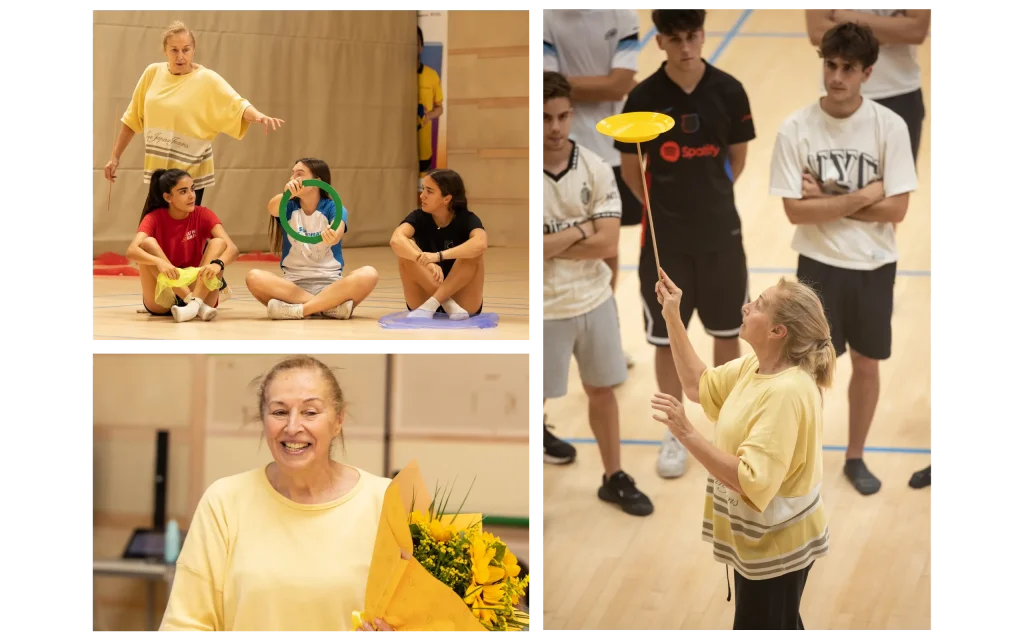
Note. Photographs provided by INEFC.
This article falls within the genre of historiographic narrative review with an interpretive approach and aimed to analyze and contextualize the main contributions of Mercè Mateu to the development of Body Expression in both academic and educational contexts. To this end, an exhaustive review of her published scientific production was carried out, both as a principal author and as a co-author. From the National Association of Teachers of Physical Activity and Body Expression (AFYEC), it was considered relevant to collect these contributions in recognition and gratitude toward someone who has traced a fruitful path focused on the initial training of teachers. Using a qualitative and hermeneutic research approach, an in-depth analysis of her texts was conducted based on the interpretation of the experiences lived and narrated in them. The ultimate aim was to contribute to a better understanding of her academic and pedagogical legacy, as well as to highlight her impact on consolidating Body Expression as a field of knowledge.
Methodology
The study was conducted through a historiographic narrative review with a hermeneutic-interpretive approach. This dual methodological framework allowed, on the one hand, the systematic reconstruction of Mercè Mateu’s academic and scientific trajectory (historiographic dimension) and, on the other, the interpretation of the meaning and conceptual evolution of her contributions within the socio-educational context of Body Expression (hermeneutic dimension).
Historiographic Dimension
An exhaustive compilation of the author’s published academic production between 1990 and 2024 was carried out, including articles in indexed journals, books, book chapters, conference proceedings, and her doctoral dissertation. The documents were selected according to criteria of thematic relevance (body expression, performing arts, motor praxeology, emotional education, and gender perspective) and academic relevance.
The historiographic analysis made it possible to identify key milestones in her research trajectory, especially the publication of reference works (Mateu, 1990; 2003; Mateu et al. 1992), the defense of her doctoral dissertation (Mateu, 2010), and the development of consolidated research lines in emotional education and gender (Gelpi et al., 2014; Romero et al., 2017; Mateu et al., 2021).
Hermeneutic Dimension
From a hermeneutic perspective inspired by the tradition of Husserl (1970) and Gadamer (1998), an interpretive reading was conducted aimed at understanding the evolution of the meaning attributed to Body Expression in the author’s work. Particular attention was paid to the relationship between lived experience, teaching practice, and theoretical construction.
The interpretive analysis followed an iterative procedure characteristic of the hermeneutic circle (Gadamer, 1998), alternating the understanding of individual texts with the reconstruction of the overall academic trajectory. This process made it possible to avoid a fragmented reading and to promote a contextualized and relational interpretation of the identified contributions.
The interpretation focused on identifying:
- Conceptual continuities.
- Transformations in the pedagogical approach.
- Structural contributions to the disciplinary consolidation of Body Expression as a content area within Physical Education.
This procedure made it possible to integrate documentary analysis with a contextualized understanding of the academic and pedagogical impact of her trajectory.
To reinforce the consistency of the analysis, an internal triangulation was applied between primary sources (the author’s publications) and secondary sources (co-authored works and related studies), ensuring interpretive coherence and avoiding biases derived from isolated readings.
Results
Historiographic Construction and Conceptual Evolution
The documentary analysis made it possible to reconstruct Mercè Mateu’s academic trajectory by identifying an evolution articulated around four major axes:
- the construction of an expressive perspective linked to the performing arts;
- the incorporation of motor praxeology as a theoretical framework;
- the development of a research line in emotional education and gender perspective;
- the consolidation of a specific training model in the initial education of Physical Education teachers.
The presentation of the results combines a chronological criterion with a thematic analysis, allowing observation of both the continuity and the transformations in her pedagogical and scientific thinking.
The Construction of the Expressive Perspective
Mateu’s interest in the expressive, communicative, and artistic dimension dates back to her youth as a gymnast and coach, as well as to her fondness for cultural performances. One of these proved especially significant and decisive for her. It was the staging of Jonathan Livingston Seagull by the American mime Stewy, presented at the well-known Sala Cadarso in Madrid in 1981. She explains her impressions very clearly in Mateu (2008):
I was captivated by what that body conveyed through motor evolutions that appeared gymnastic and acrobatic, placed at the service of a story about freedom. Until then, I had experienced those motor actions from the mechanistic perspective of sport, and in fact it was from that aesthetic experience as a spectator that I discovered and began to take an interest in the expressive and communicative dimension of motor behavior (p. 71).
It was precisely that same year when she completed her studies in psychology and opened herself to an immense world. This admiration for the potential of the body in motion led her to an interest in bodily expressiveness in all its dimensions, which was further strengthened by her training at the Institut del Teatre.These experiences led her to ask herself many questions that required answers and demanded determination in intellectual and academic study. With this background, she ventured to deepen her analysis through artistic manifestations and performing arts, whether dance-based, circus-based, or acrobatic.
Mercè Mateu gradually built an intellectual and motor universe to which she would devote more exclusive attention after joining the faculty of INEFC Lleida in 1982, coinciding with the creation of the center. A perfect laboratory for composing, experimenting, and reflecting through courses such as Women’s Artistic Gymnastics and Dynamic Expression, which would later be renamed Body Expression.
From all the experiences accumulated during ten years of university teaching practice emerged the publication of the book 1300 Exercises and Games Applied to Gymnastic Activities (Mateu, 1990), a work of a markedly practical nature that achieved notable dissemination, especially among Physical Education teachers.
The consolidation of her research trajectory can be understood as a process of progressive expansion from artistic experience toward theoretical grounding and applied research.
A Chronology of her Research Interests
Along this line of progressively constructing an expressive and pedagogical perspective, her research trajectory began to be structured around several thematic axes that would shape her scientific development.
The Performing Arts, the Circus
I began to train in the language of Body Expression, dance, mime, and gesture theater. My passion for the physical body and its possibilities for acrobatic expression led me to the language of the circus, the mastery of ylinx (risk, vertigo, inversion), and the relationship with objects and apparatuses, all in the service of an idea, a theme, a narrative. (Fragment written by Mateu in Garcías et al., 2023, p. 53).
Her interest in acrobatics would grow and, from 1987 onward, would be directed toward increasingly structured proposals, such as monographic courses and summer courses with professional teachers and artists. In the 1990s, the National Gymnasts’ Gatherings (Gimnastradas Nacionales) would emerge, which, with an internal logic halfway between sport and art, would become excellent showcases for presenting the collective works of INEFC.
In 2003, within the framework of the 1st International Congress on Body Expression and Education, held in Zamora and organized by AFYEC and the University of Salamanca, she presented her paper entitled The Circus, Body Expression, and Physical Education, in which she explicitly raised the educational value of the circus:
Circus artistic performances constitute centers of historical-cultural knowledge (like creations in dance, gesture theater, or mime…) from which we can extract and sequence content that can be transmitted and learned in educational institutions (Mateu, 2003, p. 136).
The Motor Praxeology of Pierre Parlebas
The creative energy with which INEFC Lleida began its activity required a permanent effort to build stable structures in both teaching and research. Proof of this was the creation in 1991 of the Praxeological Study Group at INEFC Lleida, directed by Professor Francisco Lagardera, with the participation of Gerard Lasierra, Pere Lavega, Conchita Durán, Mario Lloret, and Mercè Mateu, among others.
The seed had arrived in 1986, brought by Domingo Blázquez, a professor at INEFC Barcelona, when Pierre Parlebas presented his work Éléments de sociologie du sport (Parlebas, 1986), a foundational text of motor praxeology that decisively influenced the subsequent development of the praxeological study group at INEFC Lleida.
That meeting sparked in Professor Lagardera an immediate interest in the science of motor action and initiated a line of work that culminated, in a first stage, in 1995 with the defense of the first doctoral dissertation on praxeological themes by Professor Pere Lavega and continued with the investiture of Professor Pierre Parlebas as doctor honoris causa by the University of Lleida in 2002.
The insatiable need for knowledge and her personal boldness in searching for the meaning of artistic motor behavior led Mateu to complete a doctoral dissertation of enormous erudition. A voluminous, profound thesis with numerous intersections, in which all the author’s concerns converge. A work of great theoretical density and analytical depth that articulates multiple conceptual frameworks and went beyond the demands of the Academy.
And thus, in 2010, she defended the dissertation Observación y Análisis de la expresión motriz escénica. Estudio de la lógica interna de los espectáculos artísticos profesionales: Cirque du Soleil (1986‐2005). In it we find all the paths she has traveled in creating her own intellectual universe: motor praxeology, the performing arts, the circus, Body Expression, and the essential value of emotions in artistic creation. Directed by Maria Teresa Anguera and Marta Castañer, it is a document of more than 700 pages in which a work of great maturity is presented, the tangible result of a solid and recognized professional trajectory, woven over time with care and dedication.
The present work develops around a theme—motor expression—that represents an association between personal life, professional trajectory, and an interest in research in the field of motor behavior, and specifically its fascinating possibilities to impress, express, and communicate. At the same time, my attraction to this theme arises from my enthusiasm for the motor manifestations of the body, as a physical, psychological, and relational entity and, above all, as something capable of perceptual and emotional resonance. (Mateu, 2010, p. 1).
Mateu studied ten productions of Cirque du Soleil, identifying the specific characteristics of stage motor-expression situations, as well as the motor, communicative, and symbolic interactions that characterize them.
Her in-depth study of the analysis of the internal logic of expressive activities constitutes a major contribution to the field of human motor behavior by combining a theoretical framework based on motor praxeology with a rigorous and exhaustive observational methodology. This combination establishes a bridge between the analysis of circus motor practice and its application in the educational context (Mateu, 2020; Mateu & Bortoleto, 2011).
The Didactics of Body Expression
Parallel to her praxeological and performing arts studies, Mateu developed a line of research focused on the didactics of Body Expression, especially on the emotional dimension of motor practices. In the field of Body Expression didactics, she made many contributions. In recent years, she has focused particularly on the study of emotions, where some of her most important conclusions are the following:
– Body Expression practices appear to promote emotional well-being, although at the beginning unfamiliarity may manifest as an initial and common embarrassment among most students.
– Positive emotions can enhance creativity and the state of flow, which is key in learning dance and Body Expression. Neuroscience also supports the idea that learning is more firmly established when it is associated with positive emotions.
– The type of task influences the emotional experience: more introspective tasks generate calm and surprise; communicative tasks generate affective bonds; group tasks generate enjoyment. It is the teacher’s responsibility to select the type of task according to the objective to be achieved.
– Physical contact and gaze can generate both well-being and discomfort, depending on the context and previous experience.
With all this, Mateu suggests that emotional education focuses especially on fostering sensations and emotions most conducive to creation, closely linked to sensing the present moment and bodily awareness. She also proposes that teachers create a safe and creative climate in classroom tasks in order to activate emotional impact, showing themselves very receptive to what happens in the classroom (Torrents et al., 2011).
Her continuous need for exploration, as well as for objectifying knowledge through scientific responses to intuitions verified in teaching practice, led her to analyze Body Expression from a gender perspective.
Her findings in this field reaffirm the pedagogical power of expressive motor practices as a bridge between body and emotion, capable of awakening pleasant and intense experiences that go beyond mere motor execution. The absence of significant gender differences questions deeply rooted stereotypes and opens the path toward a more egalitarian and conscious Physical Education. This implies that educating from the expressive dimension of movement is also opening the door to a deep understanding of emotion, and in that dance between gesture and feeling a pedagogy is forged that humanizes, balances, and transforms (Gelpi et al., 2014).
Convinced that there is a link between the positive results of practice and the level of students’ attention, Mateu collaborates in research on the factor of mindfulness, where what she transmits daily in her teaching is scientifically validated through her powerful ability to create spaces where students can express themselves freely and safely. This reaffirms what she had already defended: the educational and human value of expressive practices and the importance of dignifying bodily awareness in the academic sphere. The empirical evidence obtained in these studies consistently supports the pedagogical hypotheses previously formulated from teaching practice, which has left such a profound mark on the training of so many generations (Rovira et al., 2014).
The results of these studies require greater integration as a whole, and she continues with research focused on the emotional states generated by the practice of Body Expression (Mateu et al., 2021; Romero et al., 2017). The potential of these studies, with large samples, lies in showing how these practices produce effects on students’ well-being. Likewise, they reveal the close relationship between the emotional dimension and the positive influence on mental health, an issue that currently constitutes a matter of social concern.
On the other hand, she turns to the study of the connections between gender and sports background, highlighting the emotional importance of including expressive and cooperative practices in the degree in Physical Activity and Sport Sciences (CAFYD), since reinforcing these types of activities could promote both emotional well-being and the development of socio-affective competencies. The results suggest that emotional responses do not depend on gender, which may help dismantle stereotypes (Romero et al., 2018).
Finally, it is worth highlighting her interest in analyzing social contexts with intense stimuli of coexistence. Thus, she participates in a study that makes a valuable contribution to knowledge about the effects and usefulness of Body Expression, highlighting the importance of the interuniversity Body Expression and dance meetings organized annually by AFYEC, based on the experience of their participants. These meetings function as authentic pedagogical laboratories, where coexistence becomes an emotional element that promotes learning outside the classroom. The climate generated shows that when the environment is carefully cultivated, motor expression becomes a fertile space for personal and social growth. In this context, Body Expression and educational dance cease to be merely a form of expression based on technique and instead become a means of self-knowledge and openness toward others.
The intensity of shared emotions and the importance given to interpersonal bonds suggest that Body Expression becomes a catalyst for cohesion, belonging, and mutual recognition. Likewise, it reinforces the purpose of a more humane and sensitive education (Garcías et al., 2022).
Educational Dance
Interest in dance as an artistic and pedagogical practice constitutes another relevant line in Mercè Mateu’s trajectory, expanding the understanding of Body Expression toward its sociocultural and historical dimension. Her natural curiosity leads her to raise questions about dance and its pedagogical application, which fosters its recognition as a comprehensive educational tool for physical, mental, and emotional well-being, as well as a vehicle for expression, creativity, and social transformation.
Her contribution stands out for its innovative and reflective approach and for incorporating the figures of the spectator and the creator as educational agents. The practical application of the examples proposed by Mateu is particularly valuable, as it shows how dance can be meaningfully integrated into diverse school and social contexts (Mateu et al., 2013).
She has also addressed the perspective of the social, cultural, and historical analysis of dance. The struggle of power over the control of the body and the struggle of the body to confront power have historically been present in dance, but they require a scientific approach. Her review, characterized by a critical perspective that highlights the historical invisibility of women in dance, their struggle to occupy a deserved position, the objectification of the female body in dance, stereotypes, etc., constitutes a key element of the discourse necessary to understand, in a well-founded manner, the historical evolution of dance in terms of gender (Serrano et al., 2021).
In other collaborative works, Mateu has mapped the geography of research on dance in Catalonia, highlighting the limited production of doctoral dissertations, the importance of providing predoctoral funding, and the need to articulate dance with other fields of knowledge and art (Cañabate et al., 2022).
The Training of Physical Education Teachers
The formative dimension of Mateu’s trajectory represents one of the most consistent contributions to the development of Body Expression as a university subject within the Degree in Physical Activity and Sport Sciences. Beyond her theoretical and empirical contributions, the most visible impact of her trajectory lies in the initial training of Physical Education teachers, an area in which she consolidated her own pedagogical model.
The well-known maxim of Étienne Decroux (1963), “Head of an actor, body of an athlete, and heart of a poet,” synthesizes the pedagogical approach that has guided her university teaching.
…words that I try to keep present when conducting and sharing a working session: the head of an actor in the sense of play, the body of an athlete in the sense of working with the instrument-body, and the heart of a poet in the sense of attending to emotion, feeling, and the story inscribed in bodies. Working with actors, athletes, and poets is also the memory I keep from the meeting in Madrid with the AFYEC group, carried out through the endearing Ana Pelegrín (Mateu, 2008, p. 74).
Throughout her long trajectory, Professor Mateu has reflected extensively on the methodology of teaching Body Expression and on the outcomes manifested in her classes. It can be affirmed that at INEFC she has consolidated a unique training model based on the hybridization between sports practices and performing arts, a combination that has generated innovative pedagogical experiences, performances of great impact, and spaces of creativity capable of transforming students’ professional trajectories. The interaction between dance, gesture theater, circus, acrobatics, mime, and physical-sport activities not only broadens expressive competencies but also shapes a more integrative and sensitive educational approach to the artistic development of movement. She invites us to consider Body Expression and artistic practices as a strategic field for future research and as an emerging domain with the potential to redefine the academic and professional identity of the field. In light of this evolution, Mateu argues for recognizing the performing arts as a possible fifth training line within the degree in Physical Activity and Sport Sciences (CAFYD), given their growing educational, professionalizing, and social importance (Garcías et al., 2023). Autobiographical narratives show how this hybridization has been possible thanks to the collaborative work of faculty members, with a particularly prominent role played by Mercè Mateu, and to the active involvement of students and the INEF Lleida club in the creation of long-term artistic projects.
Regarding her research on the curricula of CAFYD, such an uneven distribution of credits highlights a broader structural problem: the persistence of a deeply masculinized body imaginary. The hegemony of competitive sports reveals a historical model that has privileged performance, competitiveness, and the logic of federated sport as the legitimate core of physical-sport knowledge. As a consequence, training in CAFYD continues to rely on traditional logics that do not respond to contemporary challenges, especially the need to construct bodily spaces that are inclusive, diverse, and sensitive to gender identities and experiences.
This predominance not only marginalizes artistic and expressive practices but also reduces the understanding of the body to a functional and achievement-oriented vision. Activities culturally associated with femininity continue to occupy a marginal position, reinforcing the dichotomy between practices considered “serious” and those relegated to the status of “accessory.” In this context, the topic raises a broader question: should the incorporation of a gender perspective go beyond simply balancing credits and lead us to rethink which bodily practices are considered valuable, which bodies are legitimized, and which models of movement are reproduced in higher education?
However, comparative data show a progressive trend toward greater incorporation of expressive practices in more recent curricula, especially in more recently established faculties, where a slight increase in credits allocated to artistic-expressive content can be observed (Serrano et al., 2024). This progress, although still insufficient, indicates a gradual opening toward more inclusive and diversified training models.
Discussion
The historiographic analysis conducted allows us to affirm that Mercè Mateu’s contribution to the development of Body Expression in Spain is articulated at three complementary levels.
First, at the epistemological level, her systematic incorporation of motor praxeology (Parlebas, 1986) made it possible to provide scientific grounding for practices traditionally considered peripheral within Physical Education. The application of the concept of internal logic to stage motor-expression situations (Mateu & Bortoleto, 2011) opened a path toward the academic legitimization of circus arts and dance as curricular content.
Second, at the pedagogical level, her research on emotions in expressive motor practices (Gelpi et al., 2014; Romero et al., 2017; Mateu et al., 2021) contributed to strengthening the link between Body Expression, well-being, and holistic education. This approach expands the traditional conception of the body in Physical Education by incorporating affective and relational dimensions consistent with contemporary demands related to mental health and emotional education.
Third, at the structural and training level, her influence on the configuration of curricula and on the hybridization between sports practices and performing arts has generated a distinctive training model within the Spanish university context (Garcías et al., 2023). This model challenges the hegemony of the competitive-sport paradigm and opens space for inclusive bodily practices that are sensitive to the gender perspective (Serrano et al., 2024).
Overall, her trajectory not only represents a significant individual contribution but also exemplifies the process of disciplinary consolidation of Body Expression as a legitimate field within university Physical Education. In hermeneutic terms, this trajectory can be interpreted as a process of progressive resignification of the body in Physical Education, shifting it from an exclusively biomechanical logic toward a symbolic and relational understanding.
Conclusion
The review of Mercè Mateu’s academic and research trajectory allows us to identify a coherent and sustained contribution to the development of Body Expression in the educational sphere and in the performing arts. Her scientific production consistently articulates motor practice, pedagogical reflection, and theoretical construction, integrating the performing arts—especially dance and circus—motor praxeology, and the study of emotional experience.
The analysis of her work, both as a principal author and as a coauthor, shows a progressive evolution of her research interests, in which the doctoral dissertation defended in 2010 occupies a central place by establishing a bridge between the analysis of the internal logic of artistic motor practices and their artistic and pedagogical application. From this framework, her subsequent research has contributed to consolidating Body Expression as a relevant space for emotional education, well-being, and the holistic development of students, as well as for the incorporation of the gender perspective in the training of Physical Education teachers.
Overall, her trajectory highlights the potential of Body Expression as an interdisciplinary field of knowledge and as a domain of teaching and research innovation in contemporary Physical Education.
The review carried out highlights the coherence and depth of a trajectory that has significantly contributed to the academic consolidation of Body Expression in Spain. Beyond personal recognition, her work constitutes a reference for understanding the evolution of this field in contemporary Physical Education and provides insights for future lines of research and teaching innovation.
References
[1] Cañabate, D., Garcías, S., Gumà, X., Iranzo, M., Mateu, M., Pérez, S. & Vendrell, E. (2022). - La investigación en danza en Cataluña en las dos últimas décadas: 2000-2021. Estado de la cuestión. En C. Giménez, M. Martínez, V. Analía, S. Manzo, I. Álvarez, & G. Preciado (Eds.), La investigación en danza (pp. 213–222). Mahali.
[2] Coterón, J. y Sánchez, G. (2010). Educación artística por el movimiento: la Expresión Corporal en Educación Física, Aula, 16, 113–134. doi.org/10.14201/7436
[3] Gadamer, H.-G. (1998). Verdad y método. Sígueme.
[4] Garcías, S. y Mateu, M. (2023). Ventajas de la aplicación de la Expresión Corporal para el bienestar del alumnado. Aula, 29, 263-279. doi.org/10.14201/aula202329263279
[5] Garcías, S., Mateu, M., Spadafora, L. & Armada, J. M. (2022). Feelings and learnings that emerge from the Interuniversity Meeting of Corporal Expression. Retos, Nuevas tendencias en Educación Física, Deporte y Recreación, 45, 1076–1086. doi.org/10.47197/retos.v45i0.91461.
[6] Garcías, S., Mateu, M., Spadafora, L. & Torrents, C. (2023). La formación en Expresión Corporal en el INEFC desde su creación hasta la actualidad. Una historia de sinergias. Aula, 29, 51-71. doi.org/10.14201/aula2023295171
[7] Gelpi, P., Romero, M.R., Mateu, M., Rovira, G. & Lavega, P. (2014). La educación emocional a través de las prácticas motrices de expresión. Perspectiva de género. Educatio Siglo XXI, 32(2), 49-70. doi.org/10.6018/j/194081
[8] Husserl, E. (1970). The crisis of European sciences and transcendental phenomenology. Northwestern University Press.
[9] Mateu, M. (1990). 1300 ejercicios y juegos aplicados a las actividades gimnásticas. Paidotribo.
[10] Mateu, M. (2003). El circo, la expresión corporal y la educación física. En Sánchez, G., Tabernero, B., Coterón, J., Llanós, C. & Learreta, B. (Eds.). Actas Expresión, Creatividad y Movimiento. I Congreso Internacional de Expresión Corporal y Educación, 125-138. Amarú Ediciones.
[11] Mateu, M. (2008). De actores, atletas y poetas, en Sánchez, G., Coterón, J., Padilla, C y Ruano, K. (Eds). Libro conmemorativo AFYEC. Expresión Corporal. Investigación y acción pedagógica, (pp. 71-75). Amarú Ediciones.
[12] Mateu, M. (2010). Observación y análisis de la expresión motriz escénica. Estudio de la lógica interna de los espectáculos artísticos profesionales: Cirque du Soleil (1986-2005). [Tesis doctoral]. Universitat de Barcelona.
[13] Mateu, M. (2013). Circo y universidad. Ambidextro, 54, 30-32.
[14] Mateu, M. (2020). Lógica interna de los “crescendos” en los números de los espectáculos de Cirque du Soleil (1986-2005), Conexões, 18, e020022. doi.org/10.20396/conex.v18i0.8659410
[15] Mateu, M. & Bortoleto, M.A.C. (2011). The internal logic and action domain of motor skills in motor expression situations (MES), Emancipação, 11(1), 129-142. doi.org/10.5212/Emancipacao.v.11i1.0010
[16] Mateu, M., Durán, C. & Troguet, M. (1992). 1000 ejercicios y juegos aplicados a las actividades corporales de expresión. Paidotribo.
[17] Mateu, M. Garcías, S., Spadafora, L., Andrés, A. & Febrer, E. (2021). Student Moods Before and After Body Expression and Dance Assessments. Gender perspective. Frontiers in Psychology, 11. doi.org/10.3389/fpsyg.2020.612811
[18] Mateu, M., Giustina, M., Gumà, X. & Sardá, G. (2013) Educational projects in dance: developing a creative reality. Retos, 24, 154–157. doi.org/10.47197/retos.v0i24.34549
[19] Parlebas, P. (1986). Éléments de sociologie du sport. Presses Universitaires de France.
[20] Romero, R., Gelpi, P., Mateu, M. & Lavega, P. (2017). Influencia de las prácticas motrices sobre el estado emocional de estudiantes universitarios. Revista Internacional de Medicina y Ciencias de la Actividad Física y del Deporte, 17 (67), 449-466. doi.org/10.15366/rimcafd2017.67.004
[21] Romero, R., Gelpi, P, Mateu, M. & Lavega, P. (2018). Prácticas cooperativas de expresión motriz y emociones en estudiantes de actividad física; género e historial deportivo. En J.L. Soler, O. Díaz, E. Escolano-Pérez, & A. Rodríguez (Eds.) Inteligencia emocional y bienestar III. Reflexiones, experiencias profesionales e investigaciones (pp.210-221). Ediciones Universidad San Jorge.
[22] Rovira, G., López-Ros, V., Lavega, P. & Mateu, M. (2014). Las emociones en las prácticas motrices de atención plena. Revista Española de orientación y psicopedagogía, 25(2) 111-126. doi.org/10.5944/reop.vol.25.num.2.2014.13523
[23] Sánchez, G. (2010). Educación estética y educación artística. Reflexiones para una enseñanza creativa. Aula, revista de pedagogía de la Universidad de Salamanca, 16, 21-32. doi.org/10.14201/7429
[24] Sánchez, G. (2022). La enseñanza de la Expresión Corporal en el sistema educativo español, Revista Historia de la Educación, 41, 103-127. doi.org/10.14201/hedu2022103127
[25] Sánchez, G., Coterón, J., Padilla, C., Llopis, A. & Montávez, M. (2008ª). La Expresión Corporal en el marco del Espacio Europeo de Educación Superior. Un proyecto de consolidación, en Sánchez, G., Coterón, J., Gil, J. & Sánchez, A. (Coords.). El movimiento expresivo. Actas del II Congreso Internacional de Expresión Corporal y Educación. Amarú Ediciones.
[26] Sánchez, G., Coterón, J., Padilla, C., & Ruano, K. (2008b). Expresión Corporal. Investigación y acción pedagógica. Amarú Ediciones.
[27] Serrano, J., Mateu, M. & Serra, P. (2024). Las actividades motrices en el grado de CAFYD desde una perspectiva de género, en CIMIE: Congreso de investigación educativa, CIMIE: Ciencia, Educación y diálogos culturales: cerrando brechas, construyendo puentes, (pp. 368-370). Universidad de Granada.
[28] Serrano, J., Soler, S. & Mateu. M. (2021). La danza desde una perspectiva de género, 1997-2010, en Grana R. (Eds.) Discursos, mujeres y artes. ¿construyendo o derribando fronteras? Dykinson.
[29] Torrents, C., Mateu, M., Planas, A. & Dinusôva, M. (2011). Posibilidades de las tareas de expresión corporal para suscitar emociones en el alumnado, Revista de Psicología del Deporte, 20(2), 401-412.
ISSN: 2014-0983
Received: November 23, 2025
Accepted: January 18, 2026
Published: April 1, 2026
Editor: © Generalitat de Catalunya Departament de la Presidència Institut Nacional d’Educació Física de Catalunya (INEFC)
© Copyright Generalitat de Catalunya (INEFC). This article is available from url https://www.revista-apunts.com/. This work is licensed under a Creative Commons Attribution-NonCommercial-NoDerivatives 4.0 International License. The images or other third party material in this article are included in the article’s Creative Commons license, unless indicated otherwise in the credit line; if the material is not included under the Creative Commons license, users will need to obtain permission from the license holder to reproduce the material. To view a copy of this license, visit https://creativecommons.org/licenses/by-nc-nd/4.0/deed.en


