Towards Predictive Analysis of Behavior and Sports Using LINCE PLUS 4 Software
Alberto Soto-Fernández

Oleguer Camerino

Xavier Iglesias
Marta Castañer
Daniel Lapresa
M. Teresa Anguera
*Corresponding author: Alberto Soto-Fernández alberto.soto@gmail.com
Cite this article
Soto-Fernández, A., Camerino, O., Iglesias, X., Castañer, M., Lapresa, D., & Anguera, M. T. (2026). Towards predictive analysis of behavior and sports using LINCE PLUS 4 software. Apunts. Educación Física y Deportes, 164, 92-97. https://doi.org/10.5672/apunts.2014-0983.es.2026.164.09
Abstract
The evolution of new technologies and the rise of artificial intelligence are already affecting how we carry out everyday tasks. Until now, developing a systematic observational study has been an intense and demanding process for researchers, and there seem to be few tools available that ease this workflow. Moreover, most artificial intelligence applications rely on quantitative data, and there are not many systems that enhance the research process for behavior analysis or sports technique analysi within a mixed-methods approach. Over the past two years, we have been working towards this horizon with LINCE PLUS 4, which we now present in this scientific note. This new framework optimizes the overall process, introducing a bridge to cloud-based features and the integration of artificial intelligence within a modern web environment. The new video player for real-time analysis and slow-motion detection includes measurement tools and 2D/3D body-pose detection, enabling a new system that integrates sensor data.
Background
With so many technological complexities involved in using a single software solution that supports all stages of the research process, LINCE PLUS introduced a new tool for conducting systematic behavior analysis in a multipurpose environment. It offers real-time video features for any video format and supports multiple observers within a web-based platform, using a flexible video player and integrating statistical tools such as R on both macOS and Windows (Soto-Fernandez et al., 2019). Multiple observers can evaluate different behavioral episodes across several well-established fields of application, including health, sports, physical activity, and physical education (Soto-Fernandez et al., 2022).
A considerable number of publications validate our software (Chacón-Moscoso et al., 2019), with a presence across practically the entire spectrum of physical activity and sport, but our pace for introducing new features has been limited, and many of them remain overlooked or unknown. On the other hand, it is remarkable how LINCE PLUS stands out as a video annotation tool and is considered, alongside Kinovea, Dartfish, and Observer XT, one of the best annotation tools currently available in the market, with LINCE PLUS and Kinovea being the only options that are free of cost (Fernandes et al., 2025; Leysens et al., 2025).
Existing Foundational Features
Despite the software’s multifunctionality and ease of use, many of the features introduced in LINCE PLUS remain unknown to the community, as they appear to be underused. One of the least-known features is that the software allows users to select videos from remote sources such as YouTube, enabling the integration of video streaming with real-time analysis for live-streams. For previously recorded videos, users can upload files in any format, and the platform will automatically convert them to a specific compression to improve performance under the MP4 format thanks to the integration of the FF-MPEG library (Made et al., 2024).
Another point of interest is that LINCE PLUS can be integrated with any other coding platform on the market, such as the R programming language (Ihaka & Gentleman, 1996) or RStudio for statistical analysis. Users can also extend its functionality by incorporating the data into real-time Python applications for artificial intelligence, BI (Business Intelligence) software for data consolidation, or even Office tools through macros, thanks to its REST API-based core. Nevertheless, these features are generally intended for advanced users. At the same time, this API-first approach has laid the foundation for transitioning toward a cloud-native architecture.
Since version 3.2 of LINCE PLUS, we introduced a very important feature that remains robust but relatively unknown: extensibility. LINCE PLUS incorporates Inversion of Control to determine the engine it uses, making the platform fully extendable through interface-driven development, being a well-known feature to improve maintainability in the long term (Yadati, 2023). In fact, the core of the application ensures a layer for common logic across the different stages of the research process, which is shared between our new cloud service, available at https://www.lince-plus.com, and the desktop application.
Features
As this article reports on the technical development and architectural design of the software platform LINCE PLUS and does not present data collected from or involve human subjects, formal ethical committee approval was not needed.
With this solid and professional environment for supporting the research process, we recognized the need to strengthen and adapt our software to emerging market trends. There is a growing demand for tools that integrate artificial intelligence (AI) as an additional means of extracting and interpreting data, with AI being a way of working that can specifically help in mobile applications and health analysis (Almanasra, 2024). To make this possible, we redesigned the entire front end, giving the application improved usability and facilitating the integration of the various functions required in a cloud‑native ecosystem—such as secure authentication. This evolution can be summarized through the following key advancements: cloud-native, new look and feel, opening external collaboration, and a new custom video player.
Cloud-Native
Although LINCE PLUS seems like a desktop application, it also launches a microservice that can be hosted online. This design allows the same application to run either on the internet or locally without major complications. In addition, the application now compiles and tests automatically during the build process, which is an important improvement compared to the previous manual steps required to build for each platform. This enhancement has strengthened our build workflow on the cloud, with the generation of an automated installer for the different supported computers and performing some consistency tests, ensuring that users do not encounter unexpected errors and improving the reliability of the application (Gami et al., 2025).
New Look and Feel of the Application
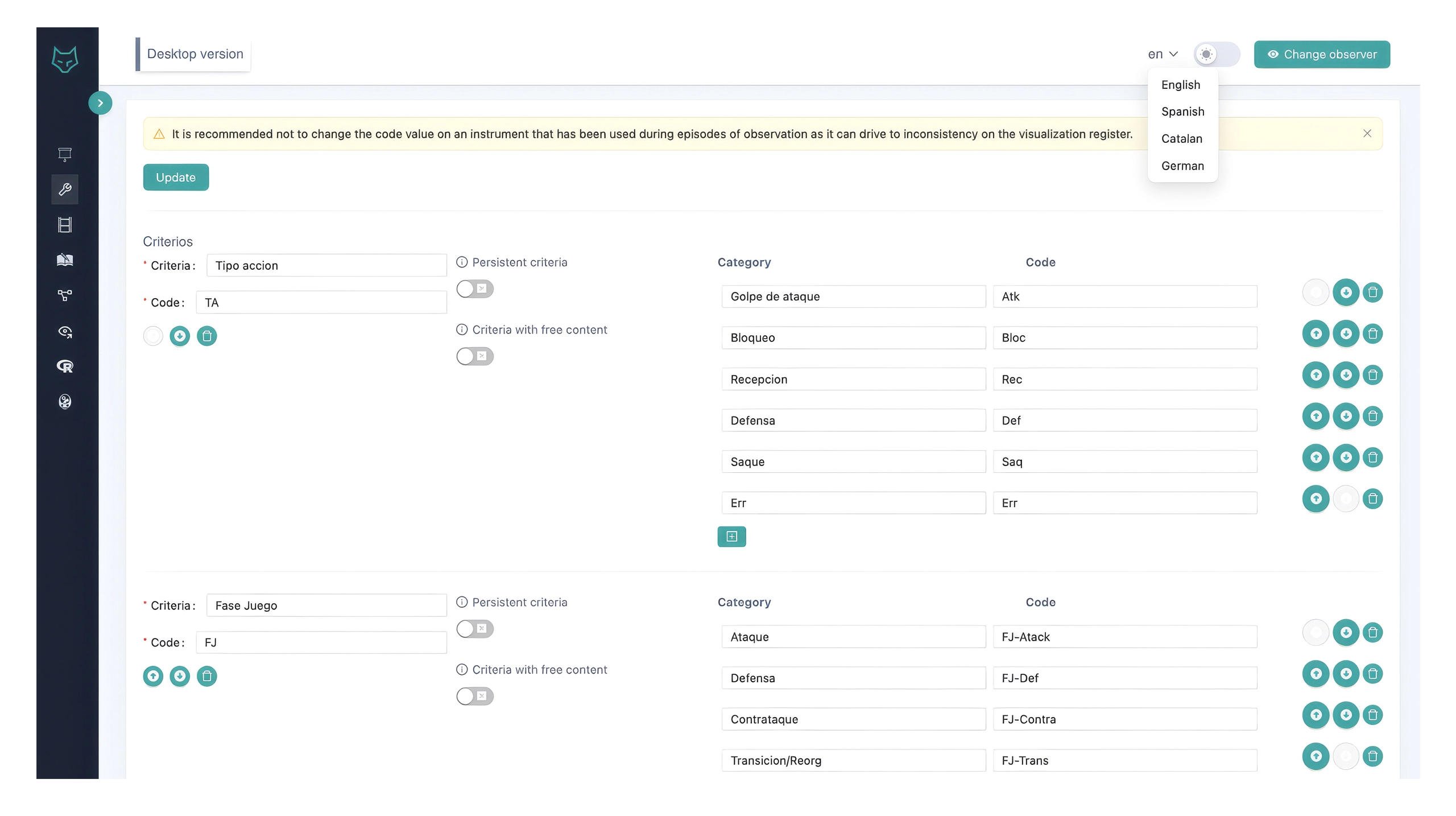
When we created the proof of concept for the cloud service at lince-plus.com, we noticed that users were already registering before the platform was fully ready. This highlighted several issues with running the current application on the web, including slowness, maintenance challenges, and translation concerns. The new user interface was designed to closely resemble the previous one, allowing users to start interacting with minimal learning. We also aimed to eliminate the need to duplicate work when switching between the cloud service and the desktop application. The new design consolidates these efforts, using the latest React patterns, ESBuilds, and NX for a standardized mono-repo, providing a solid foundation for the long-term features, offering unified versioning and a single source of truth (Potvin & Levenberg, 2016). The same environment adapts seamlessly for both desktop and cloud.
External Collaborators
Previously, collaborative observational studies could only be accessed using a QR code generated at the application’s startup. However, this required users with the code to be connected to the same local area network (LAN) or intranet, a significant limitation for external collaboration. In the latest release, we have integrated Ngrok, a secure tunneling service that allows the LINCE PLUS desktop application to be temporarily exposed to the public internet via a temporary public address (Karunamurthy et al., 2024). While the QR code sharing mechanism remains the same, it now facilitates robust remote access until the application is closed or the tunneling feature is manually disabled. This architecture enables the external sharing of user projects through a secure token generation mechanism.
Lince Video Player With AI Features
A primary objective for the latest release of LINCE PLUS was the integration of artificial intelligence (AI) capabilities into the application’s core architecture, representing a key focus since our previous collaboration. This development addressed the need to incorporate wearable sensor data by generating new data layers within the observation episodes. We initiated this by integrating quantitative data streams into a newly developed custom video player. This player retains all traditional video execution functionalities but introduces a new operational mode allowing users to perform on-screen annotation or activate custom AI models for features like human pose detection. This capability provides novel tools for the measurement of kinematic variables, including the estimation of joint angles and body segmentation calculation from the model detection and performance or body composition analysis from wearable data.
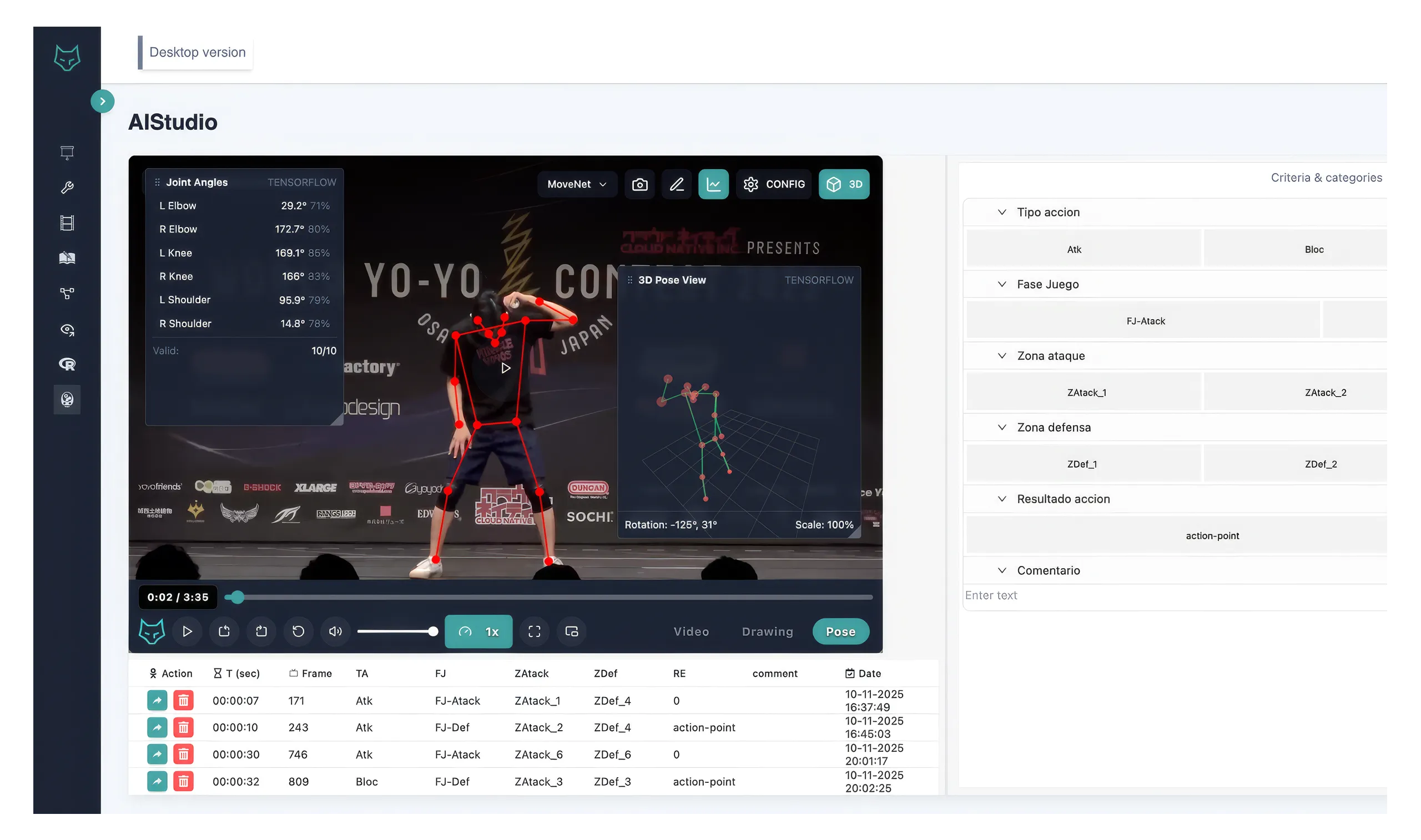
Pose estimation is a field of active research, with models such as OpenPose, PoseNet, and MoveNet being widely utilized for their high accuracy (Jo & Kim, 2022). This approach offers significant advantages over traditional motion capture (MoCap), which typically requires complex body markers, specialized multi-camera setups, and extensive post-processing. In contrast, pose estimation can be applied to naturalistic motion in real-time scenarios without compromising recognition capabilities (Takeda et al., 2020).
Our new video player leverages this technology to estimate and generate a 3D kinematic model derived directly from the pose detection output. A key feature is the ability for users to select the optimal pose recognition model for their specific observational needs. The initial release supports both MoveNet and BlazePose, which represent recent additions to validated pose estimation models and have demonstrated strong performance in clinical studies for diagnosing musculoskeletal disorders, tracking rehabilitation progress, and analyzing various sports movements (Roggio et al., 2024).
We plan to integrate additional models as we refine the integration tool and expand model support. This flexibility allows users to customize the trade-off between speed and accuracy and select between single-pose and multi-pose detection algorithms. Furthermore, the architecture supports the incorporation of custom models trained for specific sport actions.
The application features a new video player which enhances core capabilities, including native support for streaming video content hosted on platforms such as YouTube. Plans are underway to enable integration with other streaming providers. Crucially, this player is designed to facilitate the synchronous integration of quantitative data layers directly onto the video stream and also to export them to episodes of observation. This capability establishes a novel framework for integrating derived measurements, such as angle estimation, and raw input from wearable sensor data directly within observational studies.
From a practical point of view, these features allow for easy integration into the observational model, enabling aspects such as body angles and center of mass calculations to be included in the observational record. In addition, although not available at the time of writing, object detection will be enabled. These capabilities will have direct application in sports practice, facilitating biomechanical calculations.
Results
The latest release of LINCE PLUS introduces core architectural advancements for enhanced collaboration and AI-driven analysis. Remote access limitations were resolved by integrating a secure tunneling service, enabling the application to be temporarily exposed to the public internet via a temporary address, thereby facilitating the external sharing of observational projects using QR code and token generation. A new video player was implemented, providing native support for online streaming platforms and establishing a critical framework for the synchronous integration of quantitative data layers. This player allows users to overlay video content with derived measurements, such as angle estimation and wearable sensor data. Furthermore, it incorporates custom AI models for real-time human pose detection, generating a 3D kinematic model from naturalistic motion. The program still has some limitations, such as the consistency of the record in case of modification, complex exports and missing accuracy on the integration with other systems. We also have the limitation that these AI capabilities are not yet automatically integrated with the observational record. For this purpose, we recommend manually entering the information in a free-form field, which allows any value to be recorded in text format. However, it is expected that this process will soon be automated.
On the other hand, we must bear in mind that current technological advances facilitate software development at a much faster pace, and similar applications are expected to emerge. Therefore, the main limitations are the time required for development and the investment needed to bring a product to market. It should also be noted that the validation of artificial intelligence models is rapidly evolving, and their scientific justification remains open to debate, although their practical applications is a point of clear interest.
Conclusions
These features improve LINCE PLUS from a primarily local data recording tool into a powerful, secure platform for global, multimodal, and AI-assisted scientific analysis, significantly accelerating the pace and scope of observational research. It offers a new way of working and will be generating new features, while some of them will be directly available for cloud users and others remain as a foundation for desktop users. With this new foundational level, we will begin developing the integration of quantitative data and offer updated and secure integration for behavior analysis.
Acknowledgments
Observational methodology and its application within a mixed-methods approach have been the core focus of our research team since 1979. The development of the foundations of Observational Methodology in the 1990s is largely attributed to the late Dra. M. Teresa Anguera, who established a comprehensive theoretical, strategic, and technical framework for understanding all types of human behavior in natural contexts. She led the development of the LINCE (2012) and LINCE PLUS (2022) software, which focus on the direct and indirect observation of physical activities, sports, and related health fields. Her innovative vision guided us toward the use of video and its multiple applications as a fundamental tool for studying interactions in sports. We now present the new and improved version 4 of LINCE PLUS as a tribute to her legacy and generosity.
The authors gratefully acknowledge the support of a Spanish government project LINCE PLUS: Multimodal platform for data integration, synchronization and analysis in physical activity and sport [PID2024-156051NB-I00] (2025–2027) (Ministerio de Ciencia, Innovación y Universidades, Agencia Estatal de Investigación 10.13039/501100011033, FEDER, European Union), which will help our project to introduce quantitative data analysis and introduce wearable data from this stable release.
References
[1] Almanasra, S. (2024). Applications of integrating artificial intelligence and big data: A comprehensive analysis. Journal of Intelligent Systems, 33(1). doi.org/10.1515/JISYS-2024-0237/XML
[2] Chacón-Moscoso, S., Anguera, M. T., Sanduvete-Chaves, S., Losada, J. L., Lozano-Lozano, J. A., & Portell, M. (2019). Methodological quality checklist for studies based on observational methodology (MQCOM). Psicothema, 31(4), 458-464. doi.org/10.7334/psicothema2019.116
[3] Fernandes, T., Castañer, M., & Camerino, O. (2025). ARS conceptual framework for AI-driven systematic reviews in sports science and medicine. Apunts Educación Física y Deportes, 161, 68-73. doi.org/10.5672/apunts.2014-0983.es.(2025/3).161.08
[4] Gami, S. J., Rao Katru, C., & Shah, K. N. (2025). Enhancing software reliability: The role of automated continuous integration and continuous delivery. International Journal of Computer Applications, 187(1), 975–987.
[5] Ihaka, R., & Gentleman, R. (1996). R: A Language for Data Analysis and Graphics. Journal of Computational and Graphical Statistics, 5(3), 299–314. doi.org/10.1080/10618600.1996.10474713
[6] Jo, B. J., & Kim, S. K. (2022). Comparative Analysis of OpenPose, PoseNet, and MoveNet Models for Pose Estimation in Mobile Devices. Traitement Du Signal, 39(1), 119–124. doi.org/10.18280/ts.390111
[7] Karunamurthy, D. A., K, K., & A, S. (2024). Advanced Wireless Transmission Using NGROK. International Journal for Research in Applied Science and Engineering Technology, 12(5), 2839–2844. doi.org/10.22214/IJRASET.2024.62088
[8] Leysens, G., Claus, R., Van Petegem, W., & Charlier, N. (2025). Video annotation tools for assessing psychomotor skills in nursing education: A scoping review. International Journal of Assessment Tools in Education, 12(October). doi.org/10.21449/ijate.1713558
[9] Made, I., Nugroho, R. A., Putrawan, A. A., Asri, S. A., & Ambara, M. P. (2024). Implementation of FFMPEG Video Compression to Improve Performance and Storage Efficiency in Digital Knowledge Repository System. 378–384. doi.org/10.2991/978-94-6463-587-4_43
[10] Potvin, R., & Levenberg, J. (2016). Why Google stores billions of lines of code in a single repository. Communications of the ACM, 59(7), 78–87. doi.org/10.1145/2854146
[11] Roggio, F., Trovato, B., Sortino, M., & Musumeci, G. (2024). A comprehensive analysis of the machine learning pose estimation models used in human movement and posture analyses: A narrative review. Heliyon, 10(21), e39977. doi.org/10.1016/j.heliyon.2024.e39977
[12] Soto, A., Camerino, O., Iglesias, X., Anguera, M. T., & Castañer, M. (2019). LINCE PLUS: Research Software for Behavior Video Analysis. Apunts Educación Física y Deportes, 137, 149–153. doi.org/10.5672/apunts.2014-0983.es.(2019/3).137.11
[13] Soto-Fernández, A., Camerino, O., Iglesias, X., Anguera, M. T., & Castañer, M. (2022). LINCE PLUS software for systematic observational studies in sports and health. Behavior Research Methods, 54(3), 1263–1271. doi.org/10.3758/s13428-021-01642-1
[14] Takeda, I., Yamada, A., & Onodera, H. (2021). Artificial Intelligence-Assisted motion capture for medical applications: a comparative study between markerless and passive marker motion capture. Computer Methods in Biomechanics and Biomedical Engineering, 24(8), 864–873. doi.org/10.1080/10255842.2020.1856372
[15] Yadati, N. S. P. K. (2023). Importance of Dependency Injection. Journal of Artificial Intelligence, Machine Learning and Data Science, 1(2), 707–710. doi.org/10.51219/jaimld/naga-satya-praveen-kumar-yadati/178
ISSN: 2014-0983
Received: October 23, 2025
Accepted: December 12, 2025
Published: April 1, 2026
Editor: © Generalitat de Catalunya Departament de la Presidència Institut Nacional d’Educació Física de Catalunya (INEFC)
© Copyright Generalitat de Catalunya (INEFC). This article is available from url https://www.revista-apunts.com/. This work is licensed under a Creative Commons Attribution-NonCommercial-NoDerivatives 4.0 International License. The images or other third party material in this article are included in the article’s Creative Commons license, unless indicated otherwise in the credit line; if the material is not included under the Creative Commons license, users will need to obtain permission from the license holder to reproduce the material. To view a copy of this license, visit https://creativecommons.org/licenses/by-nc-nd/4.0/deed.en


