Sustainable Commitment of the Sports Network in the Valencian Community: An Analysis of Sports Federations
Cristian Gregori-Faus

Pablo Jimenez-Jimenez
Alberto Vidal-Vilaplana
Sergio Aguado-Berenguer
*Corresponding author: Cristian Gregori-Faus cristian.gregori@uv.es
Cite this article
Gregori-Faus, C., Jiménez-Jiménez, P., Vidal-Vilaplana, A., & Aguado-Berenguer, S. (2025). Sustainable commitment of the sports network in the Valencian Community: An analysis of the sports federations. Apunts Educación Física y Deportes, 161, 60-67. https://doi.org/10.5672/apunts.2014-0983.es.(2025/3).161.07
Abstract
The concept of sustainable development has taken root in many areas of society, including the sports world due to the impact and benefits that this sector can have for sustainability. However, the incorporation of sustainable practices by sports federations continues to offer a very heterogeneous outlook. In this study we used wave typology to analyze and categorize levels of sustainability integration in sports federations in the Valencian Community. The results show that, though a number of federations have started to take some sustainability-related actions, most of them have yet to integrate these into their strategies in a meaningful way. In that regard, the main conclusions indicate that, despite the key role sports federations play in improving sustainable development and environmental protection, these kinds of sports organizations must necessarily improve their strategies and efforts.
Introduction
While the concepts of sustainability and sustainable development have been widely discussed in the literature, they have clearly gained momentum in recent years (Annesi et al., 2023). This is due, to a large extent, to society’s notable concern about global issues such as climate change (Witulski & Dias, 2020) and the effects it could have, not only environmentally but also socially and economically (Sandoval-Díaz et al., 2024).
With the goal of combating these global problems, the United Nations (UN) has defined various frameworks aimed at mitigating those problems, such as the well-known 2030 Agenda and its 17 sustainable development goals, which aim to serve as a guide so all kinds of organizations, public and private alike, can conduct their activities in a more sustainable manner. (Annesi et al., 2023)
In that sense, sports organizations are not exempt from applying these sustainability improvement measures to their own sports contexts (Ulloa-Hernández et al., 2023). Not only because of the two-way relationship between sports and the environment (McCullough et al., 2020a), but because sports represents one of the essential pillars for sustainable development of the population (UN, 2015), so much so that the United Nations developed the Sports for Climate Action Framework.
Launched in 2018, this instrument is a call to all sports organizations to implement various environmentally responsible actions based on five principles: (a) Undertake systematic efforts to promote greater environmental responsibility, (b) Reduce overall climate impact, (c) Educate for climate action, (d) Promote sustainable and responsible consumption, and (e) Advocate for climate action through communication, with the aim of creating a clear trajectory for the sports community to combat climate change while simultaneously improving climate awareness among citizens (United Nations Framework Convention on Climate Change, or UNFCCC, 2020).
Since its publication, various sports bodies, such as the NBA, FIFA, and Formula 1, among more than 250 organizations adhering to this framework, have committed to aligning their efforts with the Paris Agreement goals, thus actively participating in achieving climate neutrality by 2050 via the five Sports for Climate Action Framework principles.
Similarly, the Spanish society has initiatives like Green Sport Flag, an action plan created by the Spanish Sports Association that shares the same objectives as the Sports for Climate Action Framework. Green Sport Flag proposes different levels of recognition based on the degree of implementation of sustainability-related actions at sports events: Committed Sports Event, Responsible Sports Event, and Sustainable Sports Event, with the latter being the highest level of recognition. It also works to identify which activities are most committed to the environment and takes specific actions such as organizing conferences, measuring the environmental impact of sports, and managing volunteer programs.
Without a doubt, both the academic and professional communities have made various efforts in recent years to improve and understand the role of the sporting world in relation to sustainable develop (Morán-Gámez et al., 2024). That effort has been partially focused on reducing the negative impact of sports on the environment, as well as on discovering how sports can influence citizens to behave in a more responsible manner (Cayolla et al., 2023).
Among the efforts made in relation to environmental impact, some of the most common actions taken by these types of organization include calculating the carbon footprint of their facilities, installing and using renewable energies, reducing waste production, and reducing water use (Thormann & Wicker, 2021; Zhu et al., 2023).
And yet, despite this surge in awareness of the relationship between sports and sustainability, and the increase in related initiatives in the sports world, we can observe that sports organizations still remain quite passive in terms of the sustainability phenomenon (Hugaerts et al., 2023). What’s more, of those organizations that do have sustainable initiatives, there is a clear lack of coherence in the type of actions they take as well as in how they report the effectiveness of said actions (Morán-Gámez et al., 2024). This shows that the sports world needs to continue evolving sustainably in order to fullfil the Sports for Climate Action Framework goals.
In that regard, authors McCullough et al. (2016), drawing on institutional theory, suggest that organizations within the same context tend to be similar to one another because of a phenomenon known as organizational isomorphism, which allows organizations to accept or reject certain practices in order to adapt to a specific context, such as sustainable development in this case, in addition to their own specific context. For this phenomenon to occur in relation to sports organizations’ sustainable actions, and for sports to be able to impact the environmental behavior of the stakeholders of different organizations, they must communicate with each other regarding their efforts, and the results they obtain, such that both organizations and stakeholders become aware of the effectiveness of said actions (McCullough et al., 2020b). This helps create coherence between actions performed by these types of associations and the results they can expect to achieve (Cayolla et al., 2023).
On the other hand, for sustainability-related actions to be effective, it is essential that organizations incorporate them from a strategic point of view. This involves incorporating sustainability as a core pillar of their mission, vision, and values, designing short, medium, and long-term action plans to bring about notable changes in the area of sustainable development (Glibo et al., 2022; Hulpus & Hulpus, 2022).
Therefore, due to their associative structure and ability to regulate their own sports activities, sports federations offer the ideal structure, not only for improving sustainability of the sports world (Moon et al., 2022) but also for improving stakeholders’ awareness of sustainability (Hugaerts et al., 2023). All the same, the academic world has placed more focus on sports associations and clubs, with sports federations’ sustainable initiatives taking a back seat, despite the important role they can play in sustainable development.
Since we could not find any analyses of sustainable commitment by sports federations in Spain, and due to the lack of information about actions carried out by public institutions and the potential effect of sports federations reporting and sharing their actions and strategies, which could contribute to the sports community positively evolving towards sustainable development, the aim of this study was to analyze levels of commitment to sustainable development in various sports federations in the Valencian Community. In addition, we aimed to identify the most common types of actions in these sports organizations, not only to divulge this information, but to create an easy to understand classification that can be adapted to other sports organizations.
Methodology
To gather the information analyzed in this study, we visited the Valencian Government’s web page, where we extracted a total of 58 sports federations in the Valencian Community. We then thoroughly reviewed the web pages of each sports federation in the region to gather as much information as possible about the sustainable initiatives they carry out.
The process to extract information from the sports federations websites, conducted in June 2024, was completed by reading through all sections of the website, including the documents presented therein (e.g., strategic plans, regulations, guidelines, etc.), taking note of any relevant data for subsequent analysis. Second, we searched the websites for the keywords “sustainability,” “environmental,” “environment,” “natural environment,” “SDG,” “goals,” “mission,” “vision,” and “values,” always excluding information from the news or blogs so as to avoid information of a temporary nature, much like Hugaerts et al. (2023).
For the data extraction process, two of the authors independently analyzed the information present on the websites, taking note of any initiatives found and the section of the website they were included under. All the information collected was then shared, analyzed, and reviewed to guarantee the thoroughness of the search.
To code the analyzed actions, we used the classification that McCullough et al. (2016) proposed, and Hugaerts et al. (2023) later expanded upon, which categorizes actions that sports federations integrate into their operations and activities according to the level of strategic commitment to environmental sustainability (see Table 1).

Table 1
Categorization of Organizations Based on Their Commitment to Environmental Sustainability
In terms of classifying and categorizing the content, and with an eye to gaining a deeper understanding of the sports federations’ commitment levels, the same two authors who performed the data extraction were joined by a third author, and the three independently categorized all the information available according to the classification from Hugaerts et al. (2023). After classifying and categorizing all the information, the authors pooled it into a proposal and debated all the categorizations that did not reach an initial consensus, thereby reaching a three-way agreement for the categorization and classification.
The classification of the initiatives differentiated between relatively economic and easy to implement actions, called low-intensity initiatives, and those requiring more involved integration into the actual organization, called high-intensity initiatives. According to the methodology the authors adopted, they also took into account which section of the websites presented the sports federations’ various strategies, differentiating between: (I) strategies or mentions stated in the sports federations’ mission, vision, and values; (II) strategies or actions mentioned in the sports federations’ strategic goals; (III) entire website sections dedicated to the sports federations’ sustainable strategies or actions (e.g., tabs dedicated to sustainability or projects dedicated to the environment); or (IV) sustainable strategies or actions mentioned in other secondary documents or sections (e.g., in the federations’ regulations, or other sections dedicated to different topics).
Results
From the initial study results, we can highlight that of the 58 sports federations in the Valencian Community, only two did not have an official website, leaving us with 56 as the subject of the study. Of those, only 16 (28.57%) included some kind of initiative in the available information. These were presented on a section of the website dedicated to sustainability on one occasion (1.79%); for 12 federations (21.43%), the initiatives were presented in secondary sections of the website, and on three occasions (5.36%) they were presented in both a dedicated section and in other secondary sections of the website (see Figure 1).
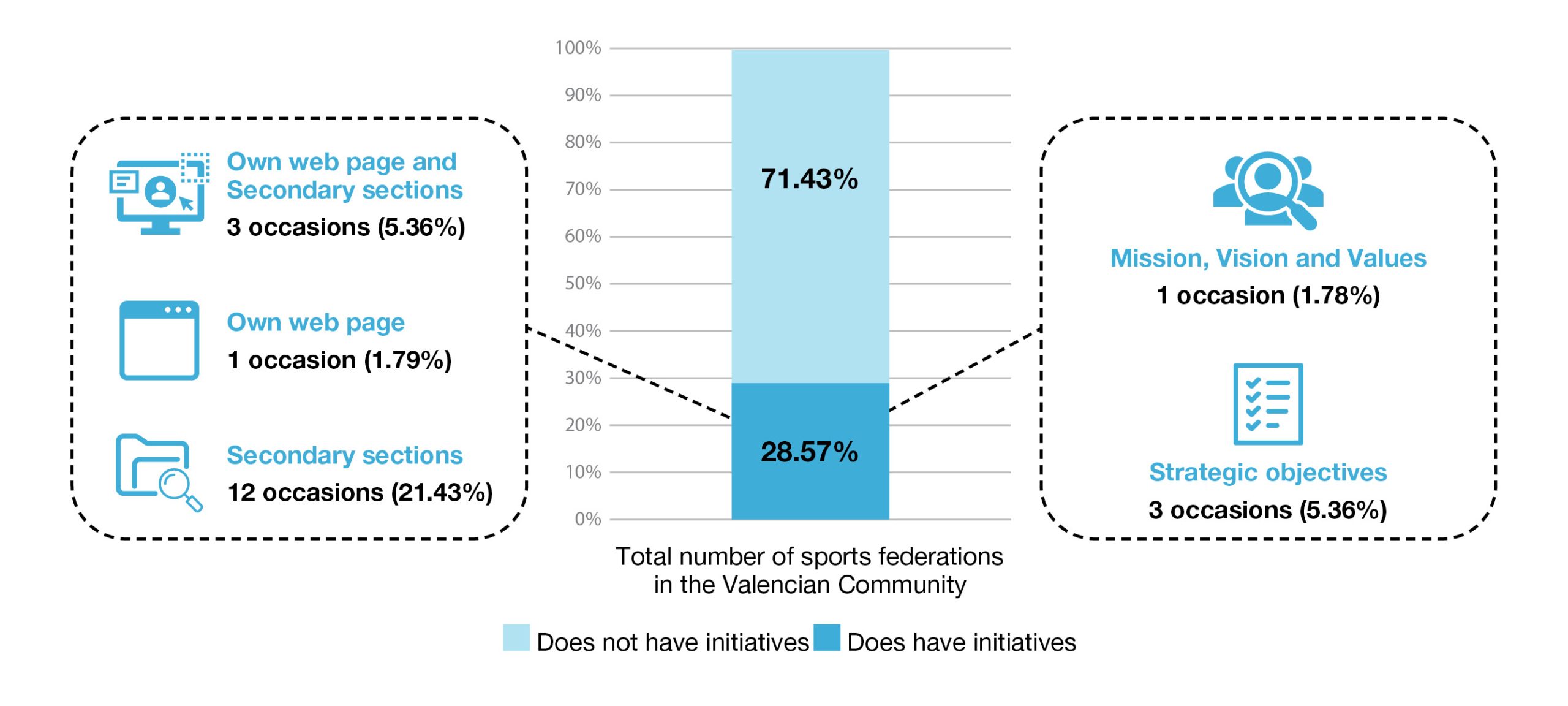
As seen in Figure 1, of the federations that did have some type of initiative, we found one case in which sustainability was a part of the organization’s mission, vision, and values and another three in which sustainability was fully integrated into the federations’ strategic objectives.
Regarding the identified initiatives, first all the generic initiatives were ruled out (e.g., the activity is conducted in an environmentally friendly manner) and the remaining ones were classified into six categories: (a) actions at events, (b) training content, (c) characteristics of the organization, (d) publications, (e) applications, and (f) financial aid, obtaining a total of 25 different initiatives found in 11 of the 16 federations that did have some kind of initiative. According to the classification from Hugaerts et al., (2023) of the 25 initiatives, 13 could be classified as high intensity and 12 as low intensity, as seen in Table 2.
Table 2
Categorization of the Initiatives Related to Environmental Sustainability in Sports Federations in the Valencian Community
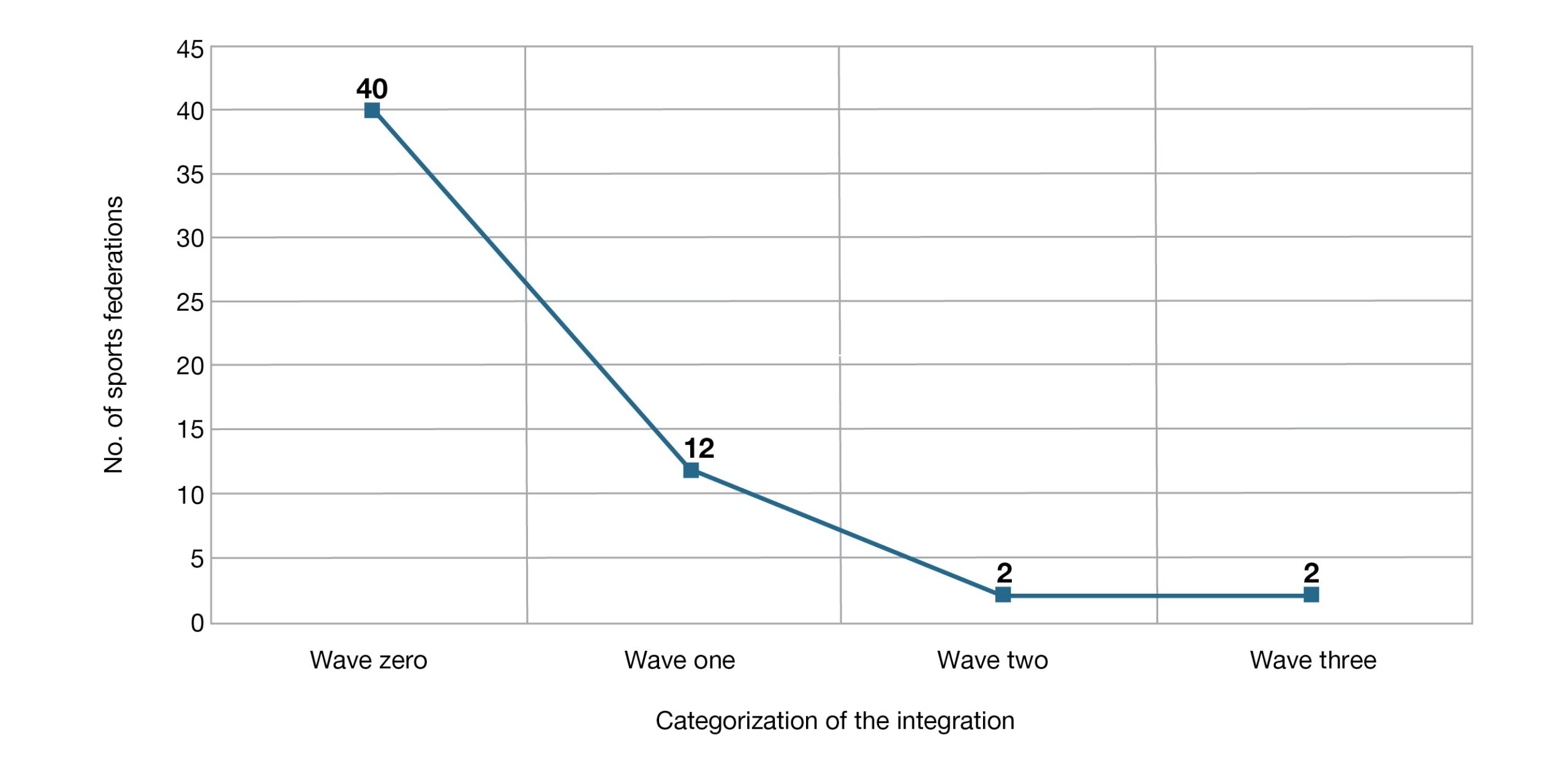
Lastly, as seen in Figure 2, according to the wave typology used to analyze the degree of sustainability integration in sports federations in the Valencian Community, we observed that 71.43% (n = 40) of the federations were in wave zero, 21.43% (n = 12) in wave one, two of the federations (3.57%) were in wave two and the two remaining federations (3.57%) were in wave three. The Valencian Federation for Mountain and Climbing Sports and the Valencian Triathlon Federation were the two federations that had integrated sustainability the most into their activities.
Discussion
The results from this analysis clearly show the notable lack of participation by sports federations in the Valencian Community with regard to sustainable initiatives, or at the very least, with regard to reporting on such initiatives on their websites. This information is concerning, not only because it reflects the passive nature of sports federations towards sustainability, as reported by authors Hugaerts et al. (2023), but also because it suggests that the sports community, in this case in the Valencian Community, is not putting in the necessary effort to counteract the negative impact of the sports industry on the environment. Of course it is also possible that sports federations are carrying out various actions that are not being reported.
In that case, as mentioned in the introduction, we must highlight that sports organizations’ sustainability initiatives can only be effective, both in terms of protecting the environment and improving stakeholders’ sustainability awareness, if they are properly reported and divulged. Sports organizations’ efforts are thus translated into potential benefits, whether attracting sponsors or improving the organization’s image, ensuring said efforts are not an extra expense, but rather a strategy for improving growth and development in an environmentally responsible manner (McCullough et al., 2020b; Moon et al., 2022).
We extracted a set of initiatives from the sports federations that communicate environmental sustainability-related actions, and proceeded to categorize them to improve their classification. By classifying the obtained results, we expanded the categorization of the types of actions previously described in the literature by Moon et al. (2022), obtaining on two occasions categories similar to their results, as in the case of the categories ‘actions at events’ and ‘characteristics of the organization.’ However, those authors also noted the presence of categories such as partnerships with NGOs or environmental consultancies, which are also interesting strategies that sports federations could implement.
On the other hand, it is worth noting that among all the initiatives analyzed, we found no actions related to reporting the effectiveness of said initiatives, nor any reports, nor did we find any reports on the environmental impact of the sports federations’ various activities. This confirms the statements by Morán-Gámez et al. (2024) and demonstrates the need to provide these types of reports so other organizations can verify the effectiveness of different actions, helping them to decide which strategies are most appropriate for inclusion among their own activities.
Lastly, in terms of the integration level of environmental sustainability in sports federations in the Valencian Community, our study results are in line with the results obtained by Hugaerts et al. (2023), in that the majority of sports federations are in Wave zero, demonstrating the lack of integration of a sustainable outlook within the Valencian sports community.
After our analysis, it seems only a minority of sports federations are interested in the possible environmental impact of their activities, and within that minority only two sports federations have managed to reach Wave three. These results for the sports community in the Valencian Community show that there is still a long way to go to ensure sustainability is adequately integrated into organizations in order to become a positive context for sustainable development (McCullough et al., 2016).
Conclusions
The main conclusions regarding the sports community in the Valencian Community highlight that sports federations are not incorporating sustainable actions into their activities, or at the very least they are not communicating said actions properly. While it is understandable that sports federations may not keep their websites updated, we must acknowledge that to maximize the sports world’s potential to combat global issues like climate change, any efforts that are made must aim to be as effective as possible.
What’s more, said efforts should be carried out from a strategic perspective to ensure they are conducted in the most effective possible manner and can provide a return on the organization’s investment of resources in relation to its environmental initiatives. Meaning that in terms of the Valencian Community, sports federations must continue their efforts to effectively integrate these types of initiatives into their organizational planning, not only in response to internal and external pressure, but as part of a strategy to further the organization’s development from an environmentally responsible standpoint.
This study not only describes the current circumstances of the sports federations in the Valencian Community and their level of sustainability integration, it also offers valuable information to help the sports world positively evolve towards more sustainable development.
Both the results and the methodology used in this study offer different practical applications for the professional and academic context. Professionally, these results can provide a set of actions and strategies to replicate in other contexts to improve sustainability integration within sports organizations and to measure its evolution. From the academic setting, we can use the classification typology developed by McCullough et al. (2016), which Hugaerts et al. (2023) then expanded upon, to analyze the degree of integration of sustainability in the sports world.
Limitations
Obviously this study is not free from limitations that must be taken into account when analyzing its results.
The results were extracted from the websites of the sports federations analyzed via a thorough data search. Nevertheless, we did not consider any news articles nor did we consult any managers regarding the federations’ actions. This could represent a bias related to the reporting of the initiatives, thus our recommendation for future lines of research is to analyze all the information found on the websites and to combine it with consultations with managers to identify the strategies being implemented and the level of integration of those initiatives, as this would help improve the analysis of those strategies.
Similarly, while websites serve as a portal where athletes and/or family members can find necessary information, social media currently plays a more important role in terms of communicating with the sports community. Therefore, we recommend that future research analyze content on the primary social networks that each federation uses, to check both the content of communications and activities they carry out or promote.
On the other hand, federations’ strategic planning and their mission, vision, and values are defined in documents and strategies that are regularly revised every few years (between 4 and 6 years the best of cases). This means our analysis could have been carried out in the final stretch of this period and that sustainability is actually more integrated than was observed in the analyzed sections, which would be included in future versions. We recommend this type of analysis for determining the level of integration of sustainability between different populations or comparing the evolution of the sports community over the years.
Acknowledgements
This analysis was conducted thanks to support from the Valencian Government via grants provided under file number HIECPU/2022/2.
References
[1] Annesi, N., Battaglia, M., & Frey, M. (2023). Sustainability in Sport-Related Studies: A Non-Systematic Review to Increase the Sports Contribution to the 2030 Agenda. Physical Culture and Sport. Studies and Research, 98(1), 81–98. doi.org/10.2478/pcssr-2023-0007
[2] Cayolla, R. R., Escadas, M., Biscaia, R., Kellison, T., Quintela, J. A., & Santos, T. (2023). Fans’ perceptions of pro-environmental sustainability initiatives in sport and triple bottom line benefits. International Journal of Sports Marketing and Sponsorship, 24(2), 395–421. doi.org/10.1108/IJSMS-07-2022-0141
[3] Glibo, I., Misener, L., & Koenigstorfer, J. (2022). Strategic Sustainable Development in International Sport Organisations: A Delphi Study. Sustainability, 14(16), Article 16. doi.org/10.3390/su14169874
[4] Hugaerts, I., Scheerder, J., Zeimers, G., Corthouts, J., Van de Sype, C., & Könecke, T. (2023). Are sport organisations environmentally sustainable? – A website analysis of sport federations in Belgium. European Sport Management Quarterly, 23(1), 38–58. doi.org/10.1080/16184742.2022.2093391
[5] Hulpus, I., & Hulpus, A. (2022). Approaches of strategic sustainable development in romanian sport. Management of Sustainable Development Journal, 14(2), 52–57. doi.org/10.54989/msd-2022-0017
[6] McCullough, B. P., Orr, M., & Watanabe, N. M. (2020a). Measuring Externalities: The Imperative Next Step to Sustainability Assessment in Sport. Journal of Sport Management, 34(5), 393–402. doi.org/10.1123/jsm.2019-0254
[7] McCullough, B. P., Pelcher, J., & Trendafilova, S. (2020b). An Exploratory Analysis of the Environmental Sustainability Performance Signaling Communications among North American Sport Organizations. Sustainability, 12(5), Article 5. doi.org/10.3390/su12051950
[8] McCullough, B. P., Pfahl, M. E., & Nguyen, S. N. (2016). The green waves of environmental sustainability in sport. Sport in Society, 19(7), 1040–1065. doi.org/10.1080/17430437.2015.1096251
[9] Moon, P., Bayle, E., & François, A. (2022). Assessing International Sport Federations’ Sustainability Practices: Toward Integrating Sustainability in Their Main Sports Events. Frontiers in Sports and Active Living, 3. doi.org/10.3389/fspor.2021.752085
[10] Morán-Gámez, G., Fernández-Martínez, A., Biscaia, R., & Nuviala, R. (2024). Measuring Green Practices in Sport: Development and Validation of a Scale. Sustainability, 16(2), Article 2. doi.org/10.3390/su16020494
[11] Sandoval-Díaz, J., Díaz-Vargas, N., Flores-Jiménez, D., López-Salazar, C., & Bravo-Ferret, C. (2024). Cambio climático y olas de calor sobre el bienestar subjetivo en jóvenes. Revista Latinoamericana de Ciencias Sociales, Niñez y Juventud, 22(1), 1–30. doi.org/10.11600/rlcsnj.22.1.5926
[12] Thormann, T. F., & Wicker, P. (2021). Determinants of pro-environmental behavior among voluntary sport club members. German Journal of Exercise and Sport Research, 51(1), 29–38. doi.org/10.1007/s12662-020-00700-8
[13] Ulloa-Hernández, M., Farías-Torbidoni, E., & Seguí-Urbaneja, J. (2023). Eventos deportivos y sostenibilidad: Una revisión sistemática (1964-2020). Apunts Educación Física y Deportes. 153, 101–113. doi.org/10.5672/ apunts.2014-0983.es.(2023/3).153.09
[14] United Nations Framework Convention on Climate Change, [UNFCCC]. (2020). Sports for Climate Action. United Nations Climate Change. uapnfccc.int/climate-action/sectoral-engagement/sports-for-climate-action
[15] United Nations, [UN]. (2015). Transforming our World: The 2030 Agenda for Sustainable Development .:. Sustainable Development Knowledge Platform. United Nations. sustainabledevelopment.un.org/post2015/transformingourworld/publication
[16] Witulski, N., & Dias, J. G. (2020). The Sustainable Society Index: Its reliability and validity. Ecological Indicators, 114, 106190. doi.org/10.1016/j.ecolind.2020.106190
[17] Zhu, J., Liang, Z., Zhang, C., & Wei, X. (2023). How are sports management, renewable energy, and green finance related? A survey evidence. Renewable Energy, 206, 39–46. doi.org/10.1016/j.renene.2023.02.040
ISSN: 2014-0983
Received: December 2, 2024
Accepted: April 8, 2025
Published: July 1, 2025
Editor: © Generalitat de Catalunya Departament de la Presidència Institut Nacional d’Educació Física de Catalunya (INEFC)
© Copyright Generalitat de Catalunya (INEFC). This article is available from url https://www.revista-apunts.com/. This work is licensed under a Creative Commons Attribution-NonCommercial-NoDerivatives 4.0 International License. The images or other third party material in this article are included in the article’s Creative Commons license, unless indicated otherwise in the credit line; if the material is not included under the Creative Commons license, users will need to obtain permission from the license holder to reproduce the material. To view a copy of this license, visit https://creativecommons.org/licenses/by-nc-nd/4.0/deed.en


